
硒、碘和铁——甲状腺激素合成与代谢所需的必需微量元素。
Selenium, Iodine and Iron-Essential Trace Elements for Thyroid Hormone Synthesis and Metabolism.
作者信息
Köhrle Josef
机构信息
Charité-Universitätsmedizin Berlin, Corporate Member of Freie Universität Berlin, Humboldt-Universität zu Berlin, Berlin Institute of Health, Institut für Experimentelle Endokrinologie, Max Rubner Center (MRC) for Cardiovascular Metabolic Renal Research, D-10115 Berlin, Germany.
出版信息
Int J Mol Sci. 2023 Feb 8;24(4):3393. doi: 10.3390/ijms24043393.
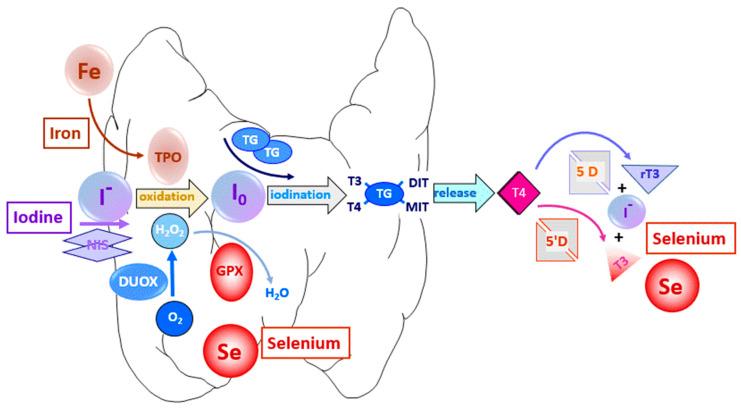
The adequate availability and metabolism of three essential trace elements, iodine, selenium and iron, provide the basic requirements for the function and action of the thyroid hormone system in humans, vertebrate animals and their evolutionary precursors. Selenocysteine-containing proteins convey both cellular protection along with HO-dependent biosynthesis and the deiodinase-mediated (in-)activation of thyroid hormones, which is critical for their receptor-mediated mechanism of cellular action. Disbalances between the thyroidal content of these elements challenge the negative feedback regulation of the hypothalamus-pituitary-thyroid periphery axis, causing or facilitating common diseases related to disturbed thyroid hormone status such as autoimmune thyroid disease and metabolic disorders. Iodide is accumulated by the sodium-iodide-symporter NIS, and oxidized and incorporated into thyroglobulin by the hemoprotein thyroperoxidase, which requires local HO as cofactor. The latter is generated by the dual oxidase system organized as 'thyroxisome' at the surface of the apical membrane facing the colloidal lumen of the thyroid follicles. Various selenoproteins expressed in thyrocytes defend the follicular structure and function against life-long exposure to HO and reactive oxygen species derived therefrom. The pituitary hormone thyrotropin (TSH) stimulates all processes required for thyroid hormone synthesis and secretion and regulates thyrocyte growth, differentiation and function. Worldwide deficiencies of nutritional iodine, selenium and iron supply and the resulting endemic diseases are preventable with educational, societal and political measures.
碘、硒和铁这三种必需微量元素的充足供应和代谢,为人类、脊椎动物及其进化前体中甲状腺激素系统的功能和作用提供了基本条件。含硒半胱氨酸的蛋白质既提供细胞保护,又参与依赖血红素加氧酶(HO)的生物合成以及脱碘酶介导的甲状腺激素(失)活过程,这对甲状腺激素受体介导的细胞作用机制至关重要。这些元素在甲状腺中的含量失衡会挑战下丘脑 - 垂体 - 甲状腺外周轴的负反馈调节,引发或促进与甲状腺激素状态紊乱相关的常见疾病,如自身免疫性甲状腺疾病和代谢紊乱。碘离子通过钠 - 碘同向转运体(NIS)积累,由血红素蛋白甲状腺过氧化物酶氧化并掺入甲状腺球蛋白,该过程需要局部的HO作为辅助因子。后者由在面向甲状腺滤泡胶体腔的顶膜表面组织成“甲状腺过氧化物酶体”的双氧化酶系统产生。甲状腺细胞中表达的各种硒蛋白可保护滤泡结构和功能,使其免受终身暴露于HO及其衍生的活性氧的影响。垂体激素促甲状腺激素(TSH)刺激甲状腺激素合成和分泌所需的所有过程,并调节甲状腺细胞的生长、分化和功能。通过教育、社会和政治措施,可以预防全球范围内营养性碘、硒和铁供应不足以及由此导致的地方病。

 Zotero 插件