
埃及全国范围内蜂群中蜜蜂病毒的筛查。
Nationwide Screening for Bee Viruses in Colonies in Egypt.
作者信息
Kandel Mohamed, Paxton Robert J, Al Naggar Yahya
机构信息
Plant Protection and Molecular Diagnosis, Arid Lands Cultivation Research Institute, City of Scientific Research and Technological Applications (SRTA-City), Alexandria 21934, Egypt.
General Zoology, Institute for Biology, Martin Luther University Halle-Wittenberg, Hoher Weg 8, 06120 Halle (Saale), Germany.
出版信息
Insects. 2023 Feb 9;14(2):172. doi: 10.3390/insects14020172.
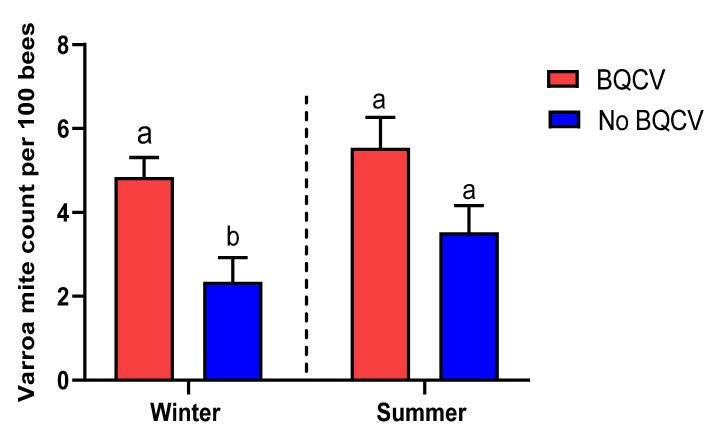
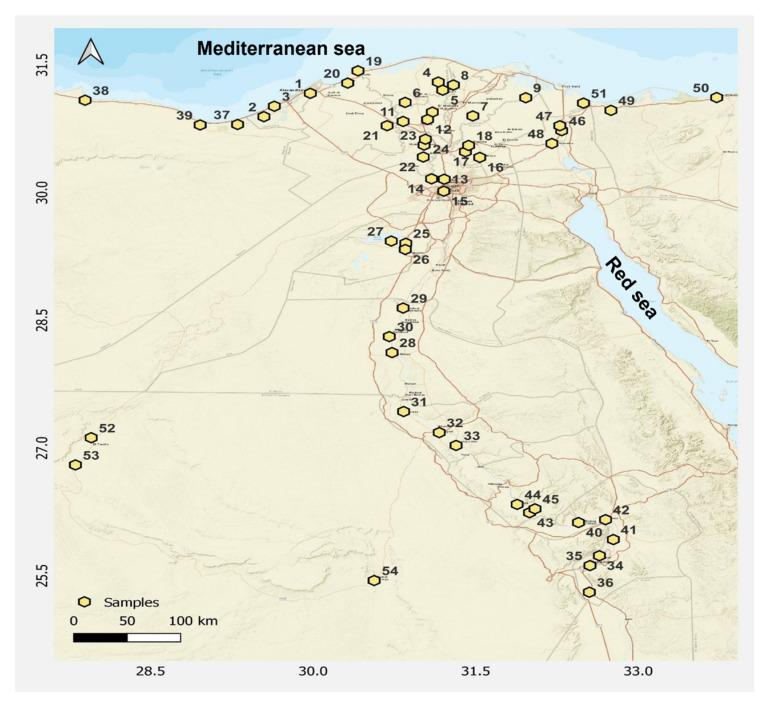
Honey bees are essential for crop and wild plant pollination. However, many countries have reported high annual colony losses caused by multiple possible stressors. Diseases, particularly those caused by viruses, are a major cause of colony losses. However, little is known about the prevalence of honey bee pathogens, particularly virus prevalence, in Egyptian honey bees. To address this shortfall, we determined the prevalence of widespread bee viruses in honey bee colonies in Egypt-whether it is affected by geography, the season, or infestation with (varroa) mites. Honey bee worker samples were collected from 18 geographical regions across Egypt during two seasons: winter and summer of 2021. Three apiaries were chosen in each region, and a pooled sample of 150 worker bees was collected from five colonies in each apiary then screened by qPCR for 10 viral targets: acute bee paralysis virus (ABPV), black queen cell virus (BQCV), chronic bee paralysis virus (CBPV), deformed wing virus (DWV) genotypes A (DWV-A), B (DWV-B) and D (Egyptian bee virus), Israeli acute paralysis virus (IAPV), Kashmir bee virus (KBV), sacbrood virus (SBV), and slow bee paralysis virus (SBPV). Our results revealed that DWV-A was the most prevalent virus, followed by BQCV and ABPV; the DWV genotype now spreading across the world, DWV-B, was not detected. There was no difference in varroa infestation rates as well as virus prevalence between winter and summer. However, colonies infected with BQCV had a significantly higher varroa count (adjusted < 0.05) in the winter season, indicating that there is a seasonal association between the intensity of infestation by varroa and the presence of this virus. We provide data on the current virus prevalence in Egypt, which could assist in the protection of Egypt's beekeeping industry. Moreover, our study aids in the systematic assessment of the global honey bee virome by filling a knowledge gap about the prevalence of honey bee viruses in Egypt.
蜜蜂对农作物和野生植物授粉至关重要。然而,许多国家报告称,每年都有大量蜂群因多种可能的压力因素而损失。疾病,尤其是由病毒引起的疾病,是蜂群损失的主要原因。然而,对于埃及蜜蜂中蜜蜂病原体的流行情况,尤其是病毒的流行情况,人们知之甚少。为了弥补这一不足,我们确定了埃及蜜蜂蜂群中广泛传播的蜜蜂病毒的流行情况——它是否受地理、季节或 (瓦螨) 螨虫感染的影响。在2021年的冬季和夏季这两个季节,从埃及18个地理区域采集了蜜蜂工蜂样本。每个区域选择了三个养蜂场,从每个养蜂场的五个蜂群中采集了150只工蜂的混合样本,然后通过定量聚合酶链反应(qPCR)对10种病毒靶点进行筛查:急性蜜蜂麻痹病毒(ABPV)、黑蜂王台病毒(BQCV)、慢性蜜蜂麻痹病毒(CBPV)、畸形翅病毒(DWV)基因型A(DWV-A)、B(DWV-B)和D(埃及蜜蜂病毒)、以色列急性麻痹病毒(IAPV)、克什米尔蜜蜂病毒(KBV)、囊状幼虫病毒(SBV)和缓慢蜜蜂麻痹病毒(SBPV)。我们的结果显示,DWV-A是最普遍的病毒,其次是BQCV和ABPV;未检测到目前在全球传播的DWV基因型DWV-B。冬季和夏季的瓦螨感染率以及病毒流行率没有差异。然而,感染BQCV的蜂群在冬季的瓦螨数量显著更高(校正后 < 0.05),这表明瓦螨感染强度与这种病毒的存在之间存在季节性关联。我们提供了埃及当前病毒流行情况的数据,这有助于保护埃及的养蜂业。此外,我们的研究通过填补关于埃及蜜蜂病毒流行情况的知识空白,有助于对全球蜜蜂病毒组进行系统评估。


 Zotero 插件