
接受腹部手术的患者发生胃肠道出血并发症的风险高吗?
Is There a High Risk for GI Bleeding Complications in Patients Undergoing Abdominal Surgery?
作者信息
Wichmann Dörte, Orlova Olena, Königsrainer Alfred, Quante Markus
机构信息
Department of General, Visceral and Transplant Surgery, University Hospital Tübingen, Hoppe-Seyler-Str. 3, 72076 Tübingen, Germany.
Medical Clinic, Mühlacker Hospital, Hermann-Hesse-Strasse 34, 75417 Mühlacker, Germany.
出版信息
J Clin Med. 2023 Feb 9;12(4):1374. doi: 10.3390/jcm12041374.
INTRODUCTION
Gastrointestinal bleeding (GIB) can cause life-threatening situations. Here, endoscopy is the first-line diagnostic and therapeutic mode in patients with GIB among further therapeutic approaches such as embolization or medical treatment. Although GIB is considered the most common indication for emergency endoscopy in clinical practice, data on GIB in abdominal surgical patients are still scarce.
PATIENTS AND METHODS
For the present study, all emergency endoscopies performed on hospitalized abdominal surgical patients over a 2-year period (1 July 2017-30 June2019) were retrospectively analyzed. Primary endpoint was 30-day mortality. Secondary endpoints were length of hospital stay, cause of bleeding, and therapeutic success of endoscopic intervention.
RESULTS
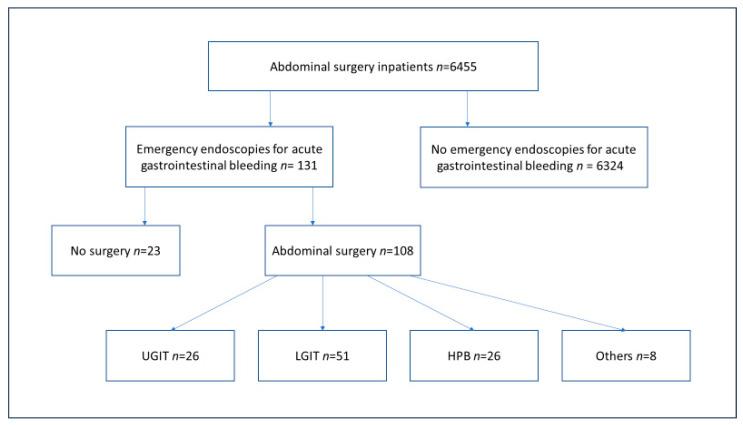
During the study period, bleeding events with an indication for emergency endoscopy occurred in 2.0% (129/6455) of all surgical inhouse patients, of whom 83.7% ( = 108) underwent a surgical procedure. In relation to the total number of respective surgical procedures during the study period, the bleeding incidence was 8.9% after hepatobiliary surgery, 7.7% after resections in the upper gastrointestinal tract, and 1.1% after colonic resections. Signs of active or past bleeding in the anastomosis area were detected in ten patients (6.9%). The overall 30-day mortality was 7.75%.
CONCLUSIONS
The incidence of relevant gastrointestinal bleeding events in visceral surgical inpatients was overall rare. However, our data call for critical peri-operative vigilance for bleeding events and underscore the importance of interdisciplinary emergency algorithms.
引言
胃肠道出血(GIB)可导致危及生命的情况。在此,在内镜检查、栓塞或药物治疗等进一步治疗方法中,内镜检查是GIB患者的一线诊断和治疗方式。尽管在临床实践中GIB被认为是急诊内镜检查最常见的适应证,但关于腹部手术患者GIB的数据仍然匮乏。
患者与方法
在本研究中,对2年期间(2017年7月1日至2019年6月30日)对住院腹部手术患者进行的所有急诊内镜检查进行了回顾性分析。主要终点是30天死亡率。次要终点是住院时间、出血原因和内镜干预的治疗成功率。
结果
在研究期间,所有住院手术患者中2.0%(129/6455)发生了有急诊内镜检查指征的出血事件,其中83.7%(n = 108)接受了手术。相对于研究期间各自手术的总数,肝胆手术后出血发生率为8.9%,上消化道切除术后为7.7%,结肠切除术后为1.1%。在10例患者(6.9%)中检测到吻合口区有活动性或既往出血迹象。总体30天死亡率为7.75%。
结论
内脏手术住院患者中相关胃肠道出血事件的发生率总体较低。然而,我们的数据呼吁在围手术期对出血事件保持高度警惕,并强调跨学科急诊算法的重要性。
 Zotero 插件