
非人灵长类动物相关人畜共患病原体综述:了解对人类的潜在威胁
A Review on Zoonotic Pathogens Associated with Non-Human Primates: Understanding the Potential Threats to Humans.
作者信息
Jiang Xinjie, Fan Zhenyu, Li Shijia, Yin Haichang
机构信息
College of Life Science and Agriculture Forestry, Qiqihar University, Qiqihar 161006, China.
Heilongjiang Provincial Technology Innovation Center of Agromicrobial Preparation Industrialization, Qiqihar 161006, China.
出版信息
Microorganisms. 2023 Jan 18;11(2):246. doi: 10.3390/microorganisms11020246.
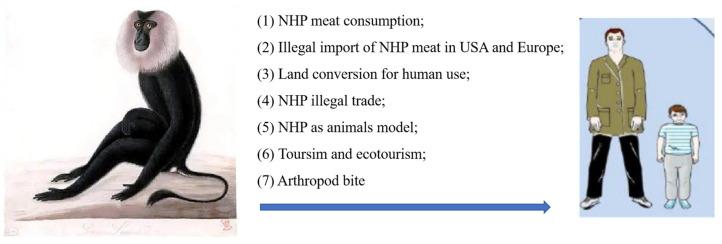
Non-human primates (NHP) share a close relationship with humans due to a genetic homology of 75-98.5%. NHP and humans have highly similar tissue structures, immunity, physiology, and metabolism and thus often can act as hosts to the same pathogens. Agriculture, meat consumption habits, tourism development, religious beliefs, and biological research have led to more extensive and frequent contact between NHPs and humans. Deadly viruses, such as rabies virus, herpes B virus, Marburg virus, Ebola virus, human immunodeficiency virus, and monkeypox virus can be transferred from NHP to humans. Similarly, herpes simplex virus, influenza virus, and yellow fever virus can be transmitted to NHP from humans. Infectious pathogens, including viruses, bacteria, and parasites, can affect the health of both primates and humans. A vast number of NHP-carrying pathogens exhibit a risk of transmission to humans. Therefore, zoonotic infectious diseases should be evaluated in future research. This article reviews the research evidence, diagnostic methods, prevention, and treatment measures that may be useful in limiting the spread of several common viral pathogens via NHP and providing ideas for preventing zoonotic diseases with epidemic potential.
由于75%-98.5%的基因同源性,非人灵长类动物(NHP)与人类有着密切的关系。NHP与人类具有高度相似的组织结构、免疫、生理和代谢,因此常常可作为相同病原体的宿主。农业、肉类消费习惯、旅游业发展、宗教信仰以及生物研究导致NHP与人类之间的接触更加广泛和频繁。狂犬病病毒、B族疱疹病毒、马尔堡病毒、埃博拉病毒、人类免疫缺陷病毒和猴痘病毒等致命病毒可从NHP传播给人类。同样,单纯疱疹病毒、流感病毒和黄热病病毒可从人类传播给NHP。包括病毒、细菌和寄生虫在内的传染性病原体可影响灵长类动物和人类的健康。大量携带病原体的NHP存在传播给人类的风险。因此,未来的研究应评估人畜共患传染病。本文综述了可能有助于限制几种常见病毒病原体通过NHP传播的研究证据、诊断方法、预防和治疗措施,并为预防具有流行潜力的人畜共患疾病提供思路。



 Zotero 插件