
超重/肥胖多囊卵巢综合征女性的不同睡眠模式。
Different sleep pattern in over-weight/obese women with polycystic ovary syndrome.
机构信息
Department of Women's and Children's Health, Division of Neonatology, Obstetrics and Gynecology, Karolinska Institutet, Stockholm, Sweden.
Department of Pelvic Cancer, Theme Cancer, Karolinska University Hospital, Stockholm, Sweden.
出版信息
Front Endocrinol (Lausanne). 2023 Feb 10;14:1068045. doi: 10.3389/fendo.2023.1068045. eCollection 2023.
CONTEXT
Sleep duration and sleep quality have important health implications although our knowledge of objectively measured sleep variables in women with Polycystic Ovary Syndrome (PCOS) is limited.
OBJECTIVE
To compare sleep variables assessed by actigraphy in over-weight/obese women with PCOS and controls, and to assess sleep variables after behavioral modification intervention in comparison with minimal intervention in a randomized trial.
DESIGN
Randomized controlled trial, and a control group.
SETTING
Outpatient gynecological clinic at a university hospital in Sweden.
PARTICIPANTS
39 women fulfilling all Rotterdam PCOS criteria, randomized to behavioral modification intervention or minimal intervention and 21 controls with no other metabolic disease, all aged 18-40 years with a BMI ≥ 27 kg/m.
INTERVENTION
A four-month behavioral modification intervention including weekly group meetings focusing on behavioral and healthy lifestyle aspects. Minimal intervention reflecting standard care.
MAIN OUTCOME MEASURE
Sleep durations and sleep efficiency assessed by actigraphy.
RESULTS
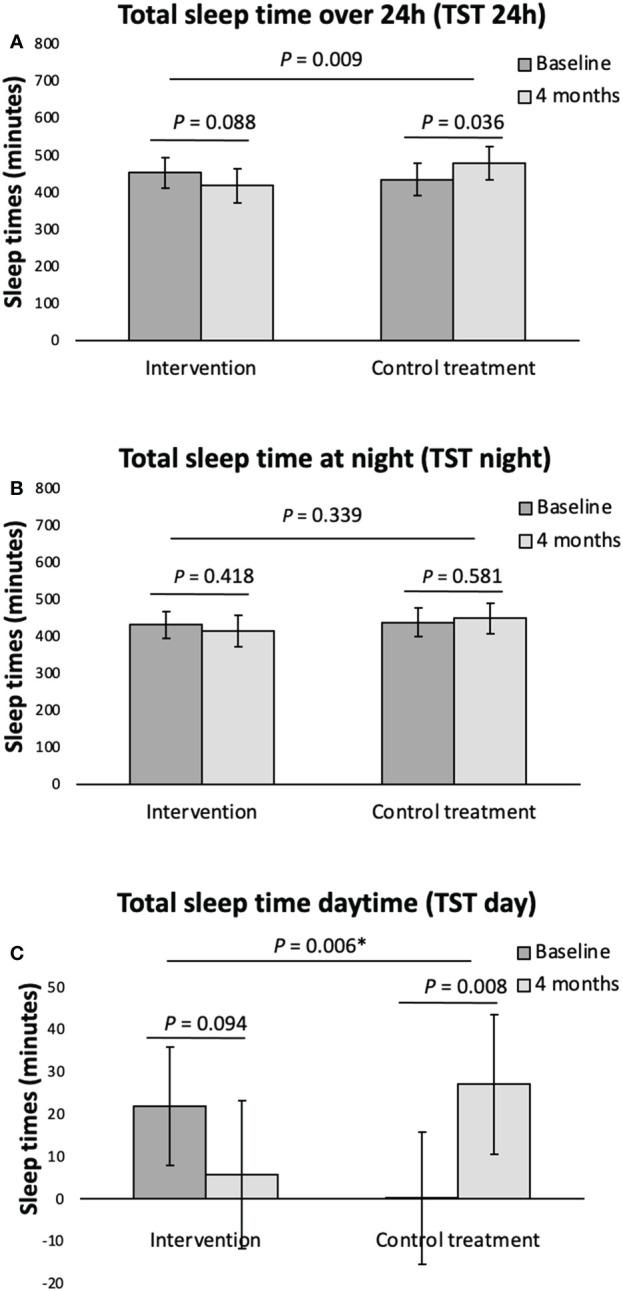
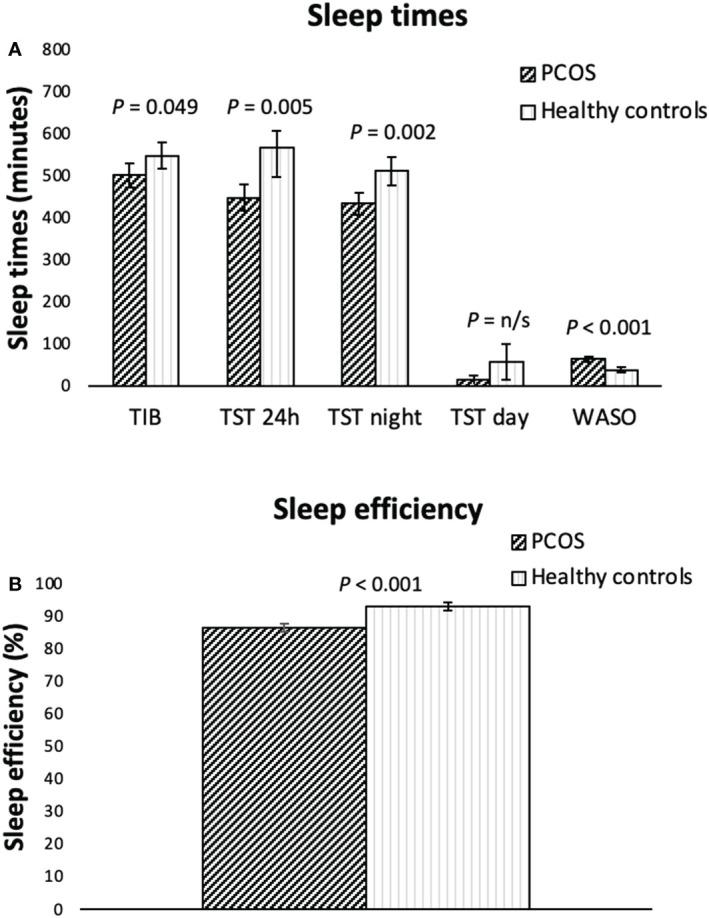
Compared to the control group, women with PCOS had significantly shorter time in bed (501 vs 548 min, p= 0.049), sleep time over 24 hours (448 vs 567 min, p=0.005) and sleep time at night (434 vs 511 min, p=0.002), poorer sleep efficiency (87 vs 93%, p<0.001), and longer wakefulness after sleep onset (64 vs 38 min, p<0.001). However, total sleep time at night for women with PCOS (7.2hrs) was within the normal range. Following behavioral modification intervention, the reduction from baseline in sleep over 24 hours and in the daytime sleep were significant compared to the minimal intervention group (78 min, p=0.009 and 43 min, p=0.003 respectively).
CONCLUSIONS
We found over-weight/obese women with PCOS to have normal sleep duration, but worse sleep efficiency than controls. Behavioral modification intervention seems to reduce the amount of daytime sleep, suggesting improved sleep behavior.
CLINICAL TRIALS REGISTRATION
https://doi.org/10.1186/ISRCTN48947168, identifier ISRCTN48947168.
背景
尽管我们对多囊卵巢综合征(PCOS)女性的客观睡眠变量知之甚少,但睡眠时长和睡眠质量对健康有着重要的影响。
目的
通过活动记录仪比较超重/肥胖的 PCOS 女性与对照组的睡眠变量,并在一项随机试验中比较行为修正干预与最小干预后的睡眠变量。
设计
随机对照试验和对照组。
地点
瑞典一所大学医院的门诊妇科诊所。
参与者
39 名符合所有鹿特丹 PCOS 标准的女性,随机分为行为修正干预组或最小干预组,21 名无其他代谢疾病的对照组,年龄均在 18-40 岁,BMI≥27kg/m²。
干预
为期四个月的行为修正干预,包括每周一次的小组会议,重点关注行为和健康的生活方式方面。最小干预反映了标准护理。
主要观察指标
通过活动记录仪评估的睡眠时间和睡眠效率。
结果
与对照组相比,PCOS 女性的卧床时间明显更短(501 分钟与 548 分钟,p=0.049),24 小时睡眠时间更长(448 分钟与 567 分钟,p=0.005),夜间睡眠时间更长(434 分钟与 511 分钟,p=0.002),睡眠效率更低(87%与 93%,p<0.001),睡眠起始后醒来时间更长(64 分钟与 38 分钟,p<0.001)。然而,PCOS 女性的夜间总睡眠时间(7.2 小时)处于正常范围内。与最小干预组相比,行为修正干预后,24 小时内睡眠时间和白天睡眠时间的减少具有统计学意义(78 分钟,p=0.009 和 43 分钟,p=0.003)。
结论
我们发现超重/肥胖的 PCOS 女性的睡眠时间正常,但睡眠效率低于对照组。行为修正干预似乎减少了白天的睡眠时间,表明睡眠行为得到了改善。
临床试验注册
https://doi.org/10.1186/ISRCTN48947168,标识符 ISRCTN48947168。
 Zotero 插件