
利用步态动力学进行神经退行性疾病的检测与分级
Neurodegenerative diseases detection and grading using gait dynamics.
作者信息
Erdaş Çağatay Berke, Sümer Emre, Kibaroğlu Seda
机构信息
Department of Computer Engineering, Faculty of Engineering, Başkent University, Ankara, Turkey.
Department of Neurology, Faculty of Medicine, Başkent University, Ankara, Turkey.
出版信息
Multimed Tools Appl. 2023;82(15):22925-22942. doi: 10.1007/s11042-023-14461-7. Epub 2023 Feb 18.
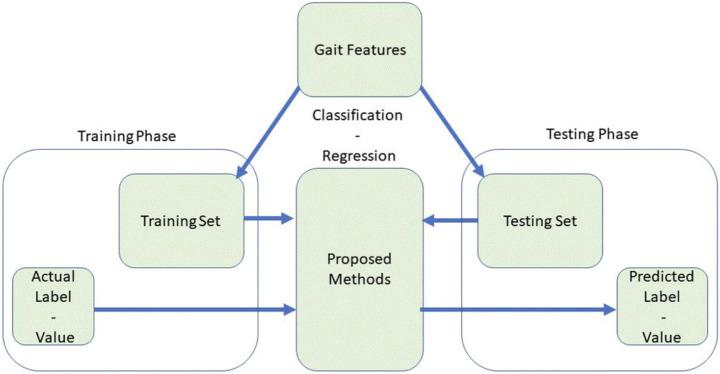
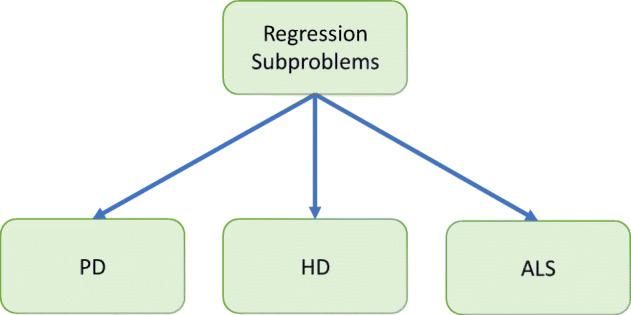
Detection of neurodegenerative diseases such as Parkinson's disease, Huntington's disease, Amyotrophic Lateral Sclerosis, and grading of these diseases' severity have high clinical significance. These tasks based on walking analysis stand out compared to other methods due to their simplicity and non-invasiveness. This study has emerged to realize an artificial intelligence-based disease detection and severity prediction system for neurodegenerative diseases using gait features obtained from gait signals. For the detection of the disease, the problem is divided into parts which are subgroups of 4 classes consisting of Parkinson's, Huntington's, Amyotrophic Lateral Sclerosis diseases, and the control group. In addition, the disease vs. control subgroup where all diseases are collected under a single label, the subgroups where each disease is separately against the control group. For disease severity grading, each disease was divided into subgroups and a solution was sought for the prediction problem mentioned by various machine and deep learning methods separately for each group. In this context, the resulting detection performance was measured by the metrics of Accuracy, F Score, Precision, and Recall while the resulting prediction performance was measured by the metrics such as R, R, MAE, MedAE, MSE, and RMSE.
检测帕金森病、亨廷顿舞蹈症、肌萎缩侧索硬化症等神经退行性疾病以及对这些疾病的严重程度进行分级具有很高的临床意义。与其他方法相比,基于步行分析的这些任务因其简单性和非侵入性而脱颖而出。本研究旨在利用从步态信号中获取的步态特征,实现一个基于人工智能的神经退行性疾病检测和严重程度预测系统。对于疾病检测,该问题被分为几个部分,这些部分是由帕金森病、亨廷顿舞蹈症、肌萎缩侧索硬化症疾病以及对照组组成的4个类别的子组。此外,还有疾病与对照组子组(所有疾病被收集在一个单一标签下),以及每种疾病分别与对照组对比的子组。对于疾病严重程度分级,每种疾病都被分为子组,并分别针对每个组通过各种机器学习和深度学习方法来寻找上述预测问题的解决方案。在此背景下,通过准确率、F分数、精确率和召回率等指标来衡量最终的检测性能,而通过R、R、平均绝对误差(MAE)、中位数绝对误差(MedAE)、均方误差(MSE)和均方根误差(RMSE)等指标来衡量最终的预测性能。

 Zotero 插件