
多巴胺DR4受体的中枢阻断通过改变雄性大鼠饮水行为的微观结构来减少蔗糖消耗。
The central blockade of the dopamine DR4 receptor decreases sucrose consumption by modifying the microstructure of drinking behavior in male rats.
作者信息
López-Alonso Verónica E, Hernández-Correa Samantha, Escobar Carolina, Escartín-Pérez Rodrigo E, Mancilla-Díaz Juan M, Díaz-Urbina Daniel
机构信息
Laboratorio de Neurobiología de la Alimentación, Facultad de Estudios Superiores Iztacala, Universidad Nacional Autónoma de México, Av. de los Barrios No. 1, Tlalnepantla de Baz, CP 54090 Estado de México, Mexico.
Departamento de Anatomía, Facultad de Medicina, Universidad Nacional Autónoma de México, CP 04510 Ciudad de México, Mexico.
出版信息
IBRO Neurosci Rep. 2023 Feb 8;14:195-201. doi: 10.1016/j.ibneur.2023.02.001. eCollection 2023 Jun.
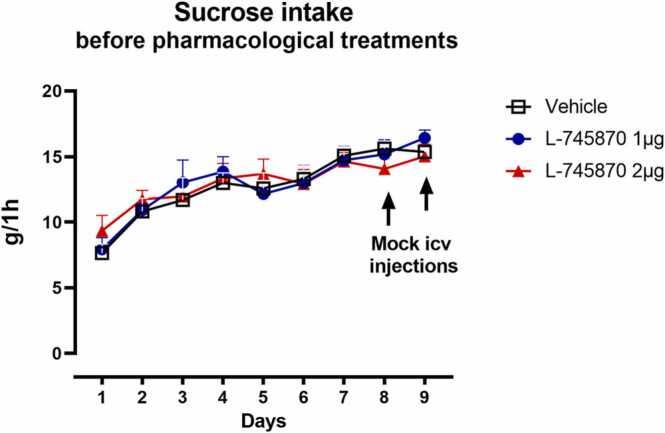
Sugar solutions promote hedonic feeding and increase the risk of obesity and binge-type behavior. In rodents, ingestion of sugar solutions enhances dopamine release to mesolimbic regions, suggesting changes in hedonic intake and brain reward processes. Moreover, dopaminergic D2R/D3R receptors contribute to the hedonic intake of palatable solutions. Although the experimental evidence indicate that the dopaminergic D4 receptor (D4R) modulates feeding at homeostatic levels, it is currently unknown whether D4R also regulate the hedonic intake of sugar solutions. In this study, we evaluated the effect of the central blockade of D4R on the consumption of a 20% sucrose solution, the drinking microstructure parameters, and levels of locomotor activity in sated rats. In the first experiment, male Wistar rats were daily exposed to a 20% sugar solution in the first hour of the light phase of the light:dark cycle. On day 10, rats received i.c.v injections of the D4R antagonist, L-745870 (0, 1 or 2 µg/5 µl) and sucrose consumption and drinking microstructure parameters (latency to start drinking, bouts, drinking duration, bout size, inter-bout interval, time in activity and time in resting) were evaluated. In the second experiment, rats were trained to receive the 20% sucrose solution as described in experiment 1. On day 10, after the 1 h of sucrose access, the rats were placed in the open field for 5-min (habituation phase). Then, rats received i.c.v injections of L-745870 (0, 1 or 2 µg/ 5 µl), and were placed again in the open-field test for 10-min (pharmacological phase). The number or crosses trough squares and number of rears were scored for both the habituation and pharmacological phase. Here we found that administration of L-745870 decreased the consumption of sucrose in a dose-depended manner. Moreover, L-745870-treated rats displayed microstructural changes, including greater number of bouts and reduced drinking duration, bout size and inter-bout intervals. Furthermore, the number of crosses and number of rears in the open field test remained unchanged for habituation and pharmacological phase. Finally, present findings suggest that D4R modulates the consumption of sugar solutions by alteration of hedonic responses, but the contribution of homeostatic systems is discussed. These results open perspectives for the potential use of the D4R antagonists for treating obesity or binge-eating behavior.
糖溶液会促进享乐性进食,并增加肥胖和暴饮暴食型行为的风险。在啮齿动物中,摄入糖溶液会增强多巴胺向中脑边缘区域的释放,这表明享乐性摄入和大脑奖赏过程发生了变化。此外,多巴胺能D2R/D3R受体有助于美味溶液的享乐性摄入。尽管实验证据表明多巴胺能D4受体(D4R)在稳态水平上调节进食,但目前尚不清楚D4R是否也调节糖溶液的享乐性摄入。在本研究中,我们评估了D4R的中枢阻断对饱足大鼠20%蔗糖溶液消耗、饮水微观结构参数和运动活动水平的影响。在第一个实验中,雄性Wistar大鼠在明暗循环的光照阶段的第一个小时每天接触20%的糖溶液。在第10天,大鼠接受脑室内注射D4R拮抗剂L-745870(0、1或2μg/5μl),并评估蔗糖消耗和饮水微观结构参数(开始饮水的潜伏期、发作次数、饮水持续时间、发作大小、发作间隔、活动时间和休息时间)。在第二个实验中,大鼠按照实验1中所述接受训练以摄入20%的蔗糖溶液。在第10天,在给予蔗糖1小时后,将大鼠放入旷场中5分钟(适应阶段)。然后,大鼠接受脑室内注射L-745870(0、1或2μg/5μl),并再次放入旷场试验中10分钟(药理阶段)。对适应阶段和药理阶段的穿越格数和直立次数进行评分。在这里,我们发现给予L-745870以剂量依赖的方式降低了蔗糖的消耗。此外,用L-745870处理的大鼠表现出微观结构变化,包括发作次数增加以及饮水持续时间、发作大小和发作间隔减少。此外,旷场试验中的穿越格数和直立次数在适应阶段和药理阶段保持不变。最后,目前的研究结果表明,D4R通过改变享乐反应来调节糖溶液的消耗,但也讨论了稳态系统的作用。这些结果为D4R拮抗剂在治疗肥胖或暴饮暴食行为方面的潜在应用开辟了前景。
 Zotero 插件