
基于公众视角的人群癌症筛查中风险分层的可接受性:一项混合方法系统评价。
Acceptability of risk stratification within population-based cancer screening from the perspective of the general public: A mixed-methods systematic review.
机构信息
The Primary Care Unit, Department of Public Health and Primary Care, School of Clinical Medicine, University of Cambridge, Cambridge, UK.
School of Clinical Medicine, University of Cambridge, Cambridge, UK.
出版信息
Health Expect. 2023 Jun;26(3):989-1008. doi: 10.1111/hex.13739. Epub 2023 Feb 28.
INTRODUCTION
Risk-stratified cancer screening has the potential to improve resource allocation and the balance of harms and benefits by targeting those most likely to benefit. Public acceptability has implications for engagement, uptake and the success of such a programme. Therefore, this review seeks to understand whether risk stratification of population-based cancer screening programmes is acceptable to the general public and in what context.
METHODS
Four electronic databases were searched from January 2010 to November 2021. Qualitative, quantitative and mixed-methods papers were eligible for inclusion. The Joanna Briggs Institute convergent integrated approach was used to synthesize the findings and the quality of included literature was assessed using the Mixed Methods Appraisal Tool. The Theoretical Framework of Acceptability was used as a coding frame for thematic analysis. PROSPERO record 2021 CRD42021286667.
RESULTS
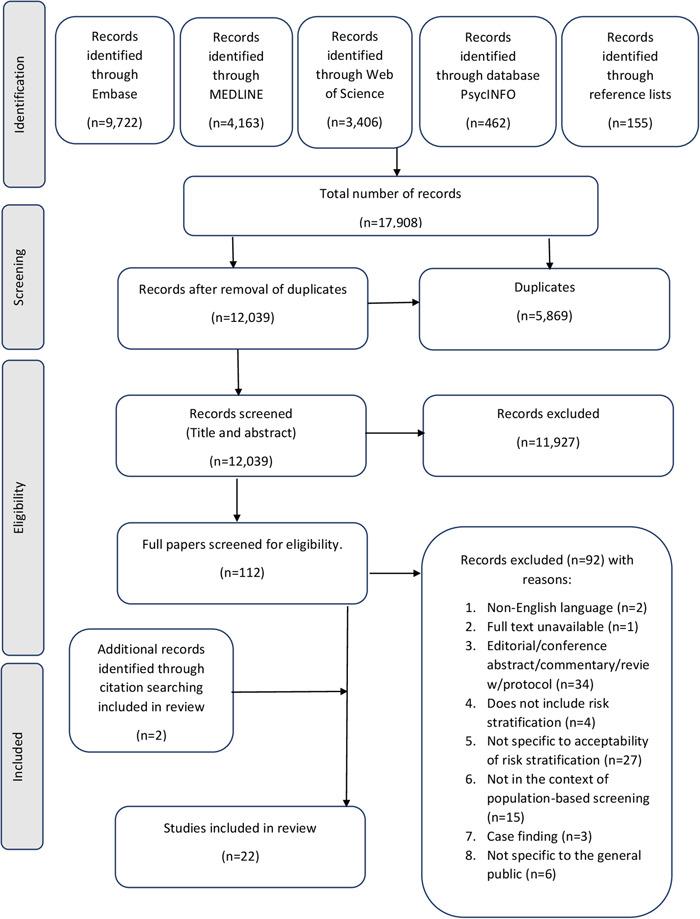
The search returned 12,039 citations, 22 of which were eligible for inclusion. The majority of studies related to breast cancer screening; other cancer types included ovarian, kidney, colorectal and prostate cancer. Risk stratification was generally acceptable to the public, who considered it to be logical and of wider benefit than existing screening practices. We identified 10 priorities for implementation across four key areas: addressing public information needs; understanding communication preferences for risk estimates; mitigating barriers to accessibility to avoid exacerbating inequalities; and the role of healthcare professionals in relation to supporting reduced screening for low-risk individuals.
CONCLUSION
The public generally find risk stratification of population-based cancer screening programmes to be acceptable; however, we have identified areas that would improve implementation and require further consideration.
PATIENT OR PUBLIC CONTRIBUTION
This paper is a systematic review and did not formally involve patients or the public; however, three patient and public involvement members were consulted on the topic and scope before the review commenced.
简介
风险分层癌症筛查有可能通过针对最有可能受益的人群来改善资源分配和危害与收益的平衡。公众接受度对参与、接受程度和此类计划的成功有影响。因此,本综述旨在了解基于人群的癌症筛查计划的风险分层是否被公众接受,以及在何种情况下被接受。
方法
从 2010 年 1 月到 2021 年 11 月,我们在四个电子数据库中进行了搜索。合格的文献包括定性、定量和混合方法论文。我们使用 Joanna Briggs 研究所的综合整合方法来综合研究结果,并使用混合方法评估工具评估纳入文献的质量。可接受性理论框架被用作主题分析的编码框架。PROSPERO 记录 2021 CRD42021286667。
结果
搜索共返回了 12039 条引用,其中 22 条符合纳入标准。大多数研究与乳腺癌筛查有关;其他癌症类型包括卵巢癌、肾癌、结直肠癌和前列腺癌。风险分层普遍被公众接受,他们认为这比现有的筛查实践更合乎逻辑,更广泛地受益。我们确定了在四个关键领域实施的十个优先事项:满足公众的信息需求;了解对风险估计的沟通偏好;减轻获取障碍以避免加剧不平等;以及医疗保健专业人员在支持低风险个体减少筛查方面的作用。
结论
公众普遍认为基于人群的癌症筛查计划的风险分层是可以接受的;然而,我们已经确定了一些需要改进的实施领域。
患者或公众的贡献
本文是一项系统综述,没有正式涉及患者或公众;然而,在审查开始之前,有三位患者和公众参与成员就主题和范围进行了咨询。
 Zotero 插件