
子宫内膜异位症的腹膜免疫微环境:作用和治疗前景。
Peritoneal immune microenvironment of endometriosis: Role and therapeutic perspectives.
机构信息
Laboratory for Reproductive Immunology, Hospital of Obstetrics and Gynecology, Fudan University, Shanghai, China.
Xinglin College, Nantong University, Nantong, Jiangsu, China.
出版信息
Front Immunol. 2023 Feb 14;14:1134663. doi: 10.3389/fimmu.2023.1134663. eCollection 2023.
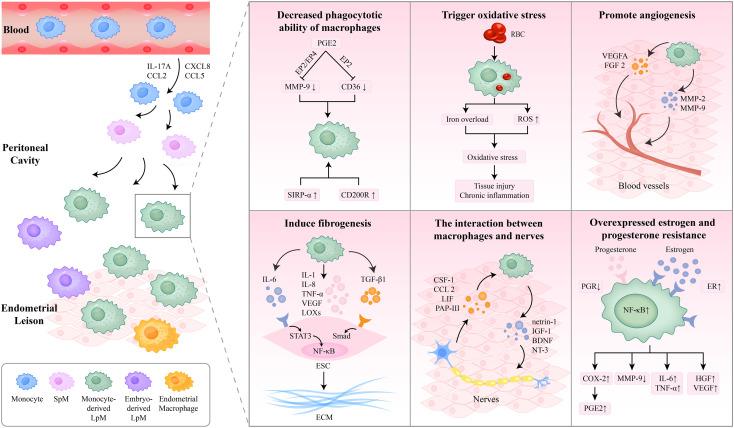
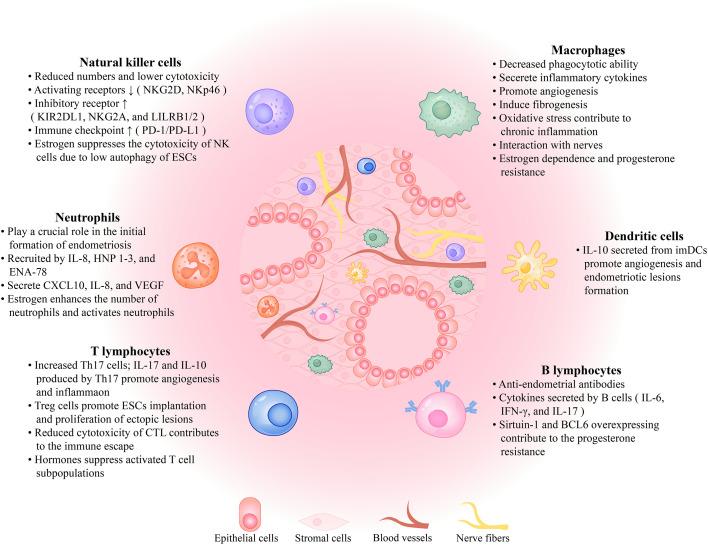
Endometriosis, an estrogen-dependent chronic inflammatory disease characterized by the growth of endometrium-like tissues outside the uterine cavity, affects 10% of reproductive-age women. Although the pathogenesis of endometriosis is uncertain, it is widely accepted that retrograde menstruation results in ectopic endometrial tissue implantation. Given that not all women with retrograde menstruation develop endometriosis, immune factors have been hypothesized to affect the pathogenesis of endometriosis. In this review, we demonstrate that the peritoneal immune microenvironment, including innate immunity and adaptive immunity, plays a central role in the pathogenesis of endometriosis. Current evidence supports the fact that immune cells, such as macrophages, natural killer (NK) cells, dendritic cells (DCs), neutrophils, T cells, and B cells, as well as cytokines and inflammatory mediators, contribute to the vascularization and fibrogenesis of endometriotic lesions, accelerating the implantation and development of ectopic endometrial lesions. Endocrine system dysfunction influences the immune microenvironment through overexpressed estrogen and progesterone resistance. In light of the limitations of hormonal therapy, we describe the prospects for potential diagnostic biomarkers and nonhormonal therapy based on the regulation of the immune microenvironment. Further studies are warranted to explore the available diagnostic biomarkers and immunological therapeutic strategies for endometriosis.
子宫内膜异位症是一种雌激素依赖性的慢性炎症性疾病,其特征是子宫内膜样组织在子宫腔外生长,影响 10%的育龄妇女。虽然子宫内膜异位症的发病机制尚不确定,但广泛认为逆行性月经会导致异位子宫内膜组织的植入。鉴于并非所有逆行性月经的妇女都会发生子宫内膜异位症,免疫因素被假设会影响子宫内膜异位症的发病机制。在这篇综述中,我们证明了腹膜免疫微环境,包括先天免疫和适应性免疫,在子宫内膜异位症的发病机制中起着核心作用。现有证据支持这样一个事实,即免疫细胞,如巨噬细胞、自然杀伤(NK)细胞、树突状细胞(DC)、中性粒细胞、T 细胞和 B 细胞,以及细胞因子和炎症介质,有助于异位子宫内膜病变的血管生成和纤维化,加速异位子宫内膜病变的植入和发展。内分泌系统功能障碍通过过度表达的雌激素和孕激素抵抗影响免疫微环境。鉴于激素治疗的局限性,我们描述了基于免疫微环境调节的潜在诊断生物标志物和非激素治疗的前景。需要进一步的研究来探索子宫内膜异位症的现有诊断生物标志物和免疫治疗策略。
 Zotero 插件