
节段性染色体畸变是18个月以上3期无扩增神经母细胞瘤患儿预后不良的因素。
Segmental chromosomal aberrations as the poor prognostic factor in children over 18 months with stage 3 neuroblastoma without amplification.
作者信息
Wieczorek Aleksandra, Szewczyk Katarzyna, Klekawka Tomasz, Stefanowicz Joanna, Ussowicz Marek, Drabik Grazyna, Pawinska-Wasikowska Katarzyna, Balwierz Walentyna
机构信息
Department of Pediatric Oncology and Hematology, Medical College, Jagiellonian University, Krakow, Poland.
Department of Pediatric Oncology and Hematology, University Children's Hospital of Krakow, Krakow, Poland.
出版信息
Front Oncol. 2023 Feb 14;13:1134772. doi: 10.3389/fonc.2023.1134772. eCollection 2023.
INTRODUCTION
Patients with stage 3 neuroblastoma (NBL) according to International Neuroblastoma Staging System (INSS) without MYCN amplification represent a heterogenous group with respect to disease presentation and prognosis.
METHODS
Retrospective analysis of 40 stage 3 patients with NBL without MYCN amplification was performed. The prognostic value of age at diagnosis (under 18 vs over 18 months), International Neuroblastoma Pathology Classification (INPC) diagnostic category and presence of segmental or numerical chromosomes aberrations were evaluated, as well as biochemical markers. Array comparative genomic hybridization (aCGH) for analyzing copy number variations and Sanger sequencing for ALK point mutations were done.
RESULTS
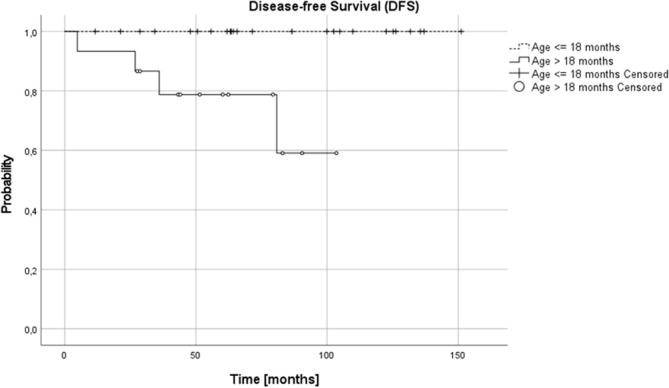
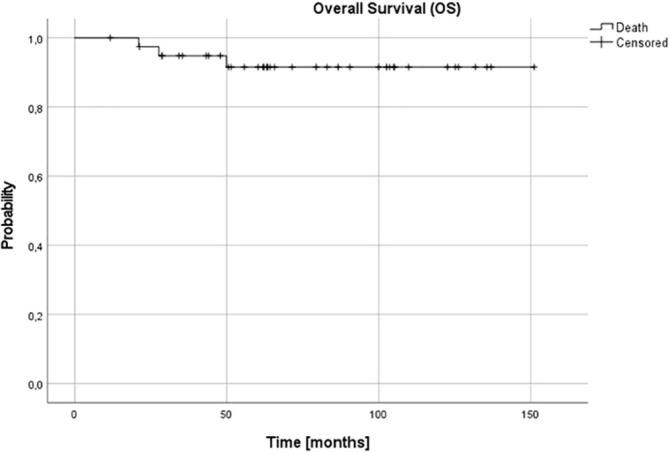
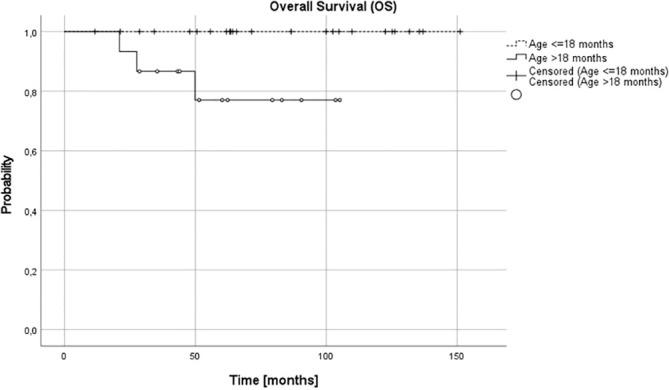
In 12 patients (two patients under 18 months), segmental chromosomal aberrations (SCA) were found and numerical chromosomal aberrations (NCA) were found in 16 patients (14 patients under 18 months). In children over 18 months SCA were more common (p=0.0001). Unfavorable pathology was significantly correlated with SCA genomic profile (p=0.04) and age over 18 months (p=0.008). No therapy failures occurred in children with NCA profile over or under 18 months or in children under 18 months, irrespective of pathology and CGH results. Three treatment failures occurred in the SCA group, in one patient CGH profile was not available. For the whole group at 3, 5 and 10-year OS and DFS were 0.95 (95% CI 0.81-0.99), 0.91 (95% CI 0.77-0.97) and 0.91 (95% CI 0.77-0.97), and 0.95 (95% CI 0.90-0.99), 0.92 (95% CI 0.85-0.98) and 0.86 (95% CI 0.78-0.97), respectively. DFS was significantly lower in the SCA group than in the NCA group (3-years, 5-years, and 10-years DFS 0.92 (95% CI 0.53-0.95), 0.80 (95% CI 0.40-0.95) and 0.60 (95% CI 0.16-0.87) vs 1.0, 1.0 and 1.0, respectively, p=0.005).
CONCLUSIONS
The risk of treatment failure was higher in patients with SCA profile, but only in patients over 18 months. All relapses occurred in children having obtained the complete remission, with no previous radiotherapy. In patients over 18 months, SCA profile should be taken into consideration for therapy stratification as it increases the risk of relapse and this group may require more intensive treatment.
引言
根据国际神经母细胞瘤分期系统(INSS),3期神经母细胞瘤(NBL)且无MYCN扩增的患者在疾病表现和预后方面构成一个异质性群体。
方法
对40例3期无MYCN扩增的NBL患者进行回顾性分析。评估诊断时年龄(18个月以下与18个月以上)、国际神经母细胞瘤病理分类(INPC)诊断类别以及节段性或数字性染色体畸变的存在情况的预后价值,以及生化标志物。进行了用于分析拷贝数变异的阵列比较基因组杂交(aCGH)和用于ALK点突变的桑格测序。
结果
在12例患者(2例18个月以下患者)中发现节段性染色体畸变(SCA),在16例患者(14例18个月以下患者)中发现数字性染色体畸变(NCA)。在18个月以上儿童中SCA更常见(p = 0.0001)。不良病理与SCA基因组图谱(p = 0.04)和18个月以上年龄(p = 0.008)显著相关。18个月以上或以下具有NCA图谱的儿童以及18个月以下儿童,无论病理和CGH结果如何,均未发生治疗失败。SCA组发生3例治疗失败,1例患者无CGH图谱。对于整个组,3年、5年和10年总生存率(OS)和无病生存率(DFS)分别为0.95(95%CI 0.81 - 0.99)、0.91(95%CI 0.77 - 0.97)和0.91(95%CI 0.77 - 0.97),以及0.95(95%CI 0.90 - 0.99)、0.92(95%CI 0.85 - 0.98)和0.86(95%CI 0.78 - 0.97)。SCA组的DFS显著低于NCA组(3年、5年和10年DFS分别为0.92(95%CI 0.53 - 0.95)、0.80(95%CI 0.40 - 0.95)和0.60(95%CI 0.16 - 0.87),而NCA组分别为1.0、1.0和1.0,p = 0.005)。
结论
具有SCA图谱的患者治疗失败风险更高,但仅在18个月以上患者中如此。所有复发均发生在已获得完全缓解且既往未接受放疗的儿童中。在18个月以上患者中,SCA图谱应在治疗分层时予以考虑,因为它会增加复发风险,且该组可能需要更强化的治疗。

 Zotero 插件