
埃塞俄比亚东部营养稳定中心出院儿童急性营养不良复发情况及相关因素
Relapse of acute malnutrition and associated factors after discharge from nutrition stabilization centers among children in Eastern Ethiopia.
作者信息
Alyi Mohammedjemal, Roba Kedir Teji, Ketema Indeshaw, Habte Sisay, Goshu Abel Tibebu, Mehadi Ame, Baye Yohannes, Ayele Behailu Hawulte
机构信息
Habro Woreda Health Office, Gelemso, Ethiopia.
School of Nursing and Midwifery, College of Health and Medical Sciences, Haramaya University, Harar, Ethiopia.
出版信息
Front Nutr. 2023 Feb 14;10:1095523. doi: 10.3389/fnut.2023.1095523. eCollection 2023.
BACKGROUND
Acute malnutrition is a major global health problem primarily affecting under-five children. In sub-Saharan Africa, children treated for severe acute malnutrition (SAM) at an inpatient have high case fatality rate and is associated with relapse of acute malnutrition after discharge from inpatient treatment programs. However, there is limited data on the rate of relapse of acute malnutrition in children after discharge from stabilization centers in Ethiopia. Hence, this study aimed to assess the magnitude and predictors of relapse of acute malnutrition among children aged 6-59 months discharged from stabilization centers in Habro Woreda, Eastern Ethiopia.
METHODS
A cross-sectional study was conducted among under-five children to determine the rate and predictors of relapse of acute malnutrition. A simple random sampling method was used to select participants. All randomly selected children aged 6-59 months discharged from stabilization centers between June 2019 and May 2020 were included. Data were collected using pretested semi-structured questionnaires and standard anthropometric measurements. The anthropometric measurements were used to determine relapse of acute malnutrition. Binary logistic regression analysis was used to identify factors associated with relapse of acute malnutrition. An odds ratio with 95% CI was used to estimate the strength of the association and a -value less than 0.05 was considered statistically significant.
RESULTS
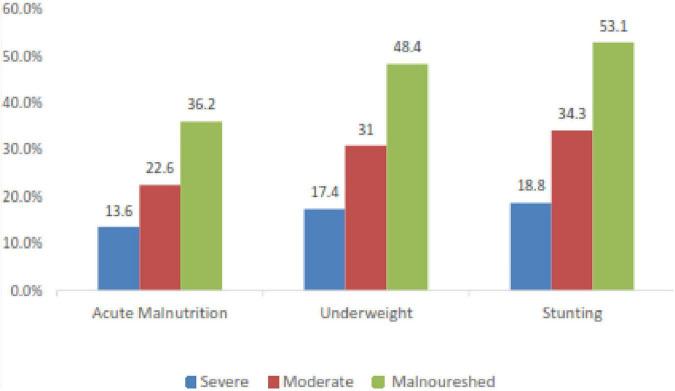
A total of 213 children with mothers/caregivers were included in the study. The mean age in months of children was 33.9 ± 11.4. More than half (50.7%) of the children were male. The mean duration of children after discharge was 10.9 (± 3.0 SD) months. The magnitude of relapse of acute malnutrition after discharge from stabilization centers was 36.2% (95% CI: 29.6,42.6). Several determinant factors were identified for relapse of acute malnutrition. Mid-upper arm circumference less than 110 mm at admission (AOR = 2.80; 95% CI: 1.05,7.92), absence of latrine (AOR = 2.50, 95% CI: 1.09,5.65), absence of follow-up visits after discharge (AOR = 2.81, 95% CI: 1.15,7.22), not received vitamin A supplementation in the past 6 months (AOR = 3.40, 95% CI: 1.40,8.09), household food insecurity (AOR = 4.51, 95% CI: 1.40,15.06), poor dietary diversity (AOR = 3.10, 95% CI: 1.31,7.33), and poor wealth index (AOR = 3.90, 95% CI: 1.23,12.43) were significant predictors of relapse of acute malnutrition.
CONCLUSION
The study revealed very high magnitude of relapse of acute malnutrition after discharge from nutrition stabilization centers. One in three children developed relapse after discharge in Habro Woreda. Programmers working on nutrition should design interventions that focus on improving household food insecurity through strengthened public Safety Net programs and emphasis should be given to nutrition counseling and education, as well as to continuous follow-up and periodic monitoring, especially during the first 6 months of discharge, to reduce relapse of acute malnutrition.
背景
急性营养不良是一个主要的全球健康问题,主要影响五岁以下儿童。在撒哈拉以南非洲,住院治疗严重急性营养不良(SAM)的儿童病死率很高,且与住院治疗项目出院后急性营养不良的复发有关。然而,关于埃塞俄比亚稳定中心出院儿童急性营养不良复发率的数据有限。因此,本研究旨在评估埃塞俄比亚东部哈布罗县稳定中心出院的6至59个月儿童急性营养不良复发的程度及其预测因素。
方法
对五岁以下儿童进行了一项横断面研究,以确定急性营养不良复发率及其预测因素。采用简单随机抽样方法选择参与者。纳入了2019年6月至2020年5月期间从稳定中心出院的所有随机选取的6至59个月儿童。使用经过预测试的半结构化问卷和标准人体测量方法收集数据。人体测量用于确定急性营养不良的复发情况。采用二元逻辑回归分析来确定与急性营养不良复发相关的因素。使用95%置信区间的比值比来估计关联强度,P值小于0.05被认为具有统计学意义。
结果
本研究共纳入了213名有母亲/照料者的儿童。儿童的平均月龄为33.9±11.4。超过一半(50.7%)的儿童为男性。儿童出院后的平均时长为10.9(±3.0标准差)个月。稳定中心出院后急性营养不良的复发率为36.2%(95%置信区间:29.6,42.6)。确定了急性营养不良复发的几个决定因素。入院时中上臂围小于ll0毫米(比值比=2.80;95%置信区间:1.05,7.92)、没有厕所(比值比=2.50,95%置信区间:1.09,5.65)、出院后没有随访(比值比=2.81,95%置信区间:1.15,7.22)、过去6个月未接受维生素A补充(比值比=3.40,95%置信区间:1.40,8.09)、家庭粮食不安全(比值比=4.51,95%置信区间:1.40,15.06)、饮食多样性差(比值比=3.10,95%置信区间:1.31,7.33)以及财富指数低(比值比=3.90,95%置信区间:1.23,12.43)是急性营养不良复发的显著预测因素。
结论
该研究表明,营养稳定中心出院后急性营养不良的复发率非常高。在哈布罗县,三分之一的儿童出院后出现复发。从事营养工作的规划者应设计干预措施,通过加强公共安全网项目来改善家庭粮食不安全状况,应重视营养咨询和教育,以及持续随访和定期监测,尤其是在出院后的前6个月,以减少急性营养不良的复发。


 Zotero 插件