
多基因背景、罕见种系致病性变异体和家族史对结直肠癌发病的临床相关联合效应。
Clinically relevant combined effect of polygenic background, rare pathogenic germline variants, and family history on colorectal cancer incidence.
机构信息
Institute for Genomic Statistics and Bioinformatics, University Hospital Bonn, Bonn, Germany.
Luxembourg Centre for Systems Biomedicine, University of Luxembourg, Esch-Sur-Alzette, Luxembourg.
出版信息
BMC Med Genomics. 2023 Mar 5;16(1):42. doi: 10.1186/s12920-023-01469-z.
BACKGROUND AND AIMS
Summarised in polygenic risk scores (PRS), the effect of common, low penetrant genetic variants associated with colorectal cancer (CRC), can be used for risk stratification.
METHODS
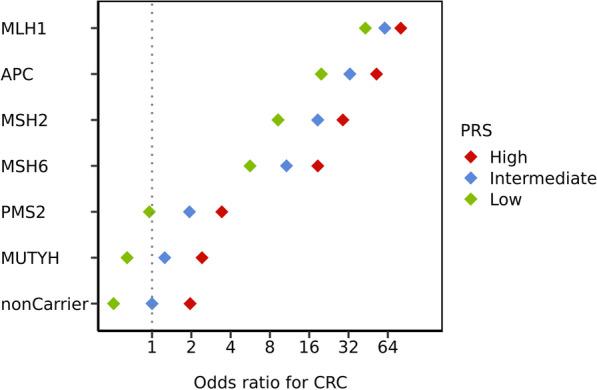
To assess the combined impact of the PRS and other main factors on CRC risk, 163,516 individuals from the UK Biobank were stratified as follows: 1. carriers status for germline pathogenic variants (PV) in CRC susceptibility genes (APC, MLH1, MSH2, MSH6, PMS2), 2. low (< 20%), intermediate (20-80%), or high PRS (> 80%), and 3. family history (FH) of CRC. Multivariable logistic regression and Cox proportional hazards models were applied to compare odds ratios and to compute the lifetime incidence, respectively.
RESULTS
Depending on the PRS, the CRC lifetime incidence for non-carriers ranges between 6 and 22%, compared to 40% and 74% for carriers. A suspicious FH is associated with a further increase of the cumulative incidence reaching 26% for non-carriers and 98% for carriers. In non-carriers without FH, but high PRS, the CRC risk is doubled, whereas a low PRS even in the context of a FH results in a decreased risk. The full model including PRS, carrier status, and FH improved the area under the curve in risk prediction (0.704).
CONCLUSION
The findings demonstrate that CRC risks are strongly influenced by the PRS for both a sporadic and monogenic background. FH, PV, and common variants complementary contribute to CRC risk. The implementation of PRS in routine care will likely improve personalized risk stratification, which will in turn guide tailored preventive surveillance strategies in high, intermediate, and low risk groups.
背景与目的
聚合遗传风险评分(PRS)概括了与结直肠癌(CRC)相关的常见、低外显率遗传变异的作用,可用于风险分层。
方法
为了评估PRS 及其他主要因素对 CRC 风险的综合影响,将英国生物库中的 163516 名个体分为以下几类:1. 结直肠癌易感性基因(APC、MLH1、MSH2、MSH6、PMS2)种系致病性变异(PV)的携带者状态,2. 低(<20%)、中(20-80%)或高(>80%)PRS,3. CRC 家族史(FH)。多变量逻辑回归和 Cox 比例风险模型分别用于比较比值比和计算终生发病率。
结果
根据 PRS,非携带者的 CRC 终生发病率在 6%至 22%之间,而携带者的发病率为 40%至 74%。可疑 FH 与累积发病率进一步增加相关,非携带者达到 26%,携带者达到 98%。在无 FH 的非携带者中,PRS 较高,CRC 风险增加一倍,而 FH 即使在低 PRS 的情况下,也会降低风险。包括 PRS、携带者状态和 FH 的全模型提高了风险预测的曲线下面积(0.704)。
结论
这些发现表明,CRC 风险受散发性和单基因背景下的 PRS 强烈影响。FH、PV 和常见变异互补性地增加 CRC 风险。PRS 在常规护理中的实施可能会改善个性化风险分层,从而指导高危、中危和低危人群的针对性预防监测策略。


 Zotero 插件