
p53突变和缺失有助于肿瘤免疫逃逸。
p53 mutation and deletion contribute to tumor immune evasion.
作者信息
Liu Siyang, Liu Tianyao, Jiang Jiaxuan, Guo Hongqian, Yang Rong
机构信息
Department of Urology, Affiliated Drum Tower Hospital, Medical School of Nanjing University, Nanjing, China.
Department of Endocrinology, Affiliated Drum Tower Hospital, Medical School of Nanjing University, Nanjing, China.
出版信息
Front Genet. 2023 Feb 20;14:1088455. doi: 10.3389/fgene.2023.1088455. eCollection 2023.
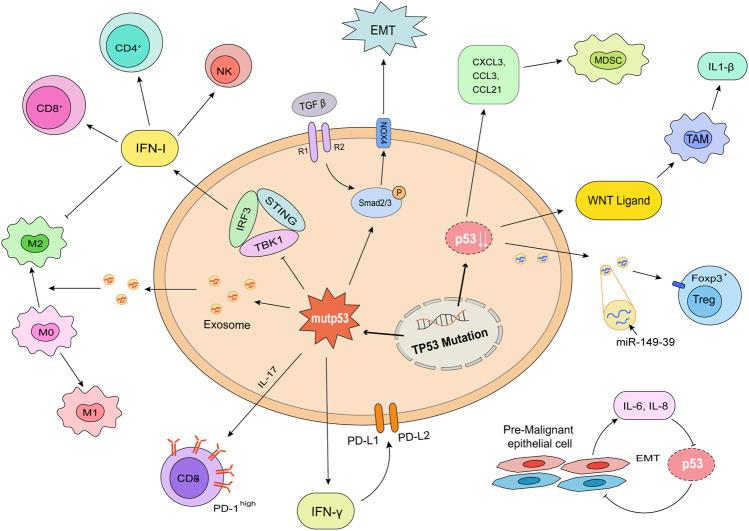
TP53 (or p53) is widely accepted to be a tumor suppressor. Upon various cellular stresses, p53 mediates cell cycle arrest and apoptosis to maintain genomic stability. p53 is also discovered to suppress tumor growth through regulating metabolism and ferroptosis. However, p53 is always lost or mutated in human and the loss or mutation of p53 is related to a high risk of tumors. Although the link between p53 and cancer has been well established, how the different p53 status of tumor cells help themselves evade immune response remains largely elusive. Understanding the molecular mechanisms of different status of p53 and tumor immune evasion can help optimize the currently used therapies. In this context, we discussed the how the antigen presentation and tumor antigen expression mode altered and described how the tumor cells shape a suppressive tumor immune microenvironment to facilitate its proliferation and metastasis.
TP53(即p53)被广泛认为是一种肿瘤抑制因子。在各种细胞应激情况下,p53介导细胞周期停滞和细胞凋亡以维持基因组稳定性。p53还被发现可通过调节代谢和铁死亡来抑制肿瘤生长。然而,p53在人类中常常缺失或发生突变,而p53的缺失或突变与肿瘤的高风险相关。尽管p53与癌症之间的联系已得到充分证实,但肿瘤细胞不同的p53状态如何帮助其逃避免疫反应在很大程度上仍不清楚。了解p53不同状态和肿瘤免疫逃逸的分子机制有助于优化目前使用的治疗方法。在此背景下,我们讨论了抗原呈递和肿瘤抗原表达模式是如何改变的,并描述了肿瘤细胞如何塑造一个抑制性的肿瘤免疫微环境以促进其增殖和转移。


 Zotero 插件