
从加纳和尼泊尔的卫生系统参与者和照护者的经验中学习,以加强生长监测和促进。
Learning from health system actor and caregiver experiences in Ghana and Nepal to strengthen growth monitoring and promotion.
机构信息
USAID Advancing Nutrition, Helen Keller International, New York, New York, United States of America.
USAID Advancing Nutrition, JSI Research & Training Institute, Inc., Arlington, Virginia, United States of America.
出版信息
PLoS One. 2023 Mar 9;18(3):e0282807. doi: 10.1371/journal.pone.0282807. eCollection 2023.
BACKGROUND
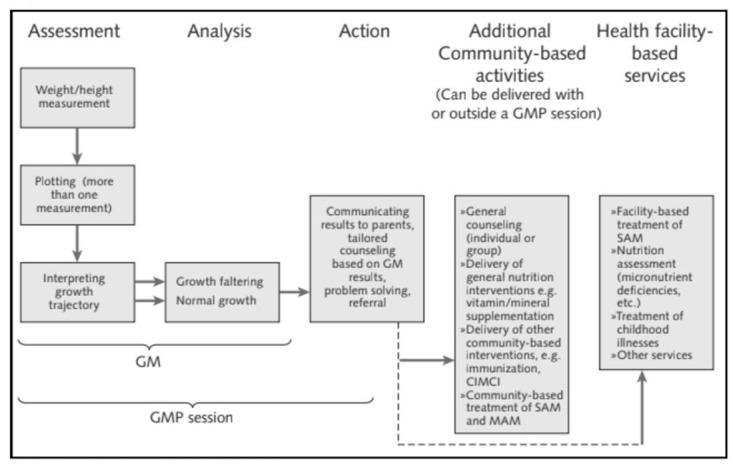
Globally, growth monitoring and promotion (GMP) of infants and young children is a fundamental component of routine preventive child health care; however, programs have experienced varying degrees of quality and success with enduring challenges. The objective of this study was to describe implementation of GMP (growth monitoring, growth promotion, data use, and implementation challenges) in two countries, Ghana and Nepal, to identify key actions to strengthen GMP programs.
METHODS
We conducted semi-structured key informant interviews with national and sub-national government officials (n = 24), health workers and volunteers (n = 40), and caregivers (n = 34). We conducted direct structured observations at health facilities (n = 10) and outreach clinics (n = 10) to complement information from interviews. We coded and analyzed interview notes for themes related to GMP implementation.
RESULTS
Health workers in Ghana (e.g., community health nurses) and Nepal (e.g., auxiliary nurse midwives) had the knowledge and skills to assess and analyze growth based on weight measurement. However, health workers in Ghana centered growth promotion on the growth trend (weight-for-age over time), whereas health workers in Nepal based growth promotion on measurement from one point in time to determine whether a child was underweight. Overlapping challenges included health worker time and workload. Both countries tracked growth-monitoring data systematically; however, there was variation in growth monitoring data use.
CONCLUSION
This study shows that GMP programs may not always focus on the growth trend for early detection of growth faltering and preventive actions. Several factors contribute to this deviation from the intended goal of GMP. To overcome them, countries need to invest in both service delivery (e.g., decision-making algorithm) and demand generation efforts (e.g., integrate with responsive care and early learning).
背景
在全球范围内,婴幼儿生长监测和促进(GMP)是常规预防儿童保健的基本组成部分;然而,各个项目在质量和持续存在的挑战方面都取得了不同程度的成功。本研究的目的是描述加纳和尼泊尔两个国家的 GMP(生长监测、生长促进、数据使用和实施挑战)实施情况,以确定加强 GMP 计划的关键行动。
方法
我们对国家和次国家政府官员(n=24)、卫生工作者和志愿者(n=40)以及照顾者(n=34)进行了半结构化的关键知情人访谈。我们在卫生设施(n=10)和外展诊所(n=10)进行了直接结构化观察,以补充访谈信息。我们对访谈笔记进行了编码和分析,以确定与 GMP 实施相关的主题。
结果
加纳(例如,社区卫生护士)和尼泊尔(例如,助理护士助产士)的卫生工作者具备根据体重测量评估和分析生长的知识和技能。然而,加纳的卫生工作者将生长促进集中在生长趋势(随时间推移的体重-年龄)上,而尼泊尔的卫生工作者则根据一个时间点的测量结果来确定儿童是否体重不足。重叠的挑战包括卫生工作者的时间和工作量。两个国家都系统地跟踪生长监测数据;然而,生长监测数据的使用存在差异。
结论
本研究表明,GMP 计划可能并不总是关注生长趋势,以早期发现生长迟缓并采取预防措施。有几个因素导致偏离 GMP 的既定目标。为了克服这些问题,各国需要投资于服务提供(例如,决策算法)和需求产生工作(例如,与响应性护理和早期学习相结合)。
 Zotero 插件