
利用口腔黏膜样本通过鸟枪法蛋白质组学检测吸入性肺炎潜在生物标志物蛋白:一项横断面病例对照研究
Potential biomarker proteins for aspiration pneumonia detected by shotgun proteomics using buccal mucosa samples: a cross-sectional case-control study.
作者信息
Ogura Kohei, Endo Maho, Hase Takashi, Negami Hitomi, Tsuchiya Kohsuke, Nishiuchi Takumi, Suzuki Takeshi, Ogai Kazuhiro, Sanada Hiromi, Okamoto Shigefumi, Sugama Junko
机构信息
Advanced Health Care Science Research Unit, Institute for Frontier Science Initiative, Kanazawa University, 5-11-80 Kodatsuno, Kanazawa, Ishikawa, 9200942, Japan.
Nursing Department, Fujita Health University Hospital, 1-98 Dengakugakubo, Kutsukake-Cho, Toyoake, Aichi, 4701192, Japan.
出版信息
Clin Proteomics. 2023 Mar 9;20(1):9. doi: 10.1186/s12014-023-09398-w.
BACKGROUND
Aspiration pneumonia (AP), which is a major cause of death in the elderly, does present with typical symptoms in the early stages of onset, thus it is difficult to detect and treat at an early stage. In this study, we identified biomarkers that are useful for the detection of AP and focused on salivary proteins, which may be collected non-invasively. Because expectorating saliva is often difficult for elderly people, we collected salivary proteins from the buccal mucosa.
METHODS
We collected samples from the buccal mucosa of six patients with AP and six control patients (no AP) in an acute-care hospital. Following protein precipitation using trichloroacetic acid and washing with acetone, the samples were analyzed by liquid chromatography and tandem mass spectrometry (LC-MS/MS). We also determined the levels of cytokines and chemokines in non-precipitated samples from buccal mucosa.
RESULTS
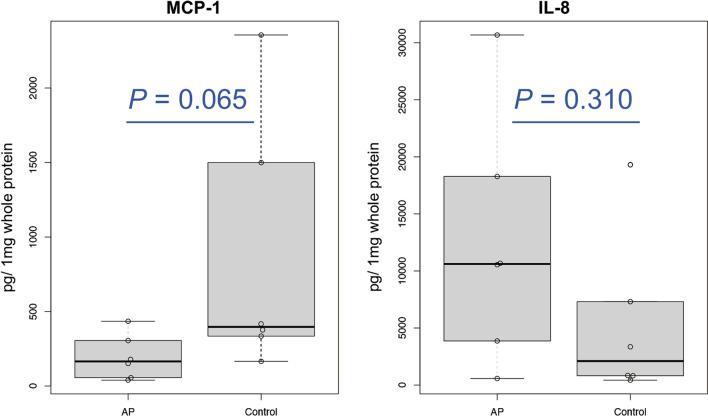
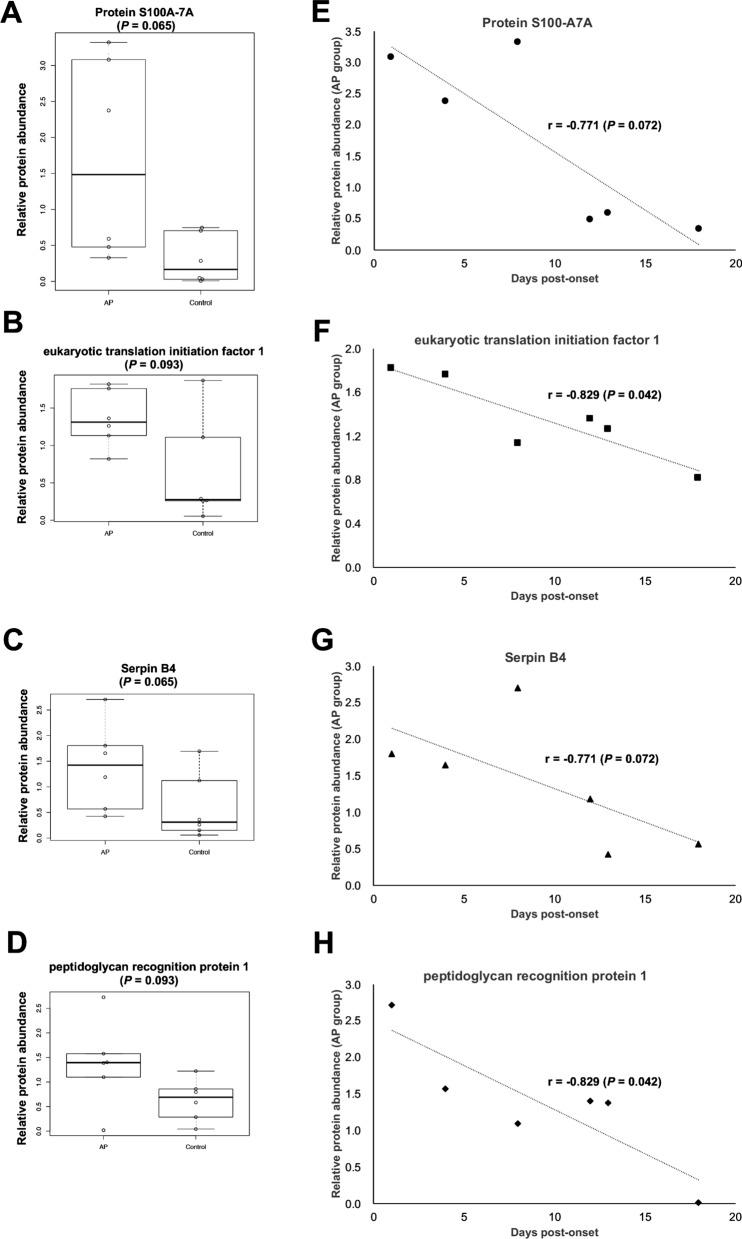
Comparative quantitative analysis of LC-MS/MS spectra revealed 55 highly (P values < 0.10) abundant proteins with high FDR confidence (q values < 0.01) and high coverage (> 50%) in the AP group compared with the control group. Among the 55 proteins, the protein abundances of four proteins (protein S100-A7A, eukaryotic translation initiation factor 1, Serpin B4, and peptidoglycan recognition protein 1) in the AP group showed a negative correlation with the time post-onset; these proteins are promising AP biomarker candidates. In addition, the abundance of C-reactive protein (CRP) in oral samples was highly correlated with serum CRP levels, suggesting that oral CRP levels may be used as a surrogate to predict serum CRP in AP patients. A multiplex cytokine/chemokine assay revealed that MCP-1 tended to be low, indicating unresponsiveness of MCP-1 and its downstream immune pathways in AP.
CONCLUSION
Our findings suggest that oral salivary proteins, which are obtained non-invasively, can be utilized for the detection of AP.
背景
吸入性肺炎(AP)是老年人死亡的主要原因之一,在发病早期并无典型症状,因此早期难以检测和治疗。在本研究中,我们确定了可用于检测AP的生物标志物,并聚焦于可通过非侵入性方式收集的唾液蛋白。由于老年人往往难以咳出唾液,我们从颊黏膜收集唾液蛋白。
方法
我们在一家急症医院收集了6例AP患者和6例对照患者(无AP)的颊黏膜样本。使用三氯乙酸进行蛋白质沉淀并经丙酮洗涤后,通过液相色谱和串联质谱(LC-MS/MS)对样本进行分析。我们还测定了颊黏膜未沉淀样本中的细胞因子和趋化因子水平。
结果
LC-MS/MS谱图的比较定量分析显示,与对照组相比,AP组中有55种蛋白质丰度较高(P值<0.10),具有高FDR置信度(q值<0.01)和高覆盖率(>50%)。在这55种蛋白质中,AP组中四种蛋白质(蛋白质S100-A7A、真核翻译起始因子1、丝氨酸蛋白酶抑制剂B4和肽聚糖识别蛋白1)的蛋白质丰度与发病后的时间呈负相关;这些蛋白质有望成为AP生物标志物候选物。此外,口腔样本中C反应蛋白(CRP)的丰度与血清CRP水平高度相关,表明口腔CRP水平可作为预测AP患者血清CRP的替代指标。多重细胞因子/趋化因子检测显示MCP-1水平往往较低,表明AP中MCP-1及其下游免疫途径无反应。
结论
我们的研究结果表明,通过非侵入性获得的口腔唾液蛋白可用于检测AP。

 Zotero 插件