
病例系列:免疫检查点抑制剂诱发的横贯性脊髓炎。
Case series: Immune checkpoint inhibitor-induced transverse myelitis.
作者信息
Chatterton Sophie, Xi Shuo, Jia Jessica Xi, Krause Martin, Long Georgina V, Atkinson Victoria, Menzies Alexander M, Fernando Suran L, Boyle Thérèse, Kwok Samuel, Duggins Andrew, Karikios Deme, Parratt John D E
机构信息
Department of Neurology, Royal North Shore Hospital, Sydney, NSW, Australia.
Department of Neurology, Nepean Hospital, Sydney, NSW, Australia.
出版信息
Front Neurol. 2023 Feb 21;14:1130313. doi: 10.3389/fneur.2023.1130313. eCollection 2023.
INTRODUCTION
Increasing implementation of the highly efficacious immune checkpoint inhibitors (ICIs) has raised awareness of their various complications in the form of immune-related adverse events (irAEs). Transverse myelitis following ICIs is thought to be a rare but serious neurologic irAE and knowledge is limited about this distinct clinical entity.
CASES
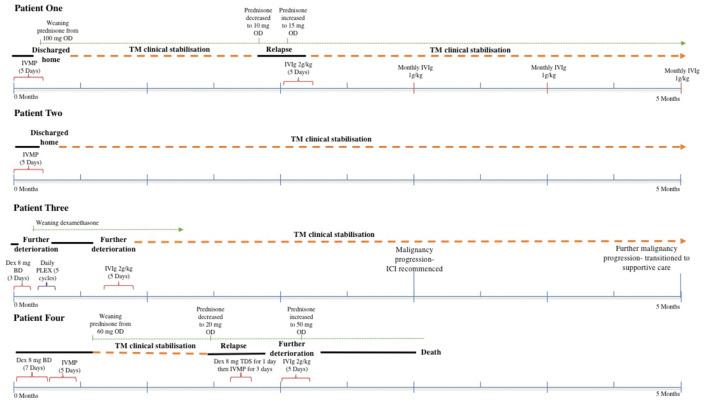
We describe four patients across three tertiary centers in Australia with ICI-induced transverse myelitis. Three patients had a diagnosis of stage III-IV melanoma treated with nivolumab and one patient had stage IV non-small cell lung cancer treated with pembrolizumab. All patients had longitudinally extensive transverse myelitis on magnetic resonance imaging (MRI) spine and clinical presentation was accompanied by inflammatory cerebrospinal fluid (CSF) findings. Half of our cohort had received spinal radiotherapy, with the areas of transverse myelitis extending beyond the level of previous radiation field. Inflammatory changes on neuroimaging did not extend to the brain parenchyma or caudal nerve roots, except for one case involving the conus medullaris. All patients received high dose glucocorticoids as first-line therapy, however the majority relapsed or had a refractory state (3/4) despite this, requiring escalation of their immunomodulation, with either induction intravenous immunoglobulin (IVIg) or plasmapheresis. Patients in our cohort who relapsed had a poorer outcome with more severe disability and reduced functional independence following resolution of their myelitis. Two patients had no progression of their malignancy and two patients had malignancy progression. Of the three patients who survived, two had resolution of their neurological symptoms and one remained symptomatic.
CONCLUSION
We propose that prompt intensive immunomodulation is favored for patients with ICI-transverse myelitis in an attempt to reduce associated significant morbidity and mortality. Furthermore, there is a significant risk of relapse following cessation of immunomodulatory therapy. We suggest one treatment approach of IVMP and induction IVIg for all patients presenting with ICI-induced transverse myelitis based on such findings. With the increasing use of ICIs across oncology, further studies are required to explore this neurological phenomenon in greater detail to help establish management consensus guidelines.
引言
高效免疫检查点抑制剂(ICI)的应用日益广泛,人们对其以免疫相关不良事件(irAE)形式出现的各种并发症的认识也有所提高。ICI 引发的横贯性脊髓炎被认为是一种罕见但严重的神经系统 irAE,对于这种独特的临床实体,人们了解有限。
病例
我们描述了澳大利亚三个三级中心的 4 例由 ICI 诱发的横贯性脊髓炎患者。3 例患者被诊断为 III-IV 期黑色素瘤,接受纳武单抗治疗,1 例患者为 IV 期非小细胞肺癌,接受帕博利珠单抗治疗。所有患者的脊柱磁共振成像(MRI)均显示为纵向广泛横贯性脊髓炎,临床表现伴有炎性脑脊液(CSF)表现。我们队列中的一半患者接受过脊柱放疗,横贯性脊髓炎区域超出了先前放疗野的范围。除 1 例涉及圆锥的病例外,神经影像学上的炎性改变未延伸至脑实质或尾神经根。所有患者均接受大剂量糖皮质激素作为一线治疗,然而,尽管如此,大多数患者复发或处于难治状态(3/4),需要加强免疫调节,采用诱导静脉注射免疫球蛋白(IVIg)或血浆置换。我们队列中复发的患者预后较差,脊髓炎缓解后残疾更严重,功能独立性降低。2 例患者的恶性肿瘤无进展,2 例患者有恶性肿瘤进展。在存活的 3 例患者中,2 例患者的神经症状得到缓解,1 例仍有症状。
结论
我们建议对 ICI 诱发的横贯性脊髓炎患者尽早进行强化免疫调节,以降低相关的严重发病率和死亡率。此外,免疫调节治疗停止后复发风险很大。基于这些发现,我们建议对所有出现 ICI 诱发的横贯性脊髓炎的患者采用静脉注射甲泼尼龙(IVMP)和诱导 IVIg 的治疗方法。随着 ICI 在肿瘤学领域的使用日益增加,需要进一步研究以更详细地探索这种神经学现象,以帮助建立管理共识指南。

 Zotero 插件