
子宫内膜异位症与盆腔炎双向关系潜在致病机制的相似性
Similarities in Pathogenetic Mechanisms Underlying the Bidirectional Relationship between Endometriosis and Pelvic Inflammatory Disease.
作者信息
Kobayashi Hiroshi
机构信息
Department of Gynecology and Reproductive Medicine, Ms.Clinic MayOne, Kashihara 634-0813, Japan.
Department of Obstetrics and Gynecology, Nara Medical University, Kashihara 634-8522, Japan.
出版信息
Diagnostics (Basel). 2023 Feb 24;13(5):868. doi: 10.3390/diagnostics13050868.
BACKGROUND
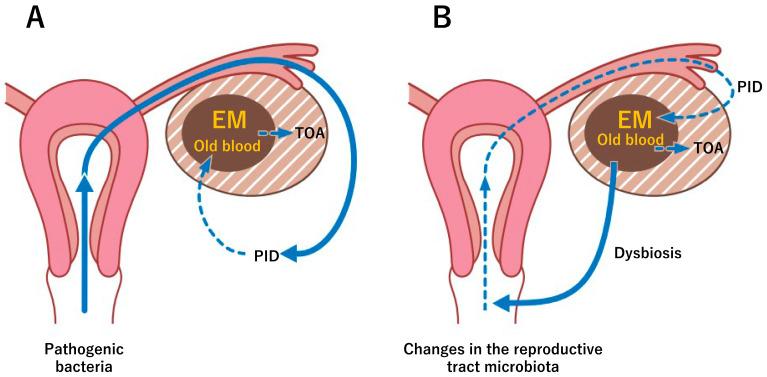
Endometriosis is a common inflammatory disease characterized by the presence of endometrial cells outside of the uterine cavity. Endometriosis affects 10% of women of reproductive age and significantly reduces their quality of life as a result of chronic pelvic pain and infertility. Biologic mechanisms, including persistent inflammation, immune dysfunction, and epigenetic modifications, have been proposed as the pathogenesis of endometriosis. In addition, endometriosis can potentially be associated with an increased risk of pelvic inflammatory disease (PID). Changes in the vaginal microbiota associated with bacterial vaginosis (BV) result in PID or a severe form of abscess formation, tubo-ovarian abscess (TOA). This review aims to summarize the pathophysiology of endometriosis and PID and to discuss whether endometriosis may predispose to PID and vice versa.
METHODS
Papers published between 2000 and 2022 in the PubMed and Google Scholar databases were included.
RESULTS
Available evidence supports that women with endometriosis are at increased risk of comorbid PID and vice versa, supporting that endometriosis and PID are likely to coexist. There is a bidirectional relationship between endometriosis and PID that shares a similar pathophysiology, which includes the distorted anatomy favorable to bacteria proliferation, hemorrhage from endometriotic lesions, alterations to the reproductive tract microbiome, and impaired immune response modulated by aberrant epigenetic processes. However, whether endometriosis predisposes to PID or vice versa has not been identified.
CONCLUSIONS
This review summarizes our current understanding of the pathogenesis of endometriosis and PID and discusses the similarities between them.
背景
子宫内膜异位症是一种常见的炎症性疾病,其特征是子宫腔外存在子宫内膜细胞。子宫内膜异位症影响10%的育龄妇女,由于慢性盆腔疼痛和不孕,显著降低了她们的生活质量。包括持续性炎症、免疫功能障碍和表观遗传修饰在内的生物学机制已被提出作为子宫内膜异位症的发病机制。此外,子宫内膜异位症可能与盆腔炎(PID)风险增加有关。与细菌性阴道病(BV)相关的阴道微生物群变化会导致PID或严重形式的脓肿形成,即输卵管卵巢脓肿(TOA)。本综述旨在总结子宫内膜异位症和PID的病理生理学,并讨论子宫内膜异位症是否可能易患PID,反之亦然。
方法
纳入2000年至2022年在PubMed和谷歌学术数据库上发表的论文。
结果
现有证据支持子宫内膜异位症患者合并PID的风险增加,反之亦然,这支持了子宫内膜异位症和PID可能共存的观点。子宫内膜异位症和PID之间存在双向关系,它们具有相似的病理生理学,包括有利于细菌增殖的解剖结构扭曲、子宫内膜异位病变出血、生殖道微生物群改变以及由异常表观遗传过程调节的免疫反应受损。然而,子宫内膜异位症是否易患PID或反之亦然尚未确定。
结论
本综述总结了我们目前对子宫内膜异位症和PID发病机制的理解,并讨论了它们之间的相似之处。

 Zotero 插件