
通过抑制晚期糖基化终产物预防废用性骨丢失。
Preventing Disused Bone Loss through Inhibition of Advanced Glycation End Products.
机构信息
Key Laboratory for Biomechanics and Mechanobiology, Ministry of Education, Beijing Advanced Innovation Center for Biomedical Engineering, School of Biological Science and Medical Engineering, Beihang University, Beijing 100083, China.
出版信息
Int J Mol Sci. 2023 Mar 3;24(5):4953. doi: 10.3390/ijms24054953.
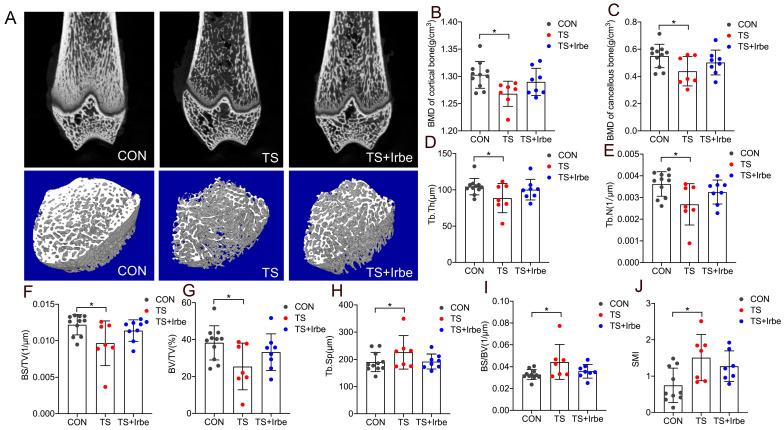
Bone loss occurs in astronauts during long-term space flight, but the mechanisms are still unclear. We previously showed that advanced glycation end products (AGEs) were involved in microgravity-induced osteoporosis. Here, we investigated the improvement effects of blocking AGEs formation on microgravity-induced bone loss by using the AGEs formation inhibitor, irbesartan. To achieve this objective, we used a tail-suspended (TS) rat model to simulate microgravity and treated the TS rats with 50 mg/kg/day irbesartan, as well as the fluorochrome biomarkers injected into rats to label dynamic bone formation. To assess the accumulation of AGEs, pentosidine (PEN), non-enzymatic cross-links (NE-xLR), and fluorescent AGEs (fAGEs) were identified in the bone; 8-hydroxydeoxyguanosine (8-OHdG) was analyzed for the reactive oxygen species (ROS) level in the bone. Meanwhile, bone mechanical properties, bone microstructure, and dynamic bone histomorphometry were tested for bone quality assessment, and Osterix and TRAP were immunofluorescences stained for the activities of osteoblastic and osteoclastic cells. Results showed AGEs increased significantly and 8-OHdG expression in bone showed an upward trend in TS rat hindlimbs. The bone quality (bone microstructure and mechanical properties) and bone formation process (dynamic bone formation and osteoblastic cells activities) were inhibited after tail-suspension, and showed a correlation with AGEs, suggesting the elevated AGEs contributed to the disused bone loss. After being treated with irbesartan, the increased AGEs and 8-OHdG expression were significantly inhibited, suggesting irbesartan may reduce ROS to inhibit dicarbonyl compounds, thus suppressing AGEs production after tail-suspension. The inhibition of AGEs can partially alter the bone remodeling process and improve bone quality. Both AGEs accumulation and bone alterations almost occurred in trabecular bone but not in cortical bone, suggesting AGEs effects on bone remodeling under microgravity are dependent on the biological milieu.
在长期的太空飞行中,宇航员会出现骨质流失,但机制尚不清楚。我们之前的研究表明,糖基化终产物(AGEs)参与了微重力诱导的骨质疏松症。在这里,我们通过使用 AGEs 形成抑制剂厄贝沙坦来研究阻断 AGEs 形成对微重力诱导的骨质流失的改善作用。为了实现这一目标,我们使用尾部悬吊(TS)大鼠模型模拟微重力,并使用 50mg/kg/天的厄贝沙坦治疗 TS 大鼠,以及向大鼠注射荧光标记生物标志物来标记动态骨形成。为了评估 AGEs 的积累,我们在骨中鉴定了戊糖(PEN)、非酶交联(NE-xLR)和荧光 AGEs(fAGEs);分析了骨中活性氧(ROS)水平的 8-羟基脱氧鸟苷(8-OHdG)。同时,测试了骨力学性能、骨微结构和动态骨组织形态计量学,以评估骨质量,并用 Osterix 和 TRAP 免疫荧光染色评估成骨细胞和破骨细胞的活性。结果表明,AGEs 在 TS 大鼠后肢中显著增加,骨中 8-OHdG 表达呈上升趋势。尾部悬吊后,骨质量(骨微结构和力学性能)和骨形成过程(动态骨形成和成骨细胞活性)受到抑制,与 AGEs 相关,表明升高的 AGEs 导致废用性骨质流失。用厄贝沙坦治疗后,AGEs 和 8-OHdG 表达的增加明显受到抑制,表明厄贝沙坦可能通过降低 ROS 来抑制二羰基化合物,从而抑制尾部悬吊后 AGEs 的产生。抑制 AGEs 可以部分改变骨重塑过程并改善骨质量。AGEs 的积累和骨改变几乎发生在小梁骨中,而不在皮质骨中,这表明 AGEs 对微重力下骨重塑的影响取决于生物环境。




 Zotero 插件