
术后辅助经动脉化疗栓塞可改善伴微血管侵犯的肝细胞癌患者的生存:一项多中心回顾性队列研究。
Postoperative adjuvant transarterial chemoembolisation improves survival of hepatocellular carcinoma patients with microvascular invasion: A multicenter retrospective cohort.
机构信息
Division of Hepatobiliary and Pancreas Surgery, Department of General Surgery, The First Affiliated Hospital of Nanchang University (The First Clinical Medical College of Nanchang University), Nanchang City, Jiangxi Province, China.
Division of Hepatobiliary and Pancreas Surgery, Department of General Surgery, Shenzhen People's Hospital (The Second Clinical Medical College, Jinan University; The First Affiliated Hospital, Southern University of Science and Technology), Shenzhen City, Guangdong Province, China.
出版信息
United European Gastroenterol J. 2023 Mar;11(2):228-241. doi: 10.1002/ueg2.12365. Epub 2023 Mar 11.
BACKGROUND
We aimed to investigate the efficacy of postoperative adjuvant transarterial chemoembolisation (PA-TACE) in patients with hepatocellular carcinoma (HCC) complicated by microvascular invasion (MVI).
METHODS
A retrospective analysis of 1505 patients with HCC who underwent hepatectomy at four medical centers, including 782 patients who received PA-TACE and 723 patients who did not receive adjuvant PA-TACE, has been conducted. Propensity score matching (PSM) (1:1) was performed on the data to minimise selection bias, which resulted in a balanced clinical profile between groups.
RESULTS
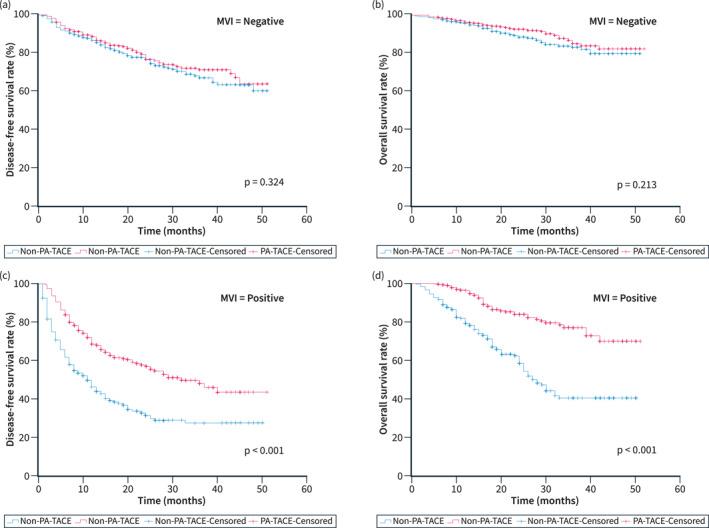
After PSM, 620 patients who received PA-TACE and 620 patients who did not receive PA-TACE were included. Disease-free survival (DFS, 1-, 2-, and 3-year: 88%-68%-61% vs. 70%-58%-51%, p < 0.001) and overall survival (OS, 1-, 2-, and 3-year: 96%-89%-82% vs. 89%-77%-67%, p < 0.001) were significantly higher in patients who received PA-TACE than in those who did not. Patients with MVI who received PA-TACE had significantly higher DFS (1-, 2-, and 3-year: 68%-57%-48% vs. 46%-31%-27%, p < 0.001) and OS (1-, 2-, and 3-year: 96%-84%-77% vs. 79%-58%-40%, p < 0.001) than those who did not receive PA-TACE. Among the six different liver cancer stages, MVI-negative patients did not have significant survival outcomes from PA-TACE (p > 0.05), whereas MVI-positive patients achieved higher DFS and OS from it (p < 0.05). Liver dysfunction, fever, and nausea/vomiting were the most common adverse events in patients receiving PA-TACE. There was no significant difference in grade 3 or 4 adverse events between the groups (p > 0.05).
CONCLUSIONS
Postoperative adjuvant transarterial chemoembolisation has a good safety profile and may be a potentially beneficial treatment modality for survival outcomes in patients with HCC, especially those with concomitant MVI.
背景
本研究旨在探讨肝癌(HCC)合并微血管侵犯(MVI)患者术后辅助经肝动脉化疗栓塞(PA-TACE)的疗效。
方法
对四家医疗机构 1505 例接受肝切除术的 HCC 患者进行回顾性分析,其中 782 例接受了 PA-TACE,723 例未接受辅助 PA-TACE。采用倾向评分匹配(PSM)(1:1)对数据进行处理,以最小化选择偏倚,从而使两组的临床特征达到平衡。
结果
PSM 后,共纳入 620 例接受 PA-TACE 和 620 例未接受 PA-TACE 的患者。PA-TACE 组的无病生存期(DFS,1、2、3 年:88%-68%-61%比 70%-58%-51%,p<0.001)和总生存期(OS,1、2、3 年:96%-89%-82%比 89%-77%-67%,p<0.001)均显著高于未接受 PA-TACE 组。合并 MVI 且接受 PA-TACE 的患者的 DFS(1、2、3 年:68%-57%-48%比 46%-31%-27%,p<0.001)和 OS(1、2、3 年:96%-84%-77%比 79%-58%-40%,p<0.001)均显著高于未接受 PA-TACE 组。在六个不同的肝癌分期中,MVI 阴性患者未从 PA-TACE 中获得显著的生存获益(p>0.05),而 MVI 阳性患者获得了更高的 DFS 和 OS(p<0.05)。肝功能障碍、发热和恶心/呕吐是接受 PA-TACE 治疗的患者最常见的不良事件。两组间 3 级或 4 级不良事件无显著差异(p>0.05)。
结论
术后辅助经肝动脉化疗栓塞具有良好的安全性,可能是改善合并 MVI 的 HCC 患者生存结局的一种潜在有益的治疗方式。



 Zotero 插件