
胸交感神经射频热凝术与化学切除术治疗雷诺病所致疼痛的疗效比较
Efficacy of Radiofrequency Thermocoagulation of the Thoracic Sympathetic Nerve versus Chemical Excision in Pain Caused by Raynaud's Disease.
作者信息
Xin Bingyue, Xie Keyue, Huang Bing, Yao Ming
机构信息
Department of Anesthesiology and Pain Research Center, The First Hospital of Jiaxing or The Affiliated Hospital of Jiaxing University, Jiaxing, People's Republic of China.
出版信息
J Pain Res. 2023 Mar 5;16:649-658. doi: 10.2147/JPR.S398298. eCollection 2023.
OBJECTIVE
To investigate the effectiveness and safety of computed tomography (CT)-guided radiofrequency thermocoagulation (RFTC) of the thoracic sympathetic nerve versus chemical resection (CTS) for the treatment of pain caused by Raynaud's disease.
METHODS
Patients who underwent CTS or thoracic sympathetic nerve RFTC between March 2012 and March 2021 were enrolled in this retrospective study. There were 28 cases in the alcohol group (Group A) and 44 in the radiofrequency group (Group R). Visual analog scores (VAS) were collected from patients at different time points, as well as preoperative and postoperative finger end perfusion index (PI) and hand temperature (T). The efficiency, postoperative recurrence rate, complications, and improvement in postoperative quality of life were observed in both groups.
RESULTS
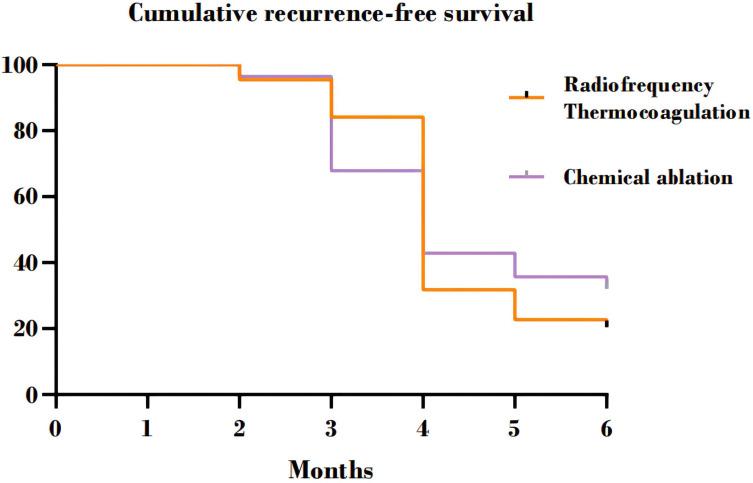
Pain scores at different follow-up times after surgery decreased in both groups compared to the preoperative period (P < 0.05). Postoperative T and PI were higher in both groups than preoperatively all (P < 0.05). The recurrence rate was higher in the R group than in the A group. Postoperative complications were observed in 13.6% and 25% of patients in groups R and A, respectively. Meanwhile, the postoperative quality of life improved in both groups, but the radiofrequency (RF) group was better than the alcohol group in terms of improvement in quality of life (P < 0.05).
CONCLUSION
Both CT-guided CTS and RFTC of the thoracic sympathetic nerve provided good treatment outcomes. However, the RF group was superior to the alcohol group in terms of complication rate and quality of life improvement.
目的
探讨计算机断层扫描(CT)引导下胸交感神经射频热凝术(RFTC)与化学切除术(CTS)治疗雷诺病所致疼痛的有效性和安全性。
方法
本回顾性研究纳入了2012年3月至2021年3月期间接受CTS或胸交感神经RFTC治疗的患者。酒精组(A组)有28例,射频组(R组)有44例。在不同时间点收集患者的视觉模拟评分(VAS),以及术前和术后的手指末端灌注指数(PI)和手部温度(T)。观察两组的治疗效果、术后复发率、并发症以及术后生活质量的改善情况。
结果
与术前相比,两组术后不同随访时间的疼痛评分均降低(P<0.05)。两组术后的T和PI均高于术前(P<0.05)。R组的复发率高于A组。R组和A组分别有13.6%和25%的患者出现术后并发症。同时,两组术后生活质量均有所改善,但射频(RF)组在生活质量改善方面优于酒精组(P<0.05)。
结论
CT引导下的胸交感神经CTS和RFTC均能提供良好的治疗效果。然而,RF组在并发症发生率和生活质量改善方面优于酒精组。



 Zotero 插件