
航天栖息地中与表面相关的微生物群落迁移。
Migration of surface-associated microbial communities in spaceflight habitats.
作者信息
Marra Daniele, Karapantsios Thodoris, Caserta Sergio, Secchi Eleonora, Holynska Malgorzata, Labarthe Simon, Polizzi Bastien, Ortega Sandra, Kostoglou Margaritis, Lasseur Christophe, Karapanagiotis Ioannis, Lecuyer Sigolene, Bridier Arnaud, Noirot-Gros Marie-Françoise, Briandet Romain
机构信息
Department of Chemical, Materials and Industrial Production Engineering (DICMaPi), University of Naples, Federico II, Piazzale Tecchio 80, 80125, Naples, Italy.
CEINGE, Advanced Biotechnologies, Via Gaetano Salvatore, 486, 80145, Naples, Italy.
出版信息
Biofilm. 2023 Feb 24;5:100109. doi: 10.1016/j.bioflm.2023.100109. eCollection 2023 Dec.
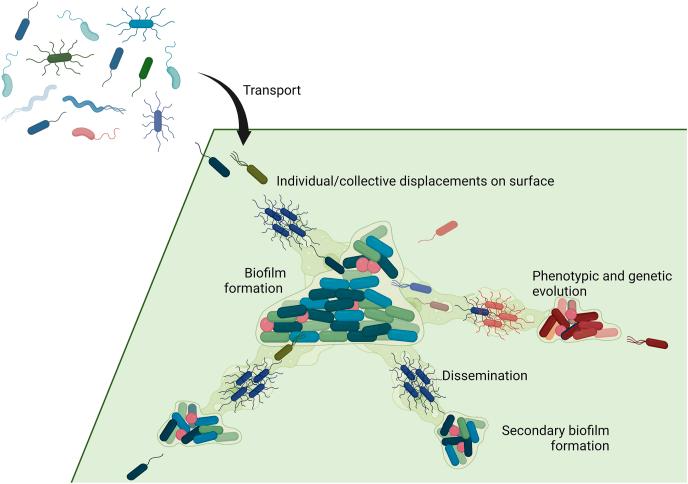
Astronauts are spending longer periods locked up in ships or stations for scientific and exploration spatial missions. The International Space Station (ISS) has been inhabited continuously for more than 20 years and the duration of space stays by crews could lengthen with the objectives of human presence on the moon and Mars. If the environment of these space habitats is designed for the comfort of astronauts, it is also conducive to other forms of life such as embarked microorganisms. The latter, most often associated with surfaces in the form of biofilm, have been implicated in significant degradation of the functionality of pieces of equipment in space habitats. The most recent research suggests that microgravity could increase the persistence, resistance and virulence of pathogenic microorganisms detected in these communities, endangering the health of astronauts and potentially jeopardizing long-duration manned missions. In this review, we describe the mechanisms and dynamics of installation and propagation of these microbial communities associated with surfaces (), as well as long-term processes of adaptation and evolution in these extreme environments (), with special reference to human health. We also discuss the means of control envisaged to allow a lasting cohabitation between these vibrant microscopic passengers and the astronauts.
宇航员在执行科学和探索太空任务时,会在飞船或空间站中被长时间禁闭。国际空间站(ISS)已经持续有人居住了20多年,随着人类在月球和火星上驻留目标的推进,宇航员在太空停留的时间可能会延长。如果这些太空栖息地的环境是为宇航员的舒适而设计的,那么它也有利于其他形式的生命,比如搭载的微生物。后者通常以生物膜的形式附着在表面,与太空栖息地中设备部件功能的显著退化有关。最新研究表明,微重力可能会增加这些群落中检测到的致病微生物的持久性、抗性和毒力,危及宇航员的健康,并可能危及长期载人任务。在这篇综述中,我们描述了这些与表面相关的微生物群落的形成和传播机制及动态(),以及在这些极端环境中的长期适应和进化过程(),特别提及对人类健康的影响。我们还讨论了为使这些充满活力的微观“乘客”与宇航员实现持久共存而设想的控制方法。

 Zotero 插件