
联合暴露于环境空气污染物、遗传风险与类风湿关节炎发病风险的关联:英国生物库中的前瞻性队列研究。
Association of Combined Exposure to Ambient Air Pollutants, Genetic Risk, and Incident Rheumatoid Arthritis: A Prospective Cohort Study in the UK Biobank.
机构信息
Department of Epidemiology and Biostatistics, School of Public Health, Anhui Medical University, Hefei, Anhui, China.
Inflammation and Immune Mediated Diseases Laboratory of Anhui Province, Hefei, Anhui, China.
出版信息
Environ Health Perspect. 2023 Mar;131(3):37008. doi: 10.1289/EHP10710. Epub 2023 Mar 13.
BACKGROUND
Evidence for a potential link between air pollution and rheumatoid arthritis (RA) is inconsistent, and the modified effect of genetic susceptibility on the relationship between air pollution and RA has not been well studied.
OBJECTIVE
Using a general population cohort from the UK Biobank, this study aimed to investigate the associations between various air pollutants and the risk of incident RA and to further estimate the impact of combined exposure to ambient air pollutants on the risk of developing RA under the modification effect of genetic predisposition.
METHODS
A total of 342,973 participants with completed genotyping data and who were free of RA at baseline were included in the study. An air pollution score was constructed by summing the concentrations of each pollutant weighted by the regression coefficients with RA from single-pollutant models to assess the combined effect of air pollutants, including particulate matter (PM) with diameters (), between 2.5 and (), and (), as well as nitrogen dioxide () and nitrogen oxides (). In addition, the polygenic risk score (PRS) of RA was calculated to characterize individual genetic risk. The Cox proportional hazard model was used to estimate hazard ratios (HRs) and 95% confidence intervals (95% CIs) of associations of single air pollutant, air pollution score, or PRS with incident RA.
RESULTS
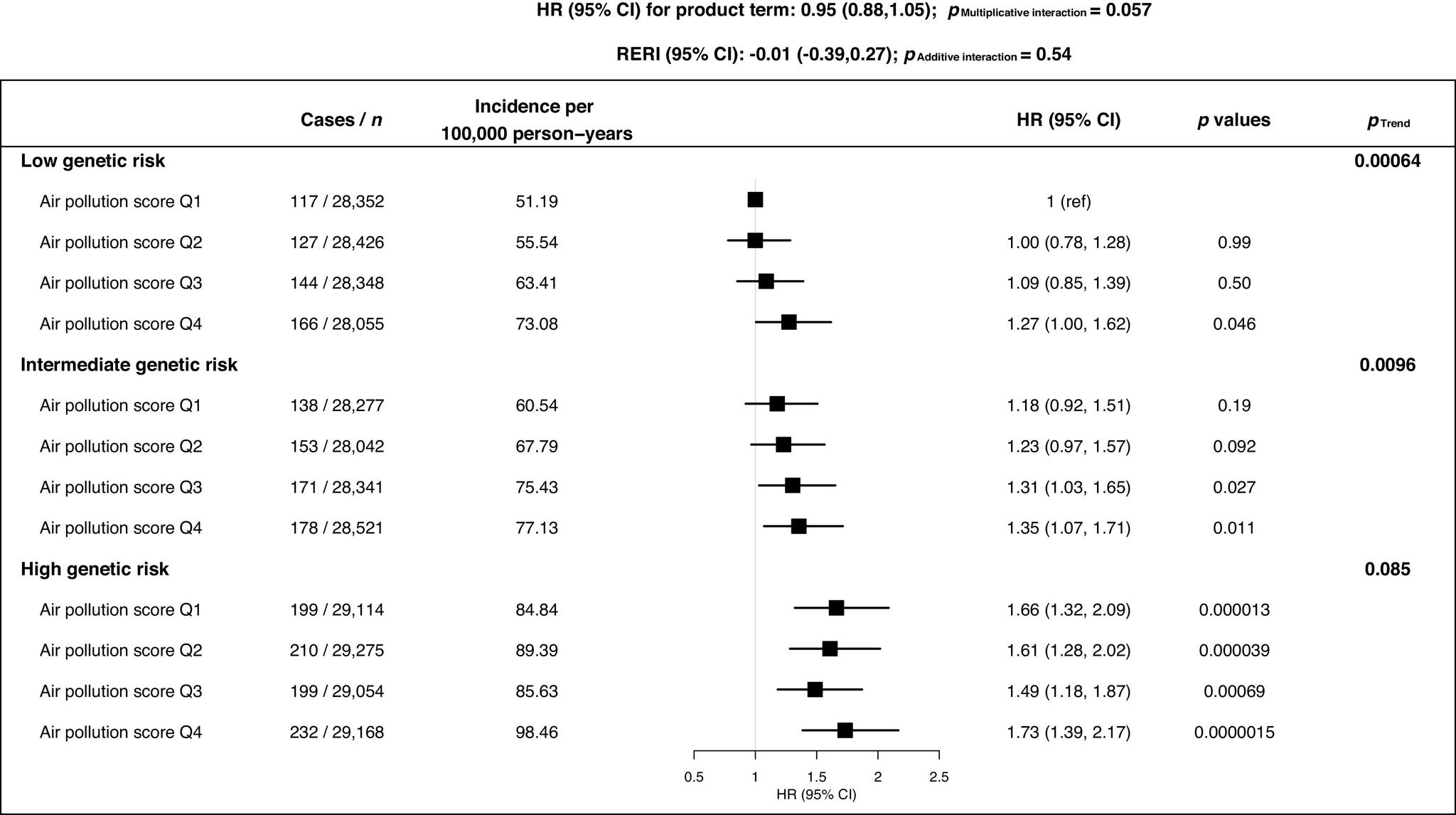
During a median follow-up time of 8.1 y, 2,034 incident events of RA were recorded. The HRs (95% CIs) of incident RA per interquartile range increment in , , , , and were 1.07 (1.01, 1.13), 1.00 (0.96, 1.04), 1.01 (0.96, 1.07), 1.03 (0.98, 1.09), and 1.07 (1.02, 1.12), respectively. We also found a positive exposure-response relationship between air pollution score and RA risk (). The HR (95% CI) of incident RA was 1.14 (1.00, 1.29) in the highest quartile group compared with the lowest quartile group of the air pollution score. Furthermore, the results of the combined effect of air pollution score and PRS on the RA risk showed that the risk of RA incidence in the highest genetic risk and air pollution score group was almost twice that of the lowest genetic risk and air pollution score group [incidence rate (IR) per 100,000 person-years: 98.46 vs. 51.19, and 1.73 (95% CI: 1.39, 2.17) vs. 1 (reference)], although no statistically significant interaction between the air pollution and genetic risk for incident RA was found ().
DISCUSSION
The results revealed that long-term combined exposure to ambient air pollutants might increase the risk of RA, particularly in those with high genetic risk. https://doi.org/10.1289/EHP10710.
背景
空气污染与类风湿关节炎(RA)之间潜在关联的证据并不一致,遗传易感性对空气污染与 RA 之间关系的修正作用也尚未得到充分研究。
目的
本研究旨在利用来自英国生物库的一般人群队列,调查各种空气污染物与新发 RA 风险之间的关联,并进一步估计在遗传易感性修饰作用下,环境空气污染物联合暴露对 RA 发病风险的影响。
方法
共纳入 342973 名完成基因分型且基线时无 RA 的参与者。通过将每个污染物的浓度乘以与单污染物模型中 RA 相关的回归系数来构建空气污染评分,以评估空气污染物(PM2.5、PM10、)、二氧化氮(NO2)和氮氧化物(NOx)的综合效应。此外,还计算了 RA 的多基因风险评分(PRS),以描述个体遗传风险。采用 Cox 比例风险模型估计单个空气污染物、空气污染评分或 PRS 与新发 RA 之间关联的风险比(HRs)和 95%置信区间(95%CI)。
结果
在中位数为 8.1 年的随访期间,共记录到 2034 例新发 RA 事件。与每四分位间距增加相关的新发 RA 的 HR(95%CI)分别为 1.07(1.01,1.13)、1.00(0.96,1.04)、1.01(0.96,1.07)、1.03(0.98,1.09)和 1.07(1.02,1.12)。我们还发现空气污染评分与 RA 风险之间存在正的暴露反应关系()。与空气污染评分最低四分位组相比,最高四分位组新发 RA 的 HR(95%CI)为 1.14(1.00,1.29)。此外,空气污染评分和 PRS 联合作用对 RA 发病风险的结果表明,遗传风险和空气污染评分最高组的 RA 发病率几乎是遗传风险和空气污染评分最低组的两倍[发病率(IR)/100000 人年:98.46 比 51.19,1.73(95%CI:1.39,2.17)比 1(参考)],尽管未发现空气污染与 RA 发病遗传风险之间存在统计学显著交互作用()。
讨论
结果表明,长期暴露于环境空气污染物可能会增加 RA 的发病风险,尤其是在遗传风险较高的人群中。

 Zotero 插件