
采用定性方法探索加拿大安大略省医学生和兽医学生对与抗生素耐药性相关的认知和沟通偏好。
Exploring medical and veterinary student perceptions and communication preferences related to antimicrobial resistance in Ontario, Canada using qualitative methods.
机构信息
Department of Population Medicine, Ontario Veterinary College, University of Guelph, N1G 2W1, Guelph, ON, Canada.
Centre for Food-borne, Environmental and Zoonotic Infectious Disease, Public Health Agency of Canada, N1H 7M7, Guelph, ON, Canada.
出版信息
BMC Public Health. 2023 Mar 13;23(1):483. doi: 10.1186/s12889-023-15193-x.
BACKGROUND
Antimicrobial resistance (AMR) threatens our ability to treat and prevent infectious diseases worldwide. A significant driver of AMR is antimicrobial use (AMU) in human and veterinary medicine. Therefore, education and awareness of AMR among antimicrobial prescribers is critical. Human and animal health professionals play important roles in the AMR issue, both as contributors to the emergence of AMR, and as potential developers and implementers of effective solutions. Studies have shown that engaging stakeholders prior to developing communication materials can increase relevance, awareness, and dissemination of research findings and communication materials. As future antimicrobial prescribers, medical and veterinary students' perspectives on AMR, as well as their preferences for future communication materials, are important. The first objective of this study was to explore medical and veterinary student perceptions and understanding of factors associated with emergence and spread of AMR. The second objective was to identify key messages, knowledge translation and transfer (KTT) methods, and dissemination strategies for communication of AMR information to these groups.
METHODS
Beginning in November 2018, focus groups were conducted with medical and veterinary students in Ontario, Canada. A semi-structured format, using standardized open-ended questions and follow-up probing questions was followed. Thematic analysis was used to identify and analyze patterns within the data.
RESULTS
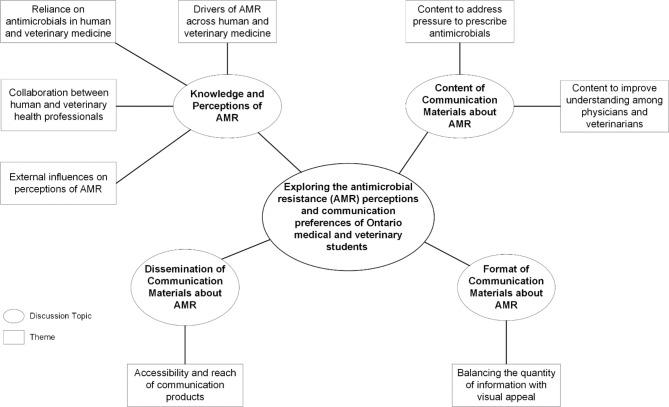
Analyses showed that students believed AMR to be an important global issue and identified AMU in food-producing animals and human medicine as the main drivers of AMR. Students also highlighted the need to address society's reliance on antimicrobials and the importance of collaboration between different sectors to effectively reduce the emergence and transmission of AMR. When assessing different communication materials, students felt that although infographics provide easily digestible information, other KTT materials such as fact sheets are better at providing more information without overwhelming the target audiences (e.g., professional or general public).
CONCLUSION
Overall, the study participants felt that AMR is an important issue and emphasized the need to develop different KTT tools for different audiences. This research will help inform the development of future communication materials, and support development of AMR-KTT tools tailored to the needs of different student and professional groups.
背景
抗菌药物耐药性(AMR)威胁着我们在全球范围内治疗和预防传染病的能力。AMR 的一个主要驱动因素是人类和兽医医学中的抗菌药物使用(AMU)。因此,抗菌药物处方者对抗菌药物耐药性的教育和认识至关重要。人类和动物卫生专业人员在 AMR 问题上发挥着重要作用,既是 AMR 出现的促成因素,也是有效解决方案的潜在开发者和执行者。研究表明,在开发传播材料之前让利益相关者参与进来,可以提高研究结果和传播材料的相关性、认识度和传播度。作为未来的抗菌药物处方者,医学生和兽医学生对抗菌药物耐药性的看法以及他们对未来传播材料的偏好是很重要的。本研究的第一个目标是探讨医学生和兽医学生对与 AMR 出现和传播相关因素的看法和理解。第二个目标是确定向这些群体传播 AMR 信息的关键信息、知识转化和转移(KTT)方法以及传播策略。
方法
从 2018 年 11 月开始,在加拿大安大略省对医学生和兽医学生进行了焦点小组讨论。采用半结构化格式,使用标准化的开放式问题和后续探查问题。采用主题分析来识别和分析数据中的模式。
结果
分析表明,学生们认为 AMR 是一个全球性的重要问题,并确定了食用动物和人类医学中的 AMU 是 AMR 的主要驱动因素。学生们还强调需要解决社会对抗生素的依赖,以及不同部门之间合作以有效减少 AMR 的出现和传播的重要性。在评估不同的传播材料时,学生们认为,虽然信息图提供了易于理解的信息,但其他 KTT 材料,如情况说明书,在向目标受众(如专业人员或普通公众)提供更多信息的同时,不会让他们感到不知所措。
结论
总的来说,研究参与者认为 AMR 是一个重要的问题,并强调需要为不同的受众开发不同的 KTT 工具。这项研究将有助于为未来的传播材料的开发提供信息,并支持开发针对不同学生和专业群体需求的 AMR-KTT 工具。
 Zotero 插件