
在资源匮乏环境下,HIV 感染者对 COVID-19 疫苗的犹豫:一项多中心研究的流行率、相关性和原因。
COVID-19 vaccine hesitancy among people living with HIV in a low-resource setting: A multi-center study of prevalence, correlates and reasons.
机构信息
Department of Medicine, Yobe State University Teaching Hospital, Damaturu, Nigeria.
Department of Medicine, Yobe State University Teaching Hospital, Damaturu, Nigeria.
出版信息
Vaccine. 2023 Apr 6;41(15):2476-2484. doi: 10.1016/j.vaccine.2023.02.056. Epub 2023 Feb 23.
BACKGROUND
Hesitancy to COVID-19 vaccine may worsen the burden of COVID-19 among people living with HIV (PLHIV), who are at a higher risk of COVID-19-related hospitalization and death, compared to HIV non-infected individuals. Therefore, we evaluate the predictors and reasons for COVID-19 vaccine hesitancy among unvaccinated PLHIV in six antiretroviral therapy (ART) clinics across northern Nigeria.
METHODOLOGY
In this cross-sectional study, conducted between October 2021 and February 2022 in six hospitals across two geopolitical regions of Nigeria, we utilized interviewer-administered questionnaires to assess COVID-19 vaccine hesitancy among a convenience sample of 790 eligible adult PLHIV. Hesitancy was defined as answering 'no' or 'maybe' to a question asking participants their willingness to accept the COVID-19 vaccine. A multivariate logistic regression model was used to estimate the adjusted odds ratio (aOR) and 95% confidence interval (CI) of the factors associated with COVID-19 vaccine hesitancy among PLHIV.
RESULTS
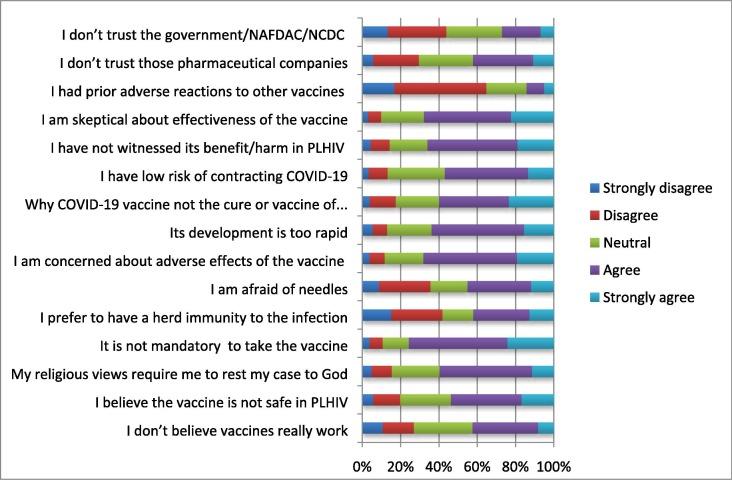
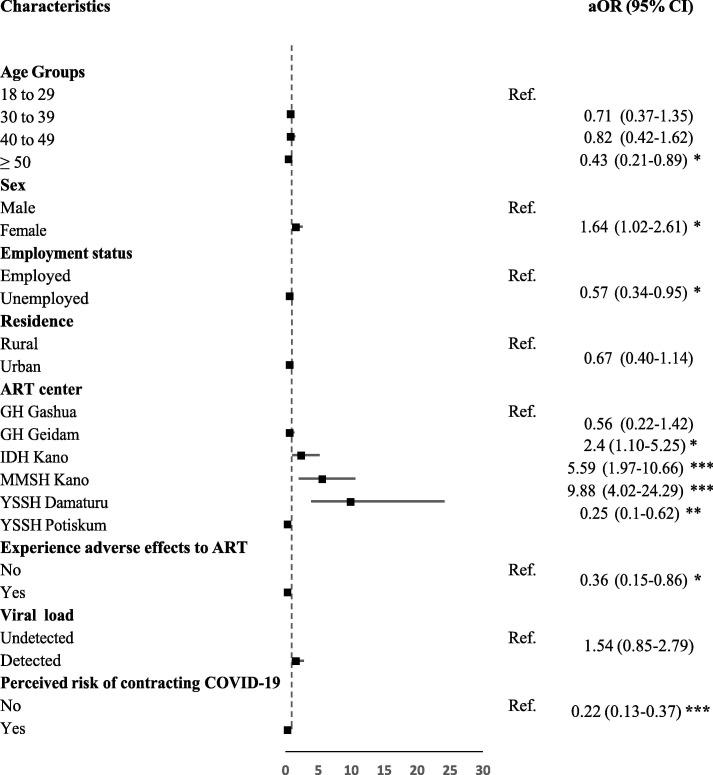
Of the total 660 unvaccinated participants included in the analysis (61.82% female, mean age [SD] of 39.76 [10.75]), 381 (57.72%) were hesitant to COVID-19 vaccine. Being 50 years and older (aOR: 0.43; 95% CI: 0.21-0.89), being unemployed (aOR: 0.57; 95% CI: 0.34-0.95), experiencing the adverse effects of ART (aOR: 0.36; 95% CI: 0.15-0.86), and perception of being at high risk of contracting COVID-19 (aOR: 0.22; 95% CI: 0.13-0.37) were associated with significantly lower odds of hesitancy. Conversely, being female (aOR: 1.64; 95% CI: 1.02-2.61) and attending ART clinics at state administrative capital cities (IIDH Kano [aOR: 2.40; 95% CI: 1.10-5.25], MMSH Kano [aOR: 5.59; 95% CI: 1.97-10.66], YSSH Damaturu [aOR: 9.88; 95% CI: 4.02-24.29] vs. GH Gashua) were associated with significantly higher odds of hesitancy. The most common reasons for hesitancy include fear of potential adverse effects, skepticism about vaccine efficacy, the rapid development of the COVID-19 vaccine, and the perceived lack of effort to develop a cure or vaccine for HIV/AIDS.
CONCLUSION
Interventions aimed at combating misperceptions and misinformation regarding the COVID-19 vaccination program may reduce the prevalence of COVID-19 vaccine hesitancy among unvaccinated PLHIV.
背景
由于对 COVID-19 疫苗的犹豫不决,艾滋病毒感染者(PLHIV)感染 COVID-19 的负担可能会加重,与未感染 HIV 的个体相比,他们感染 COVID-19 相关住院和死亡的风险更高。因此,我们评估了尼日利亚北部六家抗逆转录病毒治疗 (ART) 诊所中未接种 COVID-19 疫苗的 PLHIV 对 COVID-19 疫苗犹豫不决的预测因素和原因。
方法
在这项横断面研究中,我们于 2021 年 10 月至 2022 年 2 月在尼日利亚两个地缘政治区域的六家医院进行,利用访谈者管理的问卷评估了便利抽样的 790 名合格成年 PLHIV 对 COVID-19 疫苗的犹豫不决。犹豫不决的定义是回答“否”或“可能”来询问参与者是否愿意接受 COVID-19 疫苗。使用多变量逻辑回归模型来估计与 PLHIV 对 COVID-19 疫苗犹豫不决相关的因素的调整后优势比 (aOR) 和 95%置信区间 (CI)。
结果
在总共纳入分析的 660 名未接种疫苗的参与者中(61.82%为女性,平均年龄 [SD] 为 39.76 [10.75]),381 名(57.72%)对 COVID-19 疫苗犹豫不决。50 岁及以上(aOR:0.43;95%CI:0.21-0.89)、失业(aOR:0.57;95%CI:0.34-0.95)、经历过 ART 的不良反应(aOR:0.36;95%CI:0.15-0.86)以及认为自己有很高的感染 COVID-19 的风险(aOR:0.22;95%CI:0.13-0.37)与较低的犹豫不决几率显著相关。相反,女性(aOR:1.64;95%CI:1.02-2.61)和在州行政首府的 ART 诊所就诊(IIDH Kano [aOR:2.40;95%CI:1.10-5.25]、MMSH Kano [aOR:5.59;95%CI:1.97-10.66]、YSSH Damaturu [aOR:9.88;95%CI:4.02-24.29] 与 GH Gashua)与较高的犹豫不决几率显著相关。犹豫不决的最常见原因包括对潜在不良反应的恐惧、对疫苗有效性的怀疑、COVID-19 疫苗的快速开发以及对 HIV/AIDS 缺乏研发治愈或疫苗的看法。
结论
针对 COVID-19 疫苗接种计划的误解和错误信息的干预措施可能会降低未接种 COVID-19 疫苗的 PLHIV 对 COVID-19 疫苗犹豫不决的比例。
 Zotero 插件