
在蛋白质生物合成过程中丙氨酰-tRNA 合成酶和一个手性校对因子的对映选择性的设计原则和功能基础。
Design principles and functional basis of enantioselectivity of alanyl-tRNA synthetase and a chiral proofreader during protein biosynthesis.
机构信息
CSIR-Centre for Cellular and Molecular Biology (CSIR-CCMB), Hyderabad, Telangana 500007, India.
Academy of Scientific and Innovative Research (AcSIR), Ghaziabad, Uttar Pradesh 201002, India.
出版信息
Nucleic Acids Res. 2023 Apr 24;51(7):3327-3340. doi: 10.1093/nar/gkad205.
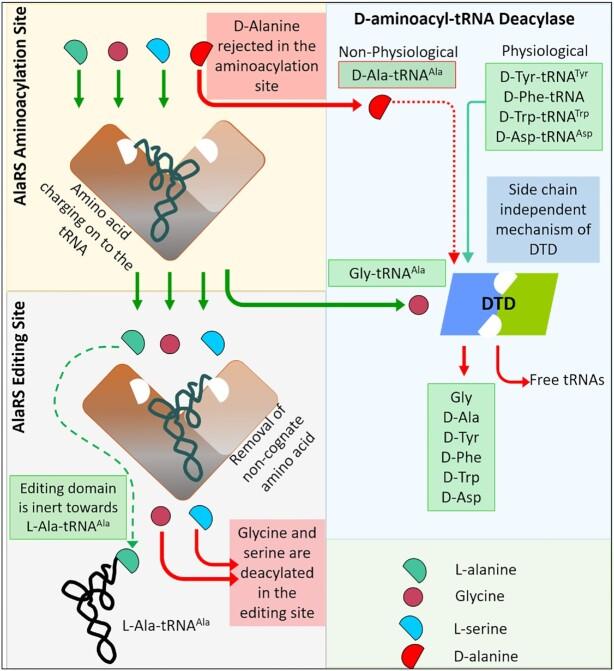
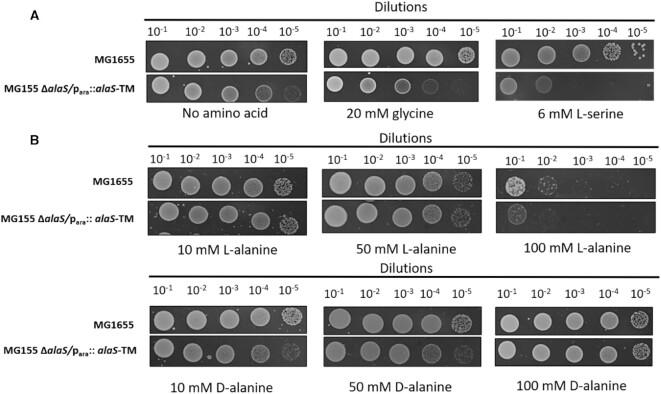
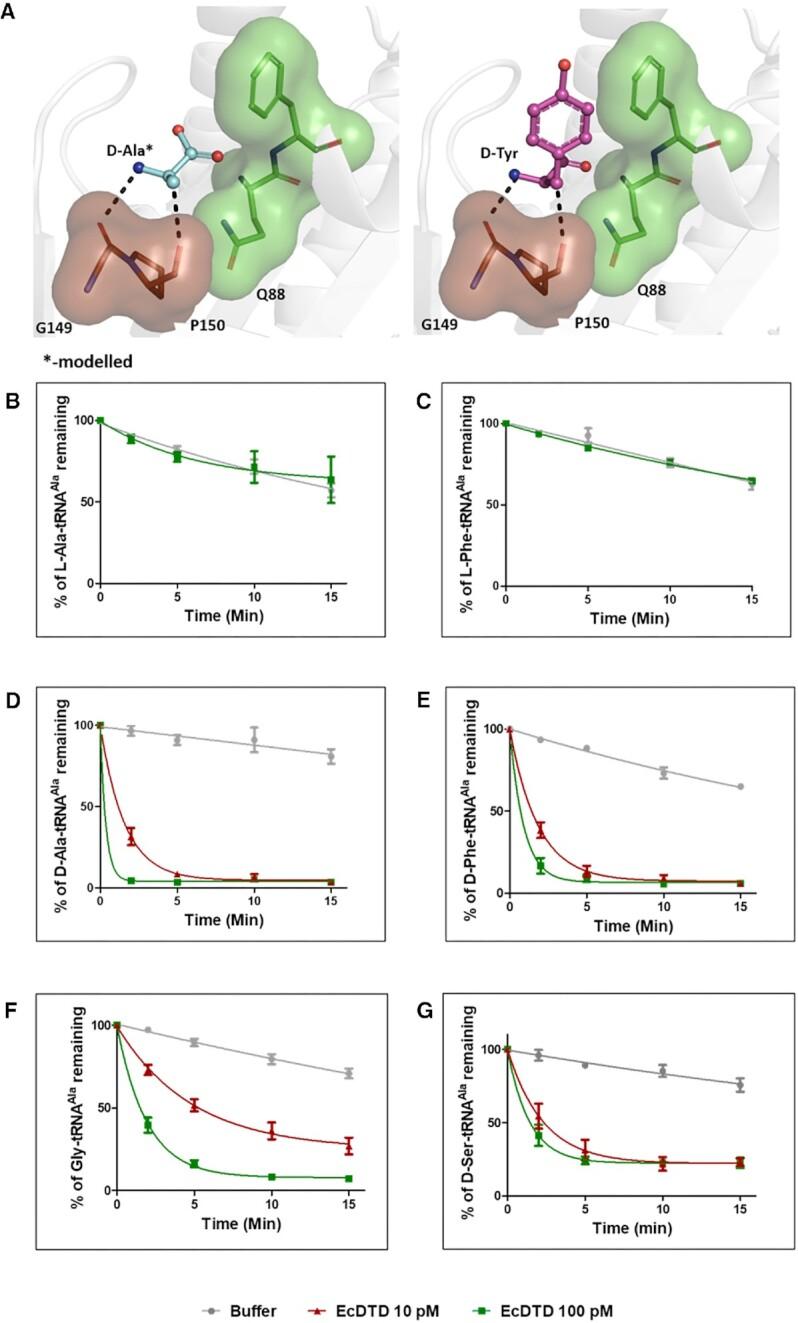
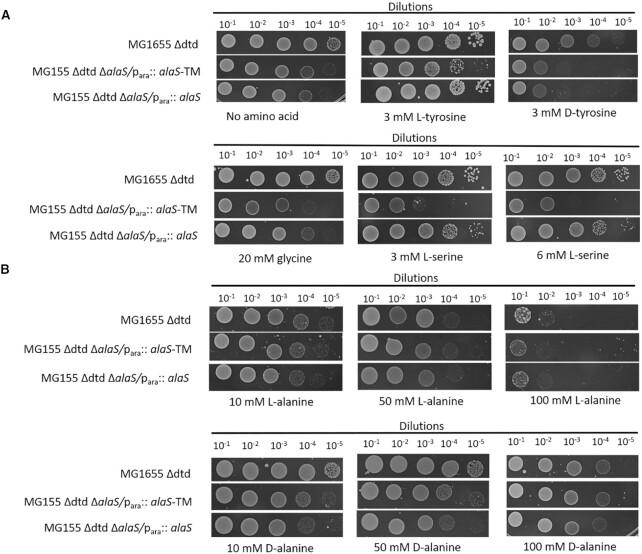
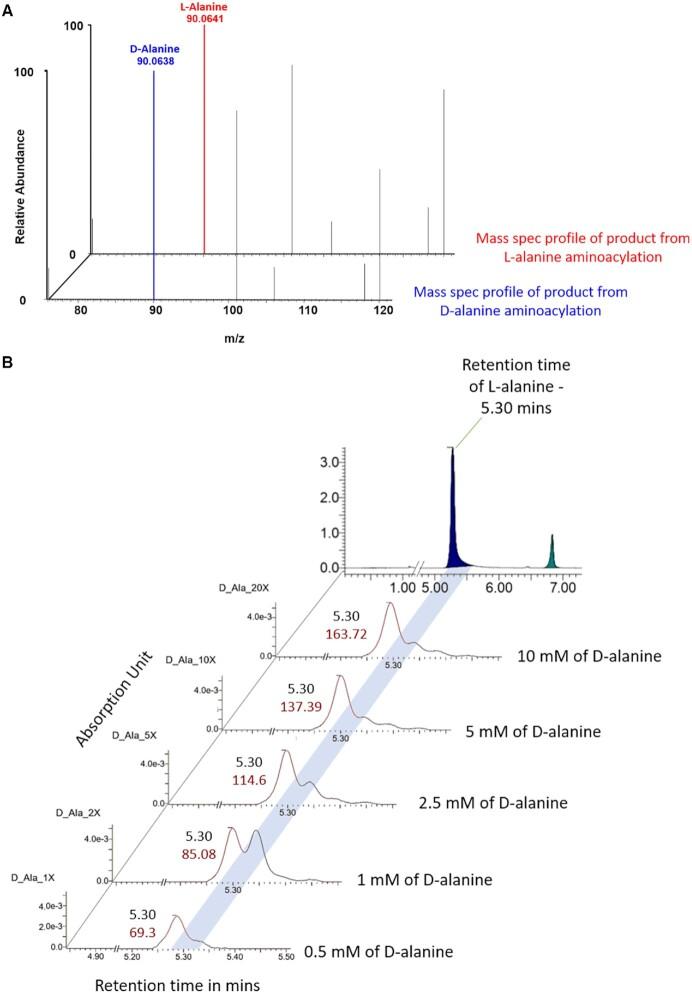
Homochirality of the cellular proteome is attributed to the L-chiral bias of the translation apparatus. The chiral specificity of enzymes was elegantly explained using the 'four-location' model by Koshland two decades ago. In accordance with the model, it was envisaged and noted that some aminoacyl-tRNA synthetases (aaRS) that charge larger amino acids are porous to D-amino acids. However, a recent study showed that alanyl-tRNA synthetase (AlaRS) can mischarge D-alanine and that its editing domain, but not the universally present D-aminoacyl-tRNA deacylase (DTD), is responsible for correcting the chirality-based error. Here, using in vitro and in vivo data coupled with structural analysis, we show that AlaRS catalytic site is a strict D-chiral rejection system and therefore does not activate D-alanine. It obviates the need for AlaRS editing domain to be active against D-Ala-tRNAAla and we show that it is indeed the case as it only corrects L-serine and glycine mischarging. We further provide direct biochemical evidence showing activity of DTD on smaller D-aa-tRNAs that corroborates with the L-chiral rejection mode of action proposed earlier. Overall, while removing anomalies in the fundamental recognition mechanisms, the current study further substantiates how chiral fidelity is perpetuated during protein biosynthesis.
细胞蛋白质组的手性专一性归因于翻译装置的 L-手性偏向。二十年前,Koshland 用“四定位”模型优雅地解释了酶的手性特异性。根据该模型,人们设想并注意到,一些电荷较大氨基酸的氨酰-tRNA 合成酶(aaRS)对 D-氨基酸具有通透性。然而,最近的一项研究表明,丙氨酰-tRNA 合成酶(AlaRS)可以错误地给 D-丙氨酸充电,并且负责纠正基于手性的错误的是其编辑结构域,而不是普遍存在的 D-氨基酸酰基-tRNA 脱氨酶(DTD)。在这里,我们使用体外和体内数据结合结构分析,表明 AlaRS 催化位点是一个严格的 D-手性排斥系统,因此不会激活 D-丙氨酸。这排除了 AlaRS 编辑结构域需要针对 D-Ala-tRNAAla 发挥作用的必要性,我们表明情况确实如此,因为它只纠正 L-丝氨酸和甘氨酸的错误电荷。我们进一步提供了直接的生化证据,证明 DTD 对较小的 D-aa-tRNAs 具有活性,这与之前提出的 L-手性排斥作用模式相符。总的来说,尽管消除了基本识别机制中的异常,但本研究进一步证实了在蛋白质生物合成过程中如何保持手性保真度。


 Zotero 插件