
一项针对墨西哥和冰岛女性的研究中的感知压力与头发皮质醇浓度
Perceived stress and hair cortisol concentration in a study of Mexican and Icelandic women.
作者信息
Lynch Rebekka, Flores-Torres Mario H, Hinojosa Gabriela, Aspelund Thor, Hauksdóttir Arna, Kirschbaum Clemens, Catzin-Kuhlmann Andres, Lajous Martín, Valdimarsdottir Unnur
机构信息
Centre of Public Health Sciences, University of Iceland, Reykjavik, Iceland.
Center for Research on Population Health, National Institute of Public Health, Mexico City, Mexico.
出版信息
PLOS Glob Public Health. 2022 Aug 3;2(8):e0000571. doi: 10.1371/journal.pgph.0000571. eCollection 2022.
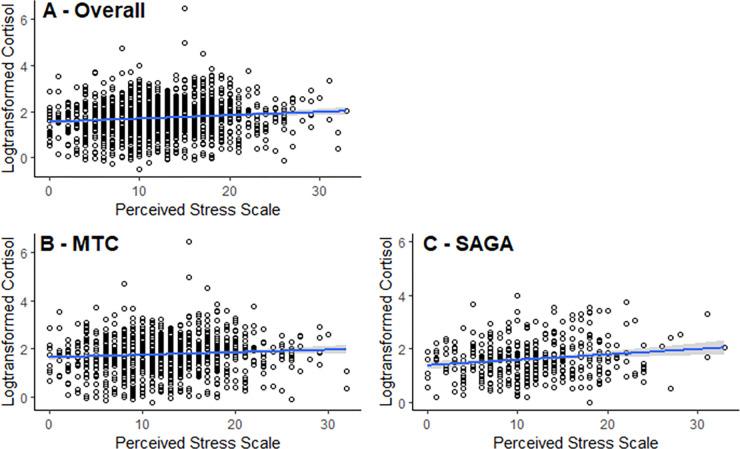
Hair cortisol concentration (HCC) represent a potential biomarker of chronic psychological stress. Previous studies exploring the association between perceived stress and HCC have been limited to relatively small and selected populations. We collected hair samples from 881 women from the Mexican Teachers' Cohort (MTC) and 398 women from the Icelandic SAGA pilot-cohort following identical protocols. HCC was quantified using liquid chromatography coupled with tandem mass spectrometry. The self-reported Perceived Stress Scale (PSS, 10 and 4 item, range 0-40 and 0-16) was used to assess psychological stress. We conducted multivariable linear regression analyses to assess the association between perceived stress and log-transformed HCC in the combined sample and in each cohort separately. MTC participants had slightly higher HCC and PSS scores than SAGA participants (median HCC 6.0pg/mg vs. 4.7pg/mg and mean PSS-10 score 12.4 vs. 11.7, respectively). After adjusting for sociodemographic factors and health behaviors, we observed a 1.4% (95% CI 0.6, 2.1) increase in HCC for each unit increase in the PSS-10 score in the combined sample. Furthermore, PSS-10 quintiles were associated with a 24.3% (95% CI 8.4, 42.6, mean logHCC 1.8 vs 1.6) increase in HCC when comparing the highest to the lowest quintile, after multivariable adjustment. Similar results were obtained when we analyzed each cohort separately and when using the PSS-4. Despite relatively small absolute differences, an association between perceived stress and HCC was found in a sample of women from two diverse geographical and cultural backgrounds supporting the hypothesis that HCC is a viable biomarker in studies of chronic psychological stress.
头发皮质醇浓度(HCC)是慢性心理压力的一种潜在生物标志物。以往探索感知压力与HCC之间关联的研究仅限于相对较小的特定人群。我们按照相同方案,从墨西哥教师队列(MTC)的881名女性和冰岛SAGA试点队列的398名女性中收集了头发样本。使用液相色谱-串联质谱法定量HCC。采用自我报告的感知压力量表(PSS,10项和4项版本,范围分别为0 - 40和0 - 16)评估心理压力。我们进行了多变量线性回归分析,以分别评估合并样本及每个队列中感知压力与对数转换后的HCC之间的关联。MTC参与者的HCC和PSS得分略高于SAGA参与者(HCC中位数分别为6.0pg/mg和4.7pg/mg,PSS - 10平均得分分别为12.4和11.7)。在调整社会人口学因素和健康行为后,我们观察到合并样本中PSS - 10得分每增加一个单位,HCC增加1.4%(95%CI 0.6, 2.1)。此外,在多变量调整后,比较最高与最低五分位数时,PSS - 10五分位数与HCC增加24.3%(95%CI 8.4, 42.6,平均logHCC 1.8对1.6)相关。当我们分别分析每个队列以及使用PSS - 4时,得到了类似结果。尽管绝对差异相对较小,但在来自两个不同地理和文化背景的女性样本中发现了感知压力与HCC之间的关联,支持了HCC是慢性心理压力研究中一种可行生物标志物的假设。

 Zotero 插件