
运用马尔可夫链物质流分析评估全球塑料垃圾管理系统。
Evaluating the Global Plastic Waste Management System with Markov Chain Material Flow Analysis.
作者信息
Smith Elijah, Bilec Melissa M, Khanna Vikas
机构信息
Department of Industrial Engineering, University of Pittsburgh, 3700 O'Hara Street, 1025 Benedum Hall, Pittsburgh, Pennsylvania15261, United States.
Department of Civil and Environmental Engineering, University of Pittsburgh, 3700 O'Hara Street, 742 Benedum Hall, Pittsburgh, Pennsylvania15261, United States.
出版信息
ACS Sustain Chem Eng. 2023 Jan 30;11(6):2055-2065. doi: 10.1021/acssuschemeng.2c04270. eCollection 2023 Feb 13.
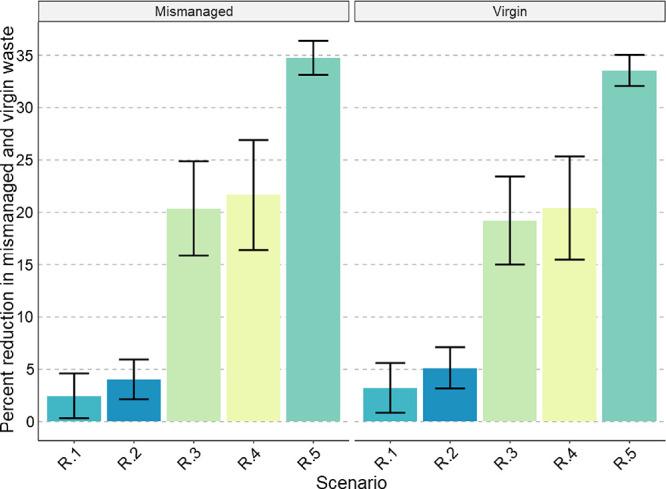
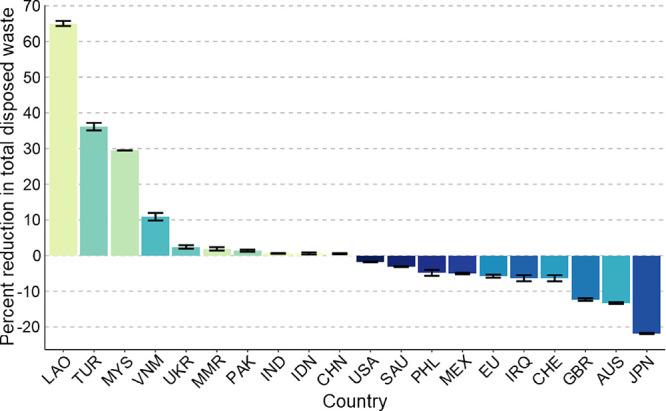
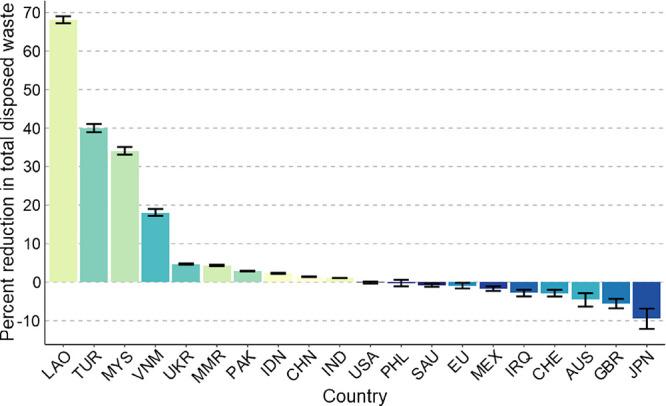
We present a global Markov chain-based material flow analysis of plastic waste of all types to estimate global virgin waste generation and waste mismanagement rates. We model nine alternative scenarios related to the elimination of plastic waste trade and improvements at various stages of the recycling chain, including "limitless" recycling promised by certain new chemical recycling technologies. We found that the elimination of trade increased global mismanagement when displaced waste was disposed but decreased mismanagement when it was instead recycled. Recycling scenarios showed little benefit for limitless recycling without prior increases in collection rates, which are currently the main constraint in the recycling chain. The most ambitious scenario only led to a 34% decrease in virgin waste generation. While significant, this implies that, given our current 40% mismanagement rate and 2050 forecasts of waste generation, landfilling and incineration capacity must increase 2.5-fold in addition to these extreme recycling targets to eliminate waste mismanagement. These results highlight the requirement for waste exporters to increase domestic recycling capacity as trade restrictions become tighter and express the urgent global need for alternative waste reduction interventions in addition to recycling.
我们对所有类型的塑料垃圾进行了基于全球马尔可夫链的物质流分析,以估算全球原生垃圾产生量和垃圾管理不善率。我们对九种与消除塑料垃圾贸易以及回收链各阶段改进相关的替代情景进行了建模,包括某些新型化学回收技术所承诺的“无限”回收。我们发现,消除贸易在被替代的垃圾被处置时会增加全球管理不善情况,但在其被回收利用时则会减少管理不善情况。回收情景表明,在未事先提高回收率的情况下,“无限”回收几乎没有益处,而回收率目前是回收链中的主要制约因素。最雄心勃勃的情景仅使原生垃圾产生量减少了34%。虽然这一降幅很大,但这意味着,鉴于我们目前40%的管理不善率以及对2050年垃圾产生量的预测,除了这些极端的回收目标外,填埋和焚烧能力还必须增加2.5倍,才能消除垃圾管理不善的情况。这些结果凸显了随着贸易限制日益严格,垃圾出口国提高国内回收能力的必要性,并表明除了回收利用之外,全球迫切需要采取其他减少垃圾的干预措施。


 Zotero 插件