
革兰氏阴性菌和脂多糖作为糖尿病足发生的危险因素。
Gram-Negative Bacteria and Lipopolysaccharides as Risk Factors for the Occurrence of Diabetic Foot.
机构信息
Department of Endocrinology and Metabolism, Nanfang Hospital, Southern Medical University, Guangzhou 510515, China.
School of Public Health, Southern Medical University, Guangzhou 510515, China.
出版信息
J Clin Endocrinol Metab. 2023 Sep 18;108(10):2604-2614. doi: 10.1210/clinem/dgad178.
CONTEXT
Imbalance of the skin microbial community could impair skin immune homeostasis and thus trigger skin lesions. Dysbiosis of skin microbiome may be involved in the early pathogenesis of diabetic foot (DF). However, the potential mechanism remains unclear.
OBJECTIVE
To investigate the dynamic composition and function of the foot skin microbiome with risk stratification for DF and assess whether dysbiosis of the skin microbiome induces diabetic skin lesions.
METHODS
We enrolled 90 consecutive subjects who were divided into 5 groups based on DF risk stratification: very low, low, moderate, and high risk for ulcers and a healthy control group. Integrated analysis of 16S ribosomal RNA and metagenomic sequencing of cotton swab samples was applied to identify the foot skin microbiome composition and functions in subjects. Then a mouse model of microbiota transplantation was used to evaluate the effects of the skin microbiome on diabetic skin lesions.
RESULTS
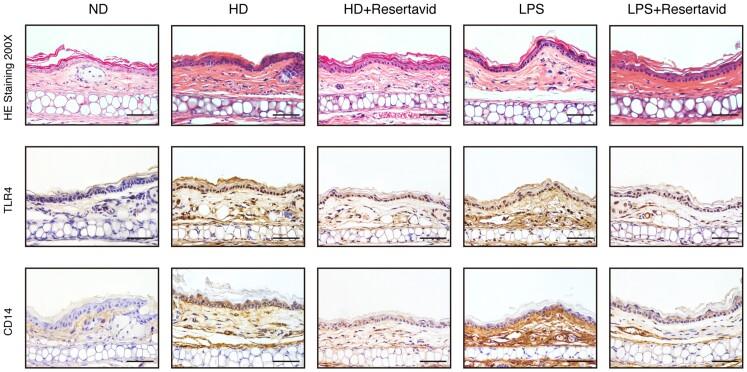
The results demonstrated that, with the progression of diabetic complications, the proportion of gram-negative bacteria in plantar skin increased. At the species level, metagenome sequencing analyses showed Moraxella osloensis to be a representative core strain in the high-risk group. The major microbial metabolites affecting diabetic skin lesions were increased amino acid metabolites, and antibiotic resistance genes in microorganisms were abundant. Skin microbiota from high-risk patients induced more inflammatory cell infiltration, similar to the lipopolysaccharide (LPS)-stimulated response, which was inhibited by Toll-like receptor 4 (TLR4) antagonists.
CONCLUSIONS
The skin microbiome in patients with diabetes undergoes dynamic changes at taxonomic and functional levels with the progression of diabetic complications. The increase in gram-negative bacteria on the skin surface through LPS-TLR4 signal transduction could induce inflammatory response in early diabetic skin lesions.
背景
皮肤微生物群落失衡可能会破坏皮肤免疫稳态,从而引发皮肤损伤。皮肤微生物组的失调可能与糖尿病足(DF)的早期发病机制有关。然而,其潜在机制尚不清楚。
目的
研究具有 DF 风险分层的足部皮肤微生物组的动态组成和功能,并评估皮肤微生物组失调是否会引发糖尿病皮肤损伤。
方法
我们纳入了 90 例连续患者,根据 DF 风险分层将其分为 5 组:溃疡的极低、低、中、高风险和健康对照组。应用 16S 核糖体 RNA 和棉拭子样本的宏基因组测序综合分析来鉴定受试者足部皮肤微生物组的组成和功能。然后使用微生物群移植小鼠模型来评估皮肤微生物组对糖尿病皮肤损伤的影响。
结果
结果表明,随着糖尿病并发症的进展,足底皮肤中革兰氏阴性菌的比例增加。在种水平上,宏基因组测序分析显示莫拉氏菌(osloensis)是高危组的代表性核心菌株。影响糖尿病皮肤损伤的主要微生物代谢物是氨基酸代谢物增加,微生物中的抗生素耐药基因丰富。来自高危患者的皮肤微生物群会引起更多的炎症细胞浸润,类似于脂多糖(LPS)刺激反应,该反应可被 Toll 样受体 4(TLR4)拮抗剂抑制。
结论
糖尿病患者的皮肤微生物组在糖尿病并发症进展过程中在分类和功能水平上发生动态变化。通过 LPS-TLR4 信号转导,皮肤表面革兰氏阴性菌的增加可能会引发早期糖尿病皮肤损伤的炎症反应。


 Zotero 插件