
细胞氧化还原系统、氧气和鞘脂信号的交叉调节
Cross-Regulation of the Cellular Redox System, Oxygen, and Sphingolipid Signalling.
作者信息
Huwiler Andrea, Beck Karl-Friedrich, Pfeilschifter Josef
机构信息
Institute of Pharmacology, University of Bern, Inselspital INO-F, CH-3010 Bern, Switzerland.
Institute of General Pharmacology and Toxicology, Goethe University Frankfurt am Main, Theodor-Stern Kai 7, D-60590 Frankfurt am Main, Germany.
出版信息
Metabolites. 2023 Mar 14;13(3):426. doi: 10.3390/metabo13030426.
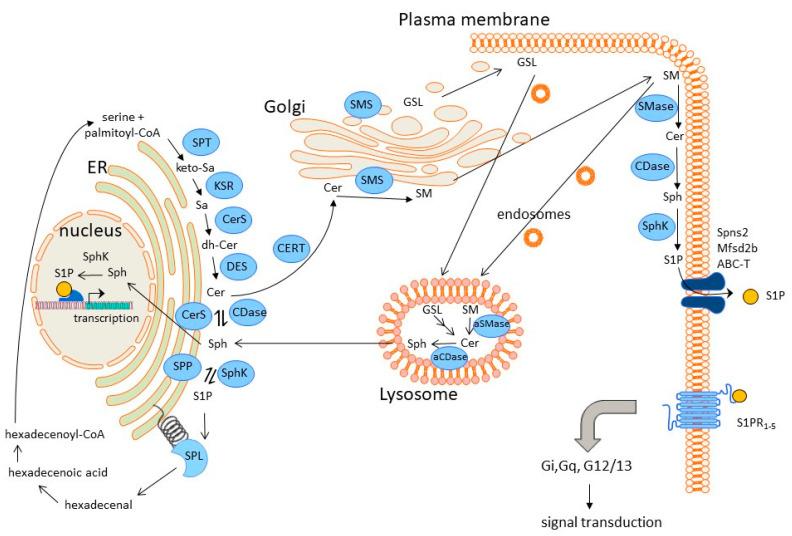
Redox-active mediators are now appreciated as powerful molecules to regulate cellular dynamics such as viability, proliferation, migration, cell contraction, and relaxation, as well as gene expression under physiological and pathophysiological conditions. These molecules include the various reactive oxygen species (ROS), and the gasotransmitters nitric oxide (NO), carbon monoxide (CO), and hydrogen sulfide (HS). For each of these molecules, direct targets have been identified which transmit the signal from the cellular redox state to a cellular response. Besides these redox mediators, various sphingolipid species have turned out as highly bioactive with strong signalling potential. Recent data suggest that there is a cross-regulation existing between the redox mediators and sphingolipid molecules that have a fundamental impact on a cell's fate and organ function. This review will summarize the effects of the different redox-active mediators on sphingolipid signalling and metabolism, and the impact of this cross-talk on pathophysiological processes. The relevance of therapeutic approaches will be highlighted.
氧化还原活性介质现在被认为是调节细胞动力学的强大分子,如细胞活力、增殖、迁移、细胞收缩和舒张,以及在生理和病理生理条件下的基因表达。这些分子包括各种活性氧(ROS),以及气体信号分子一氧化氮(NO)、一氧化碳(CO)和硫化氢(HS)。对于这些分子中的每一种,都已经确定了直接靶点,这些靶点将信号从细胞氧化还原状态传递到细胞反应。除了这些氧化还原介质外,各种鞘脂类物质也被证明具有高度生物活性和强大的信号传导潜力。最近的数据表明,氧化还原介质和鞘脂分子之间存在交叉调节,这对细胞命运和器官功能具有根本性影响。本综述将总结不同氧化还原活性介质对鞘脂信号传导和代谢的影响,以及这种相互作用对病理生理过程的影响。还将强调治疗方法的相关性。


 Zotero 插件