
从动物运动数据中推导空间明确的直接和间接相互作用网络。
Deriving spatially explicit direct and indirect interaction networks from animal movement data.
作者信息
Yang Anni, Wilber Mark Q, Manlove Kezia R, Miller Ryan S, Boughton Raoul, Beasley James, Northrup Joseph, VerCauteren Kurt C, Wittemyer George, Pepin Kim
机构信息
Department of Geography and Environmental Sustainability University of Oklahoma Oklahoma Norman USA.
Department of Fish, Wildlife and Conservation Biology Colorado State University Colorado Fort Collins USA.
出版信息
Ecol Evol. 2023 Mar 26;13(3):e9774. doi: 10.1002/ece3.9774. eCollection 2023 Mar.
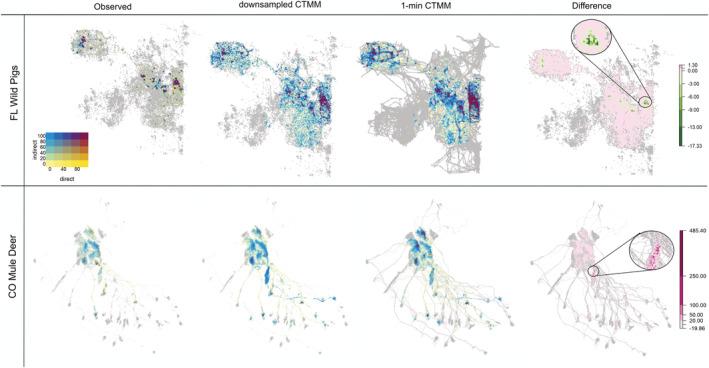
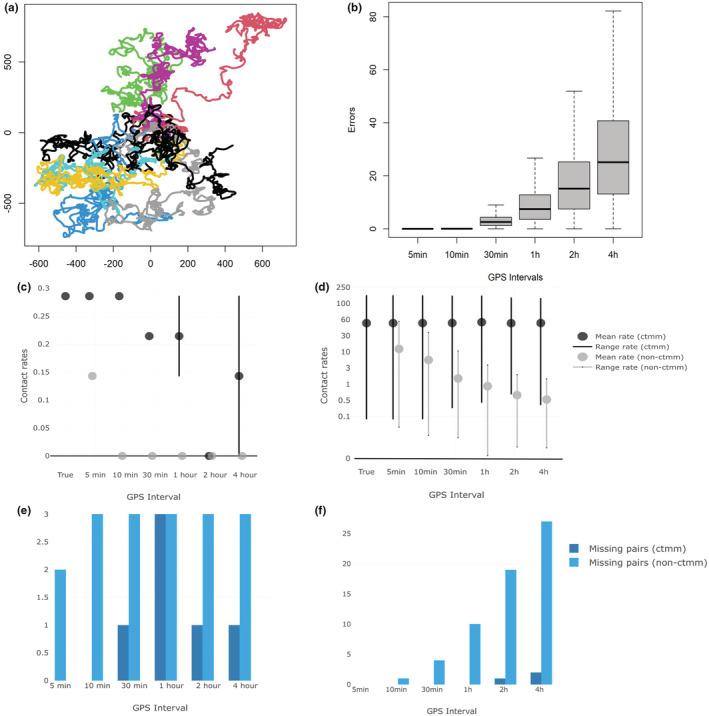
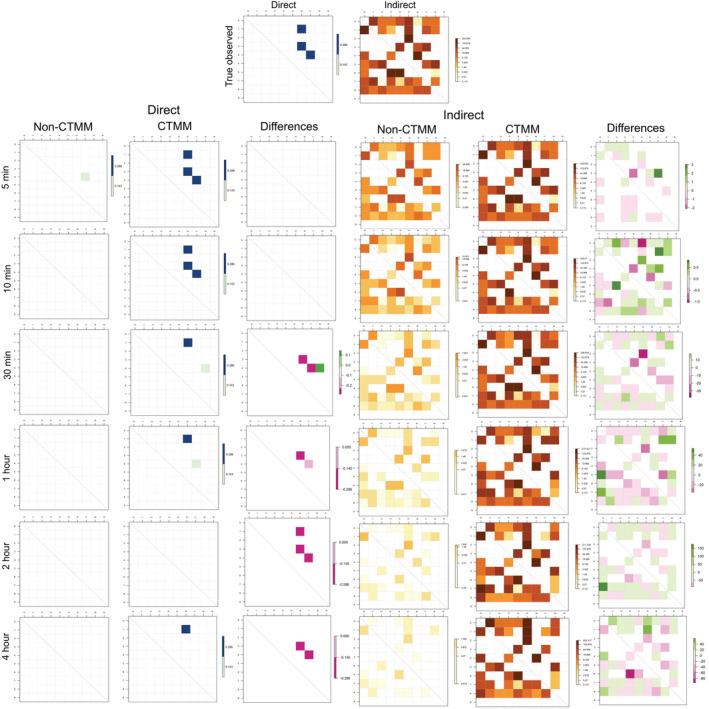
Quantifying spatiotemporally explicit interactions within animal populations facilitates the understanding of social structure and its relationship with ecological processes. Data from animal tracking technologies (Global Positioning Systems ["GPS"]) can circumvent longstanding challenges in the estimation of spatiotemporally explicit interactions, but the discrete nature and coarse temporal resolution of data mean that ephemeral interactions that occur between consecutive GPS locations go undetected. Here, we developed a method to quantify individual and spatial patterns of interaction using continuous-time movement models (CTMMs) fit to GPS tracking data. We first applied CTMMs to infer the full movement trajectories at an arbitrarily fine temporal scale before estimating interactions, thus allowing inference of interactions occurring between observed GPS locations. Our framework then infers indirect interactions-individuals occurring at the same location, but at different times-while allowing the identification of indirect interactions to vary with ecological context based on CTMM outputs. We assessed the performance of our new method using simulations and illustrated its implementation by deriving disease-relevant interaction networks for two behaviorally differentiated species, wild pigs () that can host African Swine Fever and mule deer () that can host chronic wasting disease. Simulations showed that interactions derived from observed GPS data can be substantially underestimated when temporal resolution of movement data exceeds 30-min intervals. Empirical application suggested that underestimation occurred in both interaction rates and their spatial distributions. CTMM-Interaction method, which can introduce uncertainties, recovered majority of true interactions. Our method leverages advances in movement ecology to quantify fine-scale spatiotemporal interactions between individuals from lower temporal resolution GPS data. It can be leveraged to infer dynamic social networks, transmission potential in disease systems, consumer-resource interactions, information sharing, and beyond. The method also sets the stage for future predictive models linking observed spatiotemporal interaction patterns to environmental drivers.
量化动物种群内时空明确的相互作用有助于理解社会结构及其与生态过程的关系。来自动物追踪技术(全球定位系统["GPS"])的数据可以规避在估计时空明确的相互作用方面长期存在的挑战,但数据的离散性质和粗略的时间分辨率意味着在连续GPS位置之间发生的短暂相互作用未被检测到。在这里,我们开发了一种方法,使用适合GPS追踪数据的连续时间运动模型(CTMMs)来量化个体和空间相互作用模式。我们首先应用CTMMs在任意精细的时间尺度上推断完整的运动轨迹,然后再估计相互作用,从而能够推断在观测到的GPS位置之间发生的相互作用。我们的框架随后推断间接相互作用——个体在同一位置但在不同时间出现——同时允许根据CTMM输出确定间接相互作用随生态背景的变化。我们使用模拟评估了我们新方法的性能,并通过推导两种行为有差异的物种的疾病相关相互作用网络来说明其应用,这两种物种分别是可携带非洲猪瘟的野猪()和可携带慢性消耗病的骡鹿()。模拟表明,当运动数据的时间分辨率超过30分钟间隔时,从观测到的GPS数据中得出的相互作用可能会被大幅低估。实证应用表明,相互作用率及其空间分布均出现了低估情况。CTMM-相互作用方法虽然可能会引入不确定性,但恢复了大部分真实的相互作用。我们的方法利用运动生态学的进展,从较低时间分辨率的GPS数据中量化个体之间精细尺度的时空相互作用。它可用于推断动态社会网络、疾病系统中的传播潜力、消费者-资源相互作用、信息共享等等。该方法还为未来将观测到的时空相互作用模式与环境驱动因素联系起来的预测模型奠定了基础。


 Zotero 插件