
椎间盘退变及其如何导致腰痛。
Intervertebral disc degeneration and how it leads to low back pain.
作者信息
Diwan Ashish D, Melrose James
机构信息
Spine Service, Department of Orthopaedic Surgery, St. George & Sutherland Clinical School University of New South Wales Sydney New South Wales Australia.
Raymond Purves Bone and Joint Research Laboratory Kolling Institute, Sydney University Faculty of Medicine and Health, Northern Sydney Area Health District, Royal North Shore Hospital Sydney New South Wales Australia.
出版信息
JOR Spine. 2022 Nov 14;6(1):e1231. doi: 10.1002/jsp2.1231. eCollection 2023 Mar.
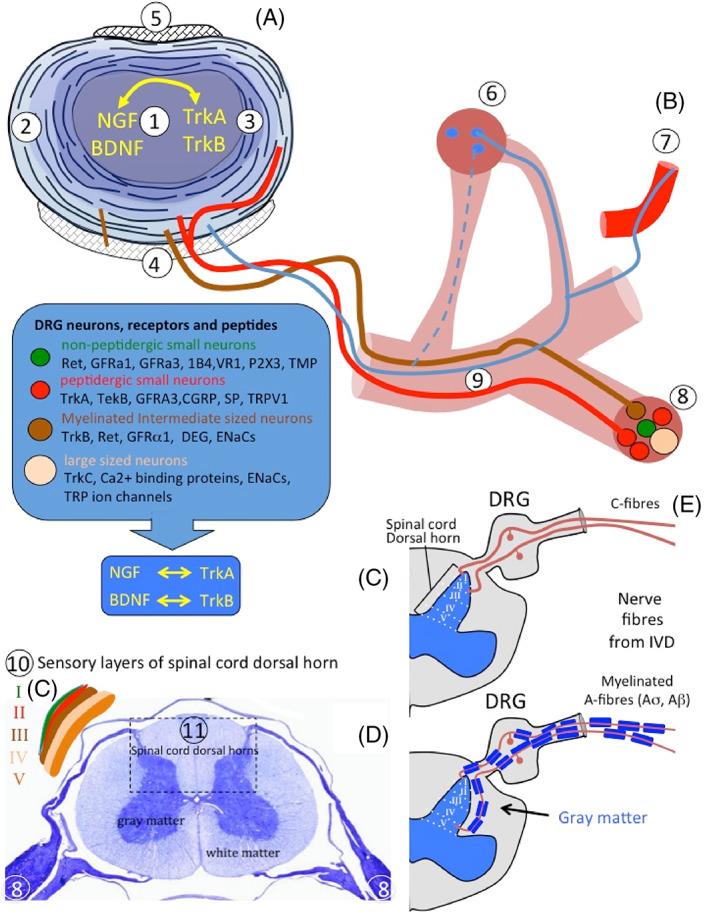
The purpose of this review was to evaluate data generated by animal models of intervertebral disc (IVD) degeneration published in the last decade and show how this has made invaluable contributions to the identification of molecular events occurring in and contributing to pain generation. IVD degeneration and associated spinal pain is a complex multifactorial process, its complexity poses difficulties in the selection of the most appropriate therapeutic target to focus on of many potential candidates in the formulation of strategies to alleviate pain perception and to effect disc repair and regeneration and the prevention of associated neuropathic and nociceptive pain. Nerve ingrowth and increased numbers of nociceptors and mechanoreceptors in the degenerate IVD are mechanically stimulated in the biomechanically incompetent abnormally loaded degenerate IVD leading to increased generation of low back pain. Maintenance of a healthy IVD is, thus, an important preventative measure that warrants further investigation to preclude the generation of low back pain. Recent studies with growth and differentiation factor 6 in IVD puncture and multi-level IVD degeneration models and a rat xenograft radiculopathy pain model have shown it has considerable potential in the prevention of further deterioration in degenerate IVDs, has regenerative properties that promote recovery of normal IVD architectural functional organization and inhibits the generation of inflammatory mediators that lead to disc degeneration and the generation of low back pain. Human clinical trials are warranted and eagerly anticipated with this compound to assess its efficacy in the treatment of IVD degeneration and the prevention of the generation of low back pain.
本综述的目的是评估过去十年间发表的椎间盘(IVD)退变动物模型所产生的数据,并展示其如何为识别椎间盘退变过程中发生的、并导致疼痛产生的分子事件做出了宝贵贡献。IVD退变及相关的脊柱疼痛是一个复杂的多因素过程,其复杂性使得在制定减轻疼痛感知、实现椎间盘修复与再生以及预防相关神经性和伤害性疼痛的策略时,在众多潜在候选靶点中选择最合适的治疗靶点变得困难。退变IVD中神经长入以及伤害感受器和机械感受器数量增加,在生物力学功能不全、负荷异常的退变IVD中受到机械刺激,导致下腰痛发生率增加。因此,维持IVD健康是一项重要的预防措施,值得进一步研究以预防下腰痛的发生。最近在IVD穿刺和多节段IVD退变模型以及大鼠异种移植神经根病疼痛模型中对生长分化因子6的研究表明,它在预防退变IVD进一步恶化方面具有相当大的潜力,具有促进IVD恢复正常结构功能组织的再生特性,并能抑制导致椎间盘退变和下腰痛产生的炎症介质的生成。有必要对这种化合物进行人体临床试验,并急切期待评估其在治疗IVD退变和预防下腰痛发生方面的疗效。

 Zotero 插件