
颈动脉体:心脏代谢合并症的新兴靶点。
Carotid body: an emerging target for cardiometabolic co-morbidities.
机构信息
Manaaki Manawa - the Centre for Heart Research, Department of Physiology, Faculty of Medical and Health Sciences, University of Auckland, Auckland, New Zealand.
Molecular Neuroendocrinology Research Group, Bristol Medical School: Translational Health Sciences, University of Bristol, Bristol, UK.
出版信息
Exp Physiol. 2023 May;108(5):661-671. doi: 10.1113/EP090090. Epub 2023 Mar 30.
NEW FINDINGS
What is the topic of this review? Regarding the global metabolic syndrome crisis, this review focuses on common mechanisms for high blood sugar and high blood pressure. Connections are made between the homeostatic regulation of blood pressure and blood sugar and their dysregulation to reveal signalling mechanisms converging on the carotid body. What advances does it highlight? The carotid body plays a major part in the generation of excessive sympathetic activity in diabetes and also underpins diabetic hypertension. As treatment of diabetic hypertension is notoriously difficult, we propose that novel receptors within the carotid body may provide a novel treatment strategy.
ABSTRACT
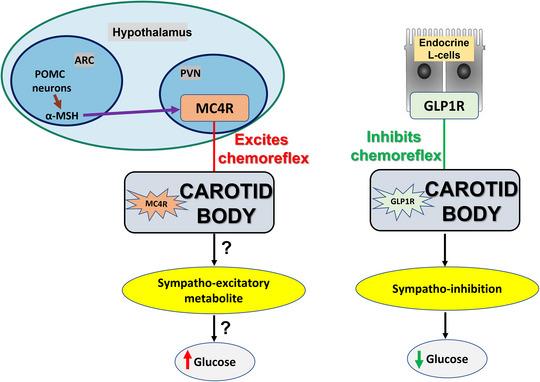
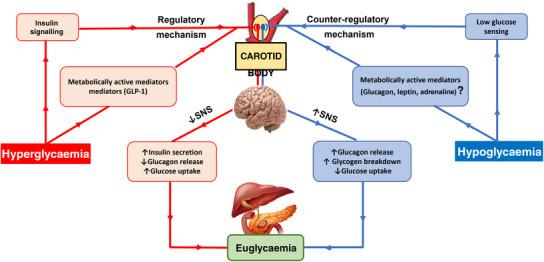
The maintenance of glucose homeostasis is obligatory for health and survival. It relies on peripheral glucose sensing and signalling between the brain and peripheral organs via hormonal and neural responses that restore euglycaemia. Failure of these mechanisms causes hyperglycaemia or diabetes. Current anti-diabetic medications control blood glucose but many patients remain with hyperglycemic condition. Diabetes is often associated with hypertension; the latter is more difficult to control in hyperglycaemic conditions. We ask whether a better understanding of the regulatory mechanisms of glucose control could improve treatment of both diabetes and hypertension when they co-exist. With the involvement of the carotid body (CB) in glucose sensing, metabolic regulation and control of sympathetic nerve activity, we consider the CB as a potential treatment target for both diabetes and hypertension. We provide an update on the role of the CB in glucose sensing and glucose homeostasis. Physiologically, hypoglycaemia stimulates the release of hormones such as glucagon and adrenaline, which mobilize or synthesize glucose; however, these counter-regulatory responses were markedly attenuated after denervation of the CBs in animals. Also, CB denervation prevents and reverses insulin resistance and glucose intolerance. We discuss the CB as a metabolic regulator (not just a sensor of blood gases) and consider recent evidence of novel 'metabolic' receptors within the CB and putative signalling peptides that may control glucose homeostasis via modulation of the sympathetic nervous system. The evidence presented may inform future clinical strategies in the treatment of patients with both diabetes and hypertension, which may include the CB.
新发现
这篇综述的主题是什么?关于全球代谢综合征危机,本综述侧重于高血糖和高血压的共同机制。本文还探讨了血压和血糖的稳态调节及其失调之间的联系,揭示了信号通路向颈动脉体汇聚的机制。它强调了哪些进展?颈动脉体在糖尿病中过度产生交感神经活动中起着重要作用,也是糖尿病高血压的基础。由于糖尿病高血压的治疗非常困难,我们提出颈动脉体中的新型受体可能提供一种新的治疗策略。
摘要
葡萄糖稳态的维持对于健康和生存是必需的。它依赖于外周葡萄糖感知和通过激素和神经反应在大脑和外周器官之间进行的信号转导,这些反应可恢复血糖正常。这些机制的失败会导致高血糖或糖尿病。目前的抗糖尿病药物可控制血糖,但许多患者仍处于高血糖状态。糖尿病常与高血压相关;在高血糖状态下,后者更难控制。我们想知道,更好地了解血糖控制的调节机制是否可以改善同时存在糖尿病和高血压的治疗效果。鉴于颈动脉体(CB)在葡萄糖感知、代谢调节和交感神经活动控制中的作用,我们认为 CB 是治疗糖尿病和高血压的潜在靶点。我们提供了有关 CB 在葡萄糖感知和葡萄糖稳态中的作用的最新信息。从生理学上讲,低血糖会刺激激素如胰高血糖素和肾上腺素的释放,这些激素可以动员或合成葡萄糖;然而,在动物的 CB 被去神经支配后,这些代偿性反应明显减弱。此外,CB 去神经支配可预防和逆转胰岛素抵抗和葡萄糖耐量异常。我们将 CB 视为代谢调节剂(不仅仅是血液气体的传感器),并考虑了 CB 中新型“代谢”受体的最新证据,以及可能通过调节交感神经系统控制葡萄糖稳态的假定信号肽。提出的证据可能为治疗同时患有糖尿病和高血压的患者提供未来的临床策略,包括 CB 治疗。


 Zotero 插件