
老年丙型肝炎患者接受直接作用抗病毒治疗后肝纤维化消退。
Regression in hepatic fibrosis in elderly Chinese patients with hepatitis C receiving direct-acting antiviral treatment.
机构信息
Clinical School of the Second People's Hospital, Tianjin Medical University, Tianjin, 300192, China.
Department of Hepatology, Tianjin Second People's Hospital, Tianjin, 300192, China.
出版信息
BMC Gastroenterol. 2023 Apr 3;23(1):102. doi: 10.1186/s12876-023-02732-4.
BACKGROUND
Patients infected with Hepatitis C virus (HCV) are recommended to receive treatment with direct-acting antiviral agents (DAAs), which have been certified to obtain a high sustained virological response (SVR). However, little is known about the benefits of successful anti-viral treatment to elderly patients with hepatic fibrosis. In this study, we aimed to assess degree of fibrosis in elderly patients with chronic hepatitis C (CHC) treated with DAAs, and to evaluate the correlations between identified factors associated with these changes.
METHODS
This study retrospectively enrolled elderly patients with CHC who received DAAs in Tianjin Second People's Hospital from April 2018 to April 2021. The degree of liver fibrosis was assessed using serum biomarkers and transient elastography (TE) expressed as the liver stiffness (LSM), while the hepatic steatosis was evaluated by controlled attenuated parameter (CAP). Changes in factors related to hepatic fibrosis were examined following treatment with DAAs, and associated prognostic factors were further evaluated.
RESULTS
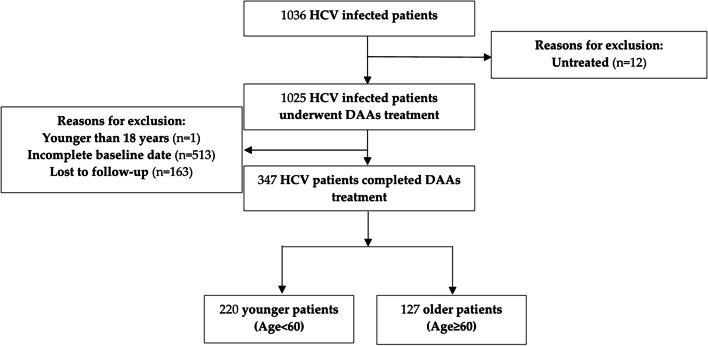
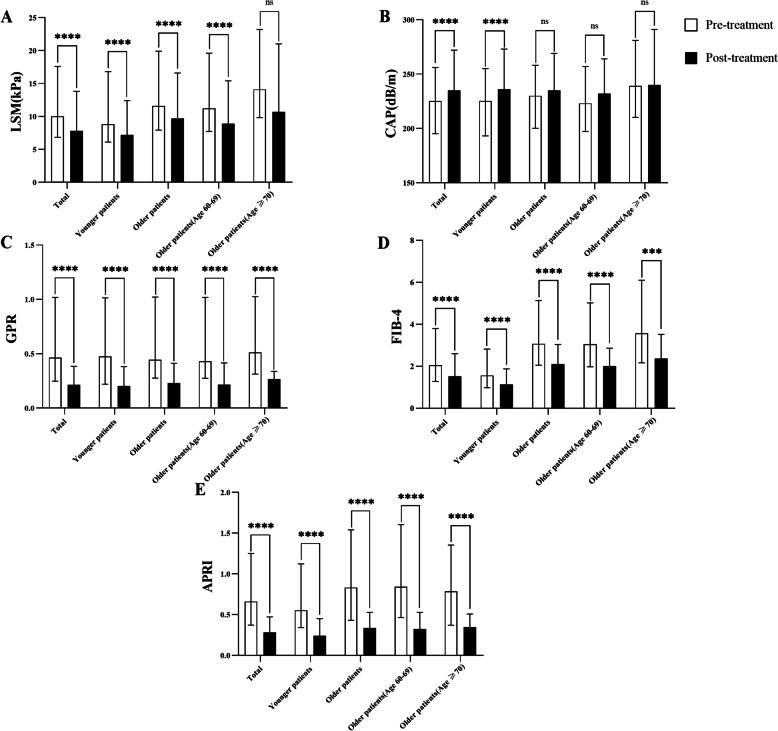
We included 347 CHC patients in our analysis, where 127 of these were elderly patients. For the elderly group, the median LSM was 11.6 (7.9-19.9) kPa, and this value was significantly reduced to 9.7 (6.2-16.6) kPa following DAA treatment. Similarly, GPR, FIB-4 and APRI indices were significantly reduced from 0.445 (0.275-1.022), 3.072 (2.047-5.129) and 0.833 (0.430-1.540) to 0.231 (0.155-0.412), 2.100 (1.540-3.034) and 0.336 (0.235-0.528), respectively. While in younger patients, the median LSM reduced from 8.8 (6.1-16.8) kPa to 7.2 (5.3-12.4) kPa, and the trends of GPR, FIB-4 and APRI were also consistent. The CAP in younger patients increased with statistical significance, but we did not observe any significant change in CAP for the elderly group. Based on multivariate analysis, age, LSM, and CAP before baseline were identified as determinants for LSM improvement in the elderly.
CONCLUSION
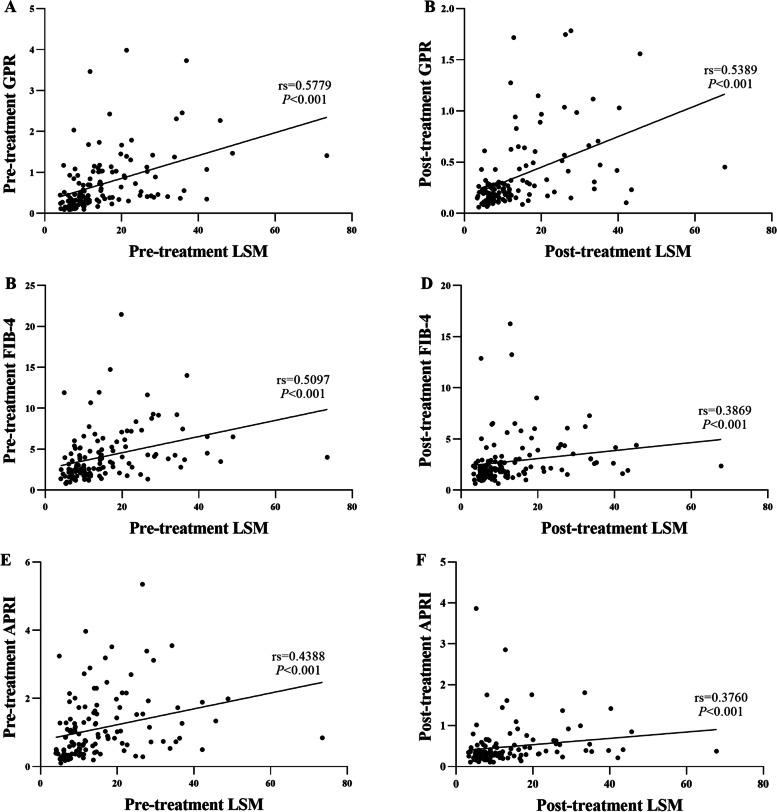
In this study, we found that elderly CHC patients treated with DAA had significantly lower LSM, GPR, FIB-4, and APRI values. DAA treatment did not significantly change CAP. Furthermore, we observed correlations between three noninvasive serological evaluation markers and LSM. Finally, age, LSM, and CAP were identified as independent predictors of fibrosis regression in elderly patients with CHC.
背景
推荐患有丙型肝炎病毒 (HCV) 感染的患者接受直接作用抗病毒药物 (DAA) 治疗,这些药物已被证明可获得高持续病毒学应答 (SVR)。然而,对于接受抗病毒治疗的老年肝纤维化患者的益处知之甚少。本研究旨在评估老年慢性丙型肝炎 (CHC) 患者接受 DAA 治疗后的纤维化程度,并评估与这些变化相关的识别因素之间的相关性。
方法
本研究回顾性纳入 2018 年 4 月至 2021 年 4 月在天津市第二人民医院接受 DAA 治疗的老年 CHC 患者。使用血清生物标志物和瞬时弹性成像 (TE) 表示的肝硬度 (LSM) 评估肝纤维化程度,而受控衰减参数 (CAP) 评估肝脂肪变性。检查 DAA 治疗后与肝纤维化相关的因素变化,并进一步评估相关预后因素。
结果
我们对 347 例 CHC 患者进行了分析,其中 127 例为老年患者。对于老年组,中位 LSM 为 11.6(7.9-19.9)kPa,DAA 治疗后明显降低至 9.7(6.2-16.6)kPa。同样,GPR、FIB-4 和 APRI 指数分别从 0.445(0.275-1.022)、3.072(2.047-5.129)和 0.833(0.430-1.540)降低至 0.231(0.155-0.412)、2.100(1.540-3.034)和 0.336(0.235-0.528)。而在年轻患者中,中位 LSM 从 8.8(6.1-16.8)kPa 降低至 7.2(5.3-12.4)kPa,GPR、FIB-4 趋势也一致。年轻患者的 CAP 显著增加,但我们没有观察到老年组 CAP 的任何显著变化。基于多变量分析,年龄、基线时的 LSM 和 CAP 被确定为老年患者 LSM 改善的决定因素。
结论
在这项研究中,我们发现接受 DAA 治疗的老年 CHC 患者的 LSM、GPR、FIB-4 和 APRI 值明显较低。DAA 治疗并未显著改变 CAP。此外,我们观察到三种非侵入性血清学评估标志物与 LSM 之间的相关性。最后,年龄、LSM 和 CAP 被确定为老年 CHC 患者纤维化消退的独立预测因子。
 Zotero 插件