
炎症饮食指数与严重非酒精性脂肪性肝病的相关性:对 171544 名英国生物库参与者的前瞻性研究。
Associations between an inflammatory diet index and severe non-alcoholic fatty liver disease: a prospective study of 171,544 UK Biobank participants.
机构信息
School of Cardiovascular and Medical Health, BHF Glasgow Cardiovascular Research Centre, University of Glasgow, Glasgow, G12 8TA, UK.
Centro de Investigación Biomédica, Facultad de Medicina, Universidad Diego Portales, Santiago, Chile.
出版信息
BMC Med. 2023 Apr 3;21(1):123. doi: 10.1186/s12916-023-02793-y.
BACKGROUND
Although non-alcoholic fatty liver disease (NAFLD) is linked to inflammation, whether an inflammatory diet increases the risk of NAFLD is unclear. This study aimed to examine the association between the Energy-adjusted Diet Inflammatory Index (E-DII) score and severe NAFLD using UK Biobank.
METHODS
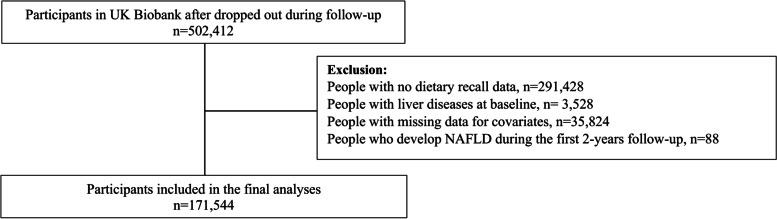
This prospective cohort study included 171,544 UK Biobank participants. The E-DII score was computed using 18 food parameters. Associations between the E-DII and incident severe NAFLD (defined as hospital admission or death) were first investigated by E-DII categories (very/moderately anti-inflammatory [E-DII < - 1], neutral [E-DII - 1 to 1] and very/moderately pro-inflammatory [E-DII > 1]) using Cox proportional hazard models. Nonlinear associations were investigated using penalised cubic splines fitted into the Cox proportional hazard models. Analyses were adjusted for sociodemographic, lifestyle and health-related factors.
RESULTS
Over a median follow-up of 10.2 years, 1489 participants developed severe NAFLD. After adjusting for confounders, individuals in the very/moderately pro-inflammatory category had a higher risk (HR: 1.19 [95% CI: 1.03 to 1.38]) of incident severe NAFLD compared with those in the very/moderately anti-inflammatory category. There was some evidence of nonlinearity between the E-DII score and severe NAFLD.
CONCLUSIONS
Pro-inflammatory diets were associated with a higher risk of severe NAFLD independent of confounders such as the components of the metabolic syndrome. Considering there is no recommended treatment for the disease, our findings suggest a potential means to lower the risk of NAFLD.
背景
虽然非酒精性脂肪性肝病(NAFLD)与炎症有关,但炎症饮食是否会增加 NAFLD 的风险尚不清楚。本研究旨在使用英国生物库(UK Biobank)研究能量调整饮食炎症指数(E-DII)评分与严重 NAFLD 之间的关系。
方法
本前瞻性队列研究纳入了 171544 名 UK Biobank 参与者。E-DII 评分通过 18 种食物参数计算。首先,通过 E-DII 分类(非常/中度抗炎[E-DII<-1]、中性[E-DII-1 至 1]和非常/中度促炎[E-DII>1]),使用 Cox 比例风险模型调查 E-DII 与严重 NAFLD(定义为住院或死亡)之间的关联。通过 Cox 比例风险模型中的惩罚三次样条拟合来研究非线性关联。分析调整了社会人口统计学、生活方式和健康相关因素。
结果
在中位数为 10.2 年的随访期间,有 1489 名参与者发生严重 NAFLD。在校正混杂因素后,与非常/中度抗炎组相比,非常/中度促炎组发生严重 NAFLD 的风险更高(HR:1.19[95%CI:1.03 至 1.38])。E-DII 评分与严重 NAFLD 之间存在一定的非线性关系。
结论
促炎饮食与严重 NAFLD 的风险增加有关,而与代谢综合征等混杂因素无关。考虑到目前尚无针对该疾病的推荐治疗方法,我们的研究结果表明,通过饮食干预可能是降低 NAFLD 风险的一种潜在方法。

 Zotero 插件