
分子特征定义了 4 组髓母细胞瘤中的临床可操作异质性,并改善了疾病风险分层。
Molecular characterisation defines clinically-actionable heterogeneity within Group 4 medulloblastoma and improves disease risk-stratification.
机构信息
Wolfson Childhood Cancer Research Centre, Newcastle University Centre for Cancer, Translational and Clinical Research Institute, Newcastle University, Newcastle Upon Tyne, UK.
Biocruces Bizkaia Health Research Institute, Barakaldo, Spain.
出版信息
Acta Neuropathol. 2023 May;145(5):651-666. doi: 10.1007/s00401-023-02566-0. Epub 2023 Apr 4.
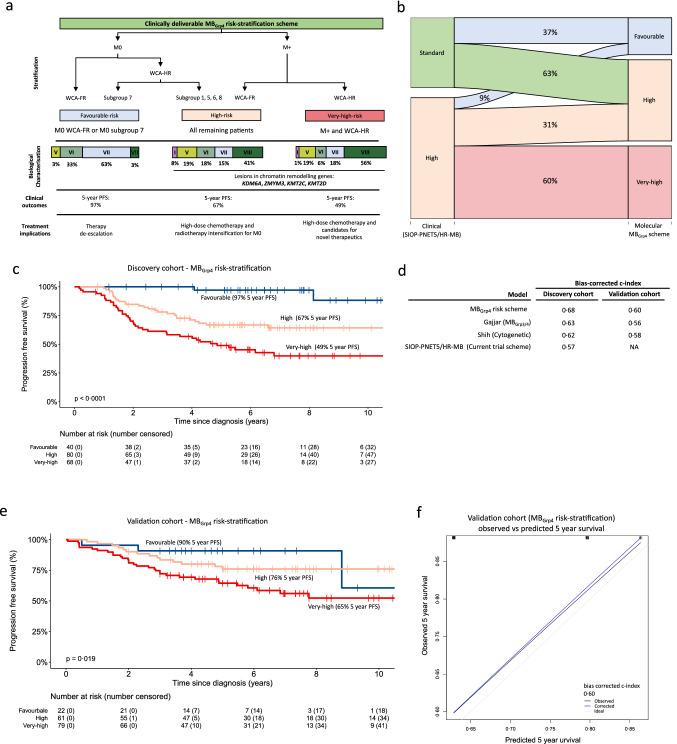
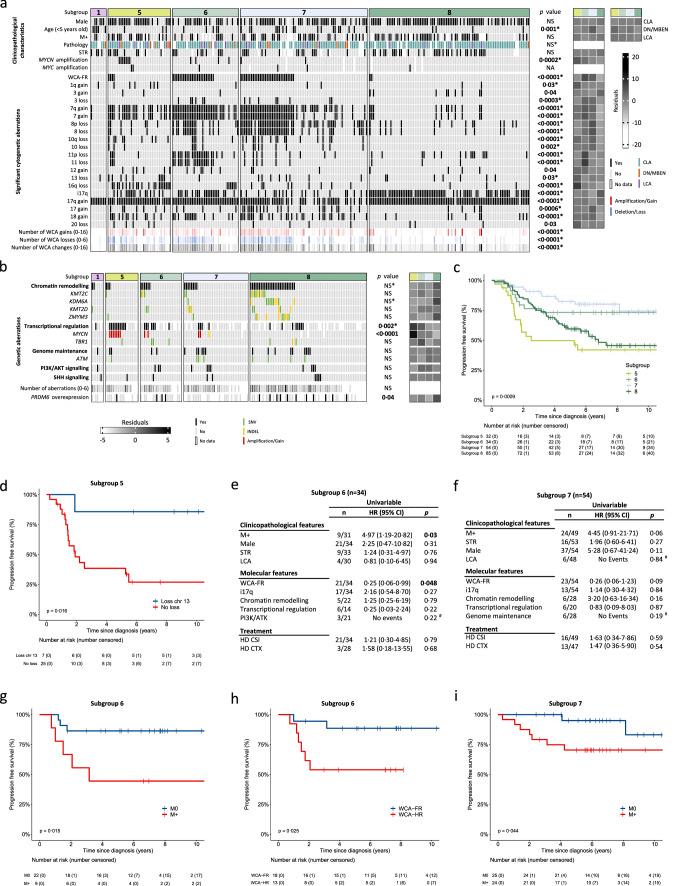
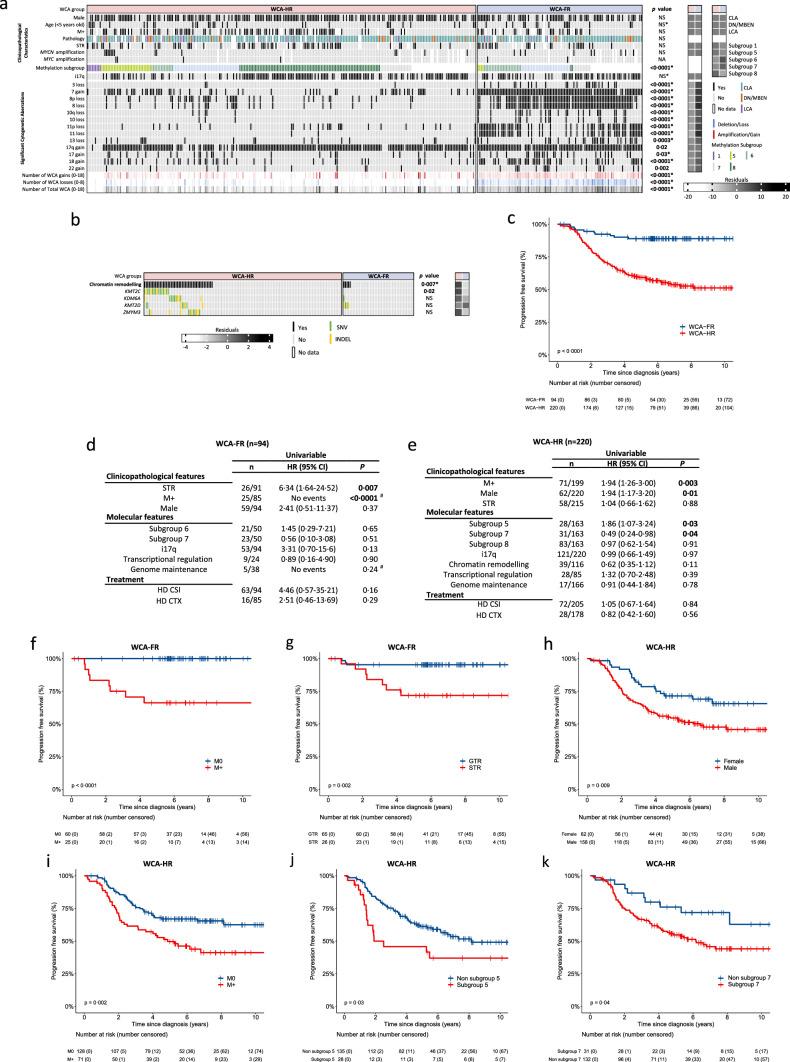
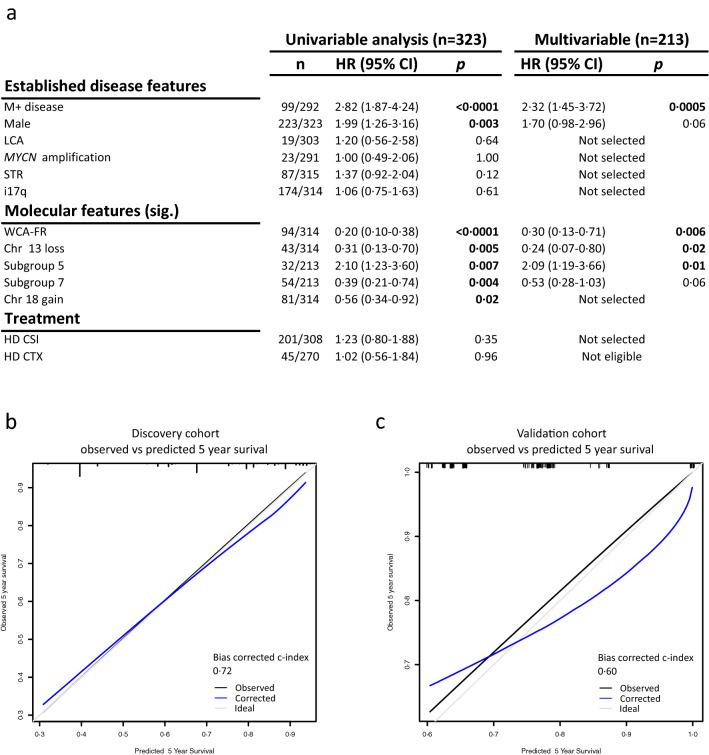
Group 4 tumours (MB) represent the majority of non-WNT/non-SHH medulloblastomas. Their clinical course is poorly predicted by current risk-factors. MB molecular substructures have been identified (e.g. subgroups/cytogenetics/mutations), however their inter-relationships and potential to improve clinical sub-classification and risk-stratification remain undefined. We comprehensively characterised the paediatric MB molecular landscape and determined its utility to improve clinical management. A clinically-annotated discovery cohort (n = 362 MB) was assembled from UK-CCLG institutions and SIOP-UKCCSG-PNET3, HIT-SIOP-PNET4 and PNET HR + 5 clinical trials. Molecular profiling was undertaken, integrating driver mutations, second-generation non-WNT/non-SHH subgroups (1-8) and whole-chromosome aberrations (WCAs). Survival models were derived for patients ≥ 3 years of age who received contemporary multi-modal therapies (n = 323). We first independently derived and validated a favourable-risk WCA group (WCA-FR) characterised by ≥ 2 features from chromosome 7 gain, 8 loss, and 11 loss. Remaining patients were high-risk (WCA-HR). Subgroups 6 and 7 were enriched for WCA-FR (p < 0·0001) and aneuploidy. Subgroup 8 was defined by predominantly balanced genomes with isolated isochromosome 17q (p < 0·0001). While no mutations were associated with outcome and overall mutational burden was low, WCA-HR harboured recurrent chromatin remodelling mutations (p = 0·007). Integration of methylation and WCA groups improved risk-stratification models and outperformed established prognostication schemes. Our MB risk-stratification scheme defines: favourable-risk (non-metastatic disease and (i) subgroup 7 or (ii) WCA-FR (21% of patients, 5-year PFS 97%)), very-high-risk (metastatic disease with WCA-HR (36%, 5-year PFS 49%)) and high-risk (remaining patients; 43%, 5-year PFS 67%). These findings validated in an independent MB cohort (n = 668). Importantly, our findings demonstrate that previously established disease-wide risk-features (i.e. LCA histology and MYC(N) amplification) have little prognostic relevance in MB disease. Novel validated survival models, integrating clinical features, methylation and WCA groups, improve outcome prediction and re-define risk-status for ~ 80% of MB. Our MB favourable-risk group has MB-like excellent outcomes, thereby doubling the proportion of medulloblastoma patients who could benefit from therapy de-escalation approaches, aimed at reducing treatment induced late-effects while sustaining survival outcomes. Novel approaches are urgently required for the very-high-risk patients.
组 4 肿瘤(MB)代表了大多数非 WNT/非 SHH 髓母细胞瘤。目前的风险因素对其临床病程的预测较差。已经确定了 MB 分子亚结构(例如亚组/细胞遗传学/突变),但其相互关系和潜在改善临床亚分类和风险分层的能力仍未定义。我们全面描述了儿科 MB 的分子特征,并确定了其在改善临床管理方面的应用。从英国 CCLG 机构和 SIOP-UKCCSG-PNET3、HIT-SIOP-PNET4 和 PNET HR+5 临床试验中组建了一个具有临床注释的发现队列(n=362 MB)。进行了分子分析,整合了驱动突变、第二代非 WNT/非 SHH 亚组(1-8)和全染色体异常(WCAs)。为接受当代多模式治疗的年龄≥3 岁的患者(n=323)得出了生存模型。我们首先独立地得出并验证了一个有利风险的 WCA 组(WCA-FR),其特征是 7 号染色体增益、8 号染色体缺失和 11 号染色体缺失的特征≥2 个。其余患者为高危(WCA-HR)。亚组 6 和 7 富含 WCA-FR(p<0.0001)和非整倍体。亚组 8 的特点是主要为平衡基因组,伴有孤立的 17q 等臂染色体(p<0.0001)。虽然没有突变与预后相关,并且总体突变负担较低,但 WCA-HR 携带反复出现的染色质重塑突变(p=0.007)。整合甲基化和 WCA 组可改善风险分层模型,并优于现有的预后预测方案。我们的 MB 风险分层方案定义:低危(无转移疾病和(i)亚组 7 或(ii)WCA-FR(21%的患者,5 年无进展生存率为 97%))、极高危(转移性疾病和 WCA-HR(36%,5 年无进展生存率为 49%))和高危(其余患者;43%,5 年无进展生存率为 67%)。该发现经过独立的 MB 队列(n=668)验证。重要的是,我们的研究结果表明,以前确定的疾病广泛的风险特征(即 LCA 组织学和 MYC(N)扩增)在 MB 疾病中与预后相关性不大。新的经过验证的生存模型,整合了临床特征、甲基化和 WCA 组,可提高预后预测,并重新定义了约 80%的 MB 的风险状况。我们的 MB 低危组具有类似于 MB 的优异结果,从而使受益于治疗降级方法的髓母细胞瘤患者比例增加一倍,这些方法旨在减少治疗引起的迟发性效应,同时维持生存结果。非常高危患者迫切需要新的方法。
 Zotero 插件