
ε4 与小胶质细胞激活有关,与 Aβ 斑块和 tau 缠结无关。
ε4 associates with microglial activation independently of Aβ plaques and tau tangles.
机构信息
Department of Psychiatry, University of Pittsburgh, Pittsburgh, PA, USA.
Graduate Program in Biological Sciences: Biochemistry, Universidade Federal do Rio Grande do Sul, Porto Alegre, RS, Brazil.
出版信息
Sci Adv. 2023 Apr 5;9(14):eade1474. doi: 10.1126/sciadv.ade1474.
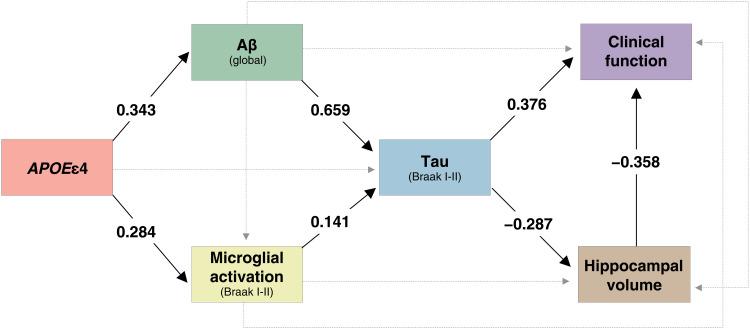
Animal studies suggest that the apolipoprotein E ε4 (ε4) allele is a culprit of early microglial activation in Alzheimer's disease (AD). Here, we tested the association between ε4 status and microglial activation in living individuals across the aging and AD spectrum. We studied 118 individuals with positron emission tomography for amyloid-β (Aβ; [F]AZD4694), tau ([F]MK6240), and microglial activation ([C]PBR28). We found that ε4 carriers presented increased microglial activation relative to noncarriers in early Braak stage regions within the medial temporal cortex accounting for Aβ and tau deposition. Furthermore, microglial activation mediated the Aβ-independent effects of ε4 on tau accumulation, which was further associated with neurodegeneration and clinical impairment. The physiological distribution of mRNA expression predicted the patterns of ε4-related microglial activation in our population, suggesting that gene expression may regulate the local vulnerability to neuroinflammation. Our results support that the ε4 genotype exerts Aβ-independent effects on AD pathogenesis by activating microglia in brain regions associated with early tau deposition.
动物研究表明载脂蛋白 E ε4 (ε4) 等位基因是阿尔茨海默病 (AD) 中早期小胶质细胞激活的罪魁祸首。在这里,我们在整个衰老和 AD 谱中研究了具有正电子发射断层扫描的 118 名个体,以检测 ε4 状态与小胶质细胞激活之间的关联。我们研究了与淀粉样蛋白-β (Aβ; [F]AZD4694)、tau ([F]MK6240) 和小胶质细胞激活 ([C]PBR28) 相关的 118 名个体。我们发现,ε4 携带者在大脑内侧颞叶的早期 Braak 阶段区域中表现出相对于非携带者的小胶质细胞激活增加,这些区域与 Aβ 和 tau 沉积有关。此外,小胶质细胞激活介导了 ε4 对 tau 积累的 Aβ 非依赖性影响,这与神经退行性变和临床损伤进一步相关。mRNA 表达的生理分布预测了我们人群中与 ε4 相关的小胶质细胞激活的模式,这表明基因表达可能调节局部神经炎症易感性。我们的研究结果支持 ε4 基因型通过激活与早期 tau 沉积相关的大脑区域中的小胶质细胞对 AD 发病机制产生 Aβ 非依赖性影响。


 Zotero 插件