
高流行率和高风险型人乳头瘤病毒基因型在巴拉圭未接种疫苗的年轻女性中的共感染。
High prevalence and co-infection of high-risk Human Papillomavirus genotypes among unvaccinated young women from Paraguay.
机构信息
Laboratory of Immunology, Central Laboratory of Public Health/Minister of Public Health and Social Welfare, Asunción, Paraguay.
Laboratory of Molecular Virology and Parasitology, Oswaldo Cruz Institute, Oswaldo Cruz Foundation, Rio de Janeiro, Brazil.
出版信息
PLoS One. 2023 Apr 6;18(4):e0283542. doi: 10.1371/journal.pone.0283542. eCollection 2023.
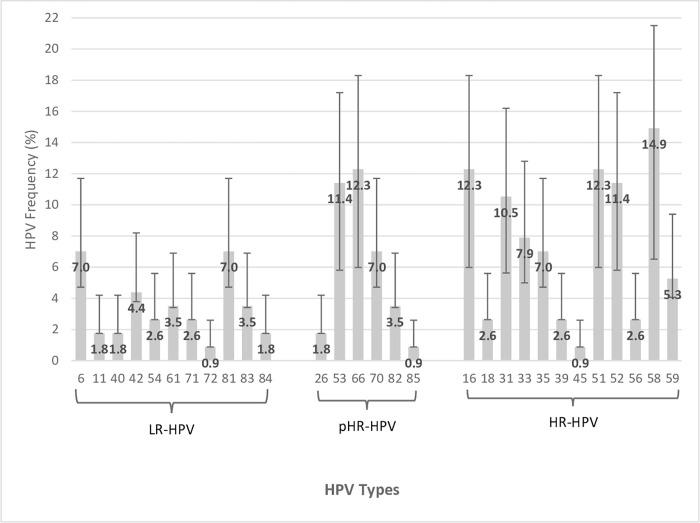
Paraguay launched a human papillomavirus (HPV) vaccination program in 2013, so virological surveillance is important for measuring the impact of HPV vaccines. This study aimed to estimate the type-specific HPV frequency in unvaccinated sexually active women aged 18-25 years in the metropolitan area of Asuncion as a baseline for monitoring the HPV vaccination program. This study included 208 women, attending the Central Laboratory of Public Health between May 2020 and December 2021, were invited for testing through social networks and flyers at local health centers and higher education institutes. All participants who agreed to contribute to the study signed a free, prior, and informed consent form and answered a questionnaire that included basic demographic data and determining factors of HPV infection. Human papillomavirus detection and genotyping were conducted using the CLART HPV2 test (Genomica, Madrid, Spain) that allows the individual identification of 35 genotypes. 54.8% women were positive for any HPV type, with 42.3% positive for high-risk HPV (HR-HPV) types. Several factors were associated with HPV detection including the number of sexual partners, new sexual partners, non-use of condoms, and history of other sexual infections. Moreover, multiple infections were identified in 43.0% of the young women. We detected 29 different viral types present in both single and multiple infections. HPV-58 was the most commonly detected HPV type (14.9%), followed by HPV-16, HPV-51, and HPV-66 (12.3%). We estimated the prevalence of bivalent (16/18), quadrivalent (6/11/16/18), and nonavalent (6/11/16/18/31/33/45/52/58) vaccine types to be 8.2%, 13%, and 38%, respectively. These results reinforce the importance of surveillance studies and provide the first data regarding circulating HPV genotypes in the unvaccinated population in Paraguay, thus generating a baseline to compare future changes in the overall and type-specific HPV prevalence after HPV vaccination.
巴拉圭于 2013 年启动了人乳头瘤病毒(HPV)疫苗接种计划,因此病毒学监测对于衡量 HPV 疫苗的影响非常重要。本研究旨在评估首都亚松森 18-25 岁未接种 HPV 疫苗的性行为活跃女性的 HPV 病毒型别流行率,作为监测 HPV 疫苗接种计划的基线。本研究共纳入 208 名女性,她们于 2020 年 5 月至 2021 年 12 月期间在公共卫生中央实验室接受检测。通过社交网络和当地卫生中心及高校的传单邀请所有同意参与研究的女性参加检测。所有同意参与研究的女性均签署了一份自由、事先和知情同意书,并回答了一份包含基本人口统计学数据和 HPV 感染决定因素的问卷。使用 CLART HPV2 检测(西班牙马德里的 Genomica)检测 HPV 并进行基因分型,该检测可单独识别 35 种基因型。54.8%的女性 HPV 呈阳性,其中 42.3%为高危型 HPV(HR-HPV)阳性。包括性伴侣数量、新性伴侣、不使用安全套和其他性感染史在内的多个因素与 HPV 检测呈阳性相关。此外,43.0%的年轻女性存在多重感染。我们在单一和多重感染中均发现了 29 种不同的病毒类型。HPV-58 是最常见的 HPV 类型(14.9%),其次是 HPV-16、HPV-51 和 HPV-66(12.3%)。我们估计二价(16/18)、四价(6/11/16/18)和九价(6/11/16/18/31/33/45/52/58)疫苗类型的流行率分别为 8.2%、13%和 38%。这些结果强调了监测研究的重要性,并提供了巴拉圭未接种人群中循环 HPV 基因型的首批数据,为 HPV 疫苗接种后总体和特定 HPV 流行率的未来变化提供了基线比较。

 Zotero 插件