
眼表结膜微生物组分析在干眼症中的应用:一项病例对照的初步研究。
Ocular conjunctival microbiome profiling in dry eye disease: A case control pilot study.
机构信息
Dr Rajendra Prasad Centre for Ophthalmic Sciences, All India Institute of Medical Sciences, New Delhi, India.
Molecular Medicine, International Centre for Genetic Engineering and Biotechnology, New Delhi, India.
出版信息
Indian J Ophthalmol. 2023 Apr;71(4):1574-1581. doi: 10.4103/ijo.IJO_1756_22.
PURPOSE
Keratoconjunctivitis sicca (KCS) or dry eye disease (DED) is a multifactorial disease that results in discomfort, visual disturbance, and tear film instability with potential damage to the ocular surface. A pilot study was undertaken to determine if there were any major substantial differences in the ocular microbiome in DED patients versus healthy controls.
METHODS
The bacterial communities residing in the conjunctiva of patients with DED (n = 4) and healthy controls (n = 4) were assessed by 16S ribosomal RNA (rRNA) gene sequencing of the V4-V5 region.
RESULTS
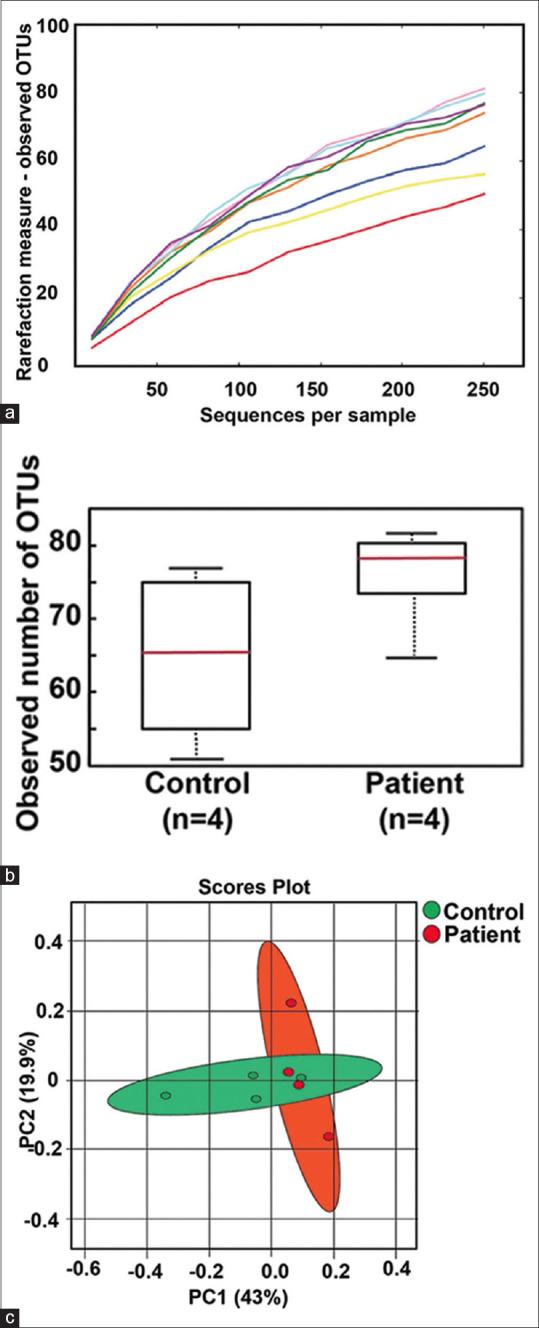
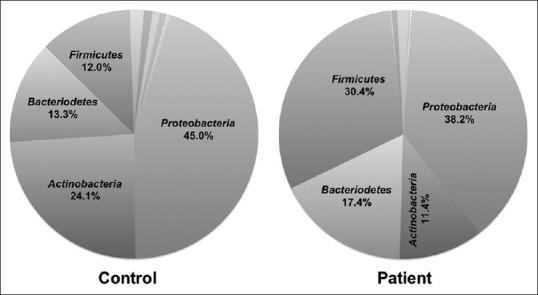
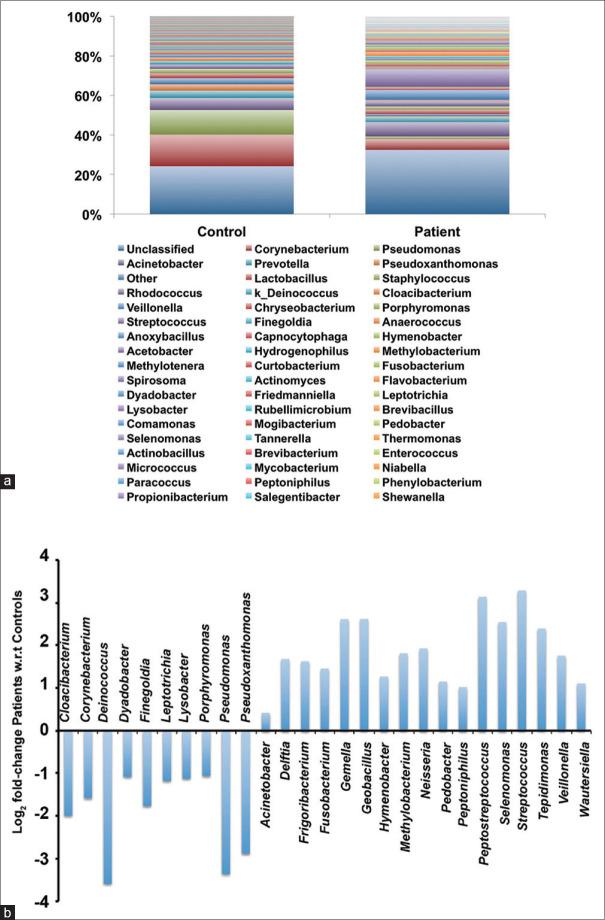
The phyla Proteobacteria, Actinobacteria, Bacteroidetes, and Firmicutes were most dominant and accounted for 97% and 94.5% of all bacterial sequences in patients and controls, respectively. At the genus level, 27 bacterial genera were found with more than two-fold difference between patients and controls. Four of these - Acinetobacter, Corynebacterium, Lactobacillus, and Pseudomonas spp. - dominated the ocular microbiome of all subjects, but were proportionately lower in DED (16.5%) compared to controls (37.7%). Several bacterial genera were found to be unique in DED (34) and controls (24).
CONCLUSION
This pilot study is an attempt to profile the ocular microbiome in patients with DED that demonstrated a higher concentration of microbial DNA compared to controls, with Firmicutes phyla dominating the bacterial population in patients with DED.
目的
干眼症(KCS)或干燥性角结膜炎(DED)是一种多因素疾病,会导致不适、视觉障碍和泪膜不稳定,可能对眼表面造成潜在损害。进行了一项初步研究,以确定 DED 患者与健康对照者的眼微生物组是否存在任何主要实质性差异。
方法
通过对 DED 患者(n=4)和健康对照者(n=4)的结膜中存在的细菌群落进行 16S 核糖体 RNA(rRNA)基因 V4-V5 区测序,评估细菌群落。
结果
在患者和对照组中,分别有 97%和 94.5%的细菌序列由厚壁菌门、放线菌门、拟杆菌门和Firmicutes 门主导。在属水平上,发现了 27 个细菌属,其中患者与对照组之间有超过两倍的差异。其中 4 种属 - 不动杆菌属、棒状杆菌属、乳杆菌属和假单胞菌属 - 主导所有受试者的眼微生物组,但在 DED 中比例较低(16.5%),而在对照组中比例较高(37.7%)。在 DED(34 种)和对照组(24 种)中发现了一些独特的细菌属。
结论
本初步研究尝试分析 DED 患者的眼微生物组,与对照组相比,患者的微生物 DNA 浓度更高,Firmicutes 门在 DED 患者的细菌群中占主导地位。


 Zotero 插件