
葡萄膜黑色素瘤中的肥胖悖论:高身体质量指数与低转移风险相关。
Obesity paradox in uveal melanoma: high body mass index is associated with low metastatic risk.
机构信息
St. Erik Eye Hospital, Stockholm, Sweden
Department of Clinical Neuroscience, Karolinska Institutet, Stockholm, Sweden.
出版信息
Br J Ophthalmol. 2024 Mar 20;108(4):578-587. doi: 10.1136/bjo-2022-322877.
BACKGROUND
Metabolic factors and obesity may influence the development and progression of cancer. In this study, we examine their association with the risk of developing metastases of uveal melanoma.
METHODS
Data on metabolic factors, medications, serum leptin levels, tumour leptin receptor RNA expression and clinical outcomes were examined in three cohorts. HRs for metastasis and cumulative incidences of melanoma-related mortality were calculated, and the levels of tumour leptin receptor expression were compared with prognostic factors including mutation, and tumour cell morphology.
RESULTS
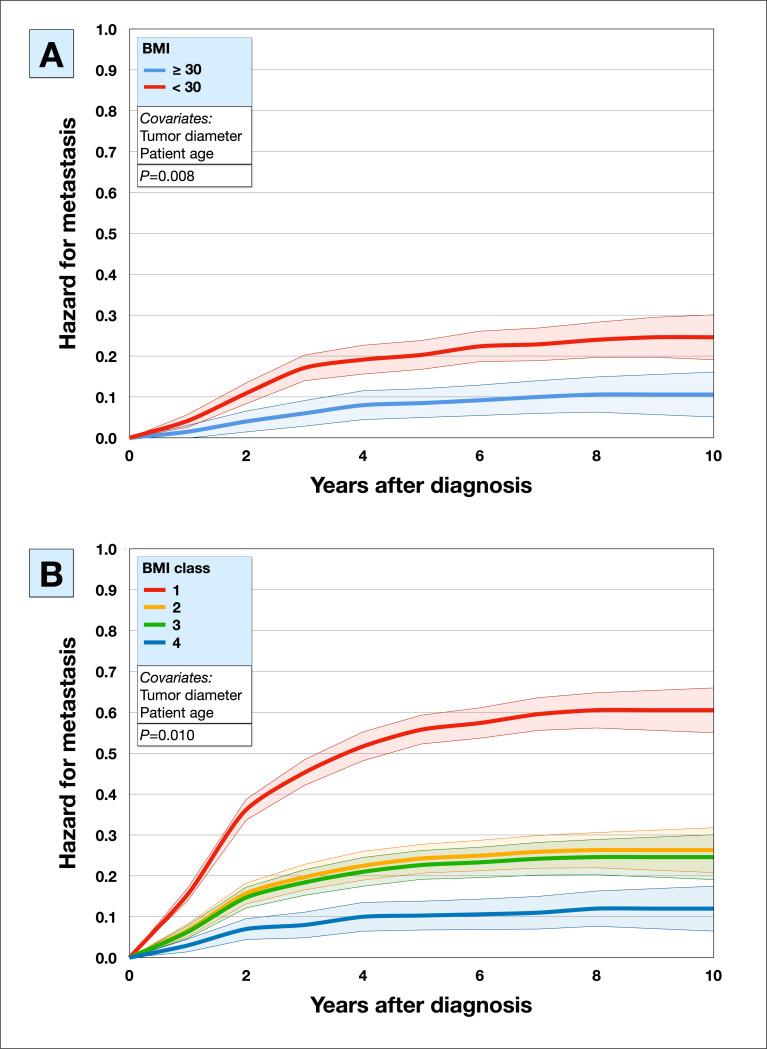
Of 581 patients in the main cohort, 116 (20%) were obese and 7 (1 %) had metastatic disease at presentation. In univariate Cox regressions, tumour diameter, diabetes type II and use of insulin were associated with metastases, but patients with obesity had a lower risk. The beneficial prognostic implication of obesity was retained in multivariate regressions. In competing risk analyses, the incidence of melanoma-related mortality was significantly lower for patients with obesity. Serum leptin levels≥median were associated with a reduced risk for metastasis, independent of patient sex and cancer stage in a separate cohort (n=80). Similarly, in a third cohort (n=80), tumours with mutation and epithelioid cells had higher leptin receptor RNA expression levels, which have a negative correlation with serum leptin levels.
CONCLUSION
Obesity and elevated serum leptin levels are associated with a lower risk for developing metastases and dying from uveal melanoma.
背景
代谢因素和肥胖可能会影响癌症的发生和发展。在这项研究中,我们研究了它们与葡萄膜黑色素瘤转移风险的关系。
方法
在三个队列中检查了代谢因素、药物、血清瘦素水平、肿瘤瘦素受体 RNA 表达和临床结果的数据。计算了转移的 HR 和黑色素瘤相关死亡率的累积发生率,并将肿瘤瘦素受体表达水平与包括突变和肿瘤细胞形态在内的预后因素进行了比较。
结果
在主要队列的 581 名患者中,116 名(20%)肥胖,7 名(1%)在就诊时出现转移性疾病。在单因素 Cox 回归中,肿瘤直径、2 型糖尿病和胰岛素的使用与转移有关,但肥胖患者的风险较低。在多变量回归中,肥胖的有利预后意义仍然存在。在竞争风险分析中,肥胖患者的黑色素瘤相关死亡率显著降低。在另一个队列(n=80)中,血清瘦素水平≥中位数与转移风险降低独立于患者性别和癌症分期有关。同样,在第三个队列(n=80)中,具有 突变和上皮样细胞的肿瘤具有更高的瘦素受体 RNA 表达水平,与血清瘦素水平呈负相关。
结论
肥胖和血清瘦素水平升高与发生葡萄膜黑色素瘤转移和死于葡萄膜黑色素瘤的风险降低有关。



 Zotero 插件