
小胶质细胞消融不改变运动活动的昼夜节律。
Ablation of microglia does not alter circadian rhythm of locomotor activity.
机构信息
Graduate School of Medicine, Hokkaido University, Sapporo, Japan.
出版信息
Mol Brain. 2023 Apr 7;16(1):34. doi: 10.1186/s13041-023-01021-1.
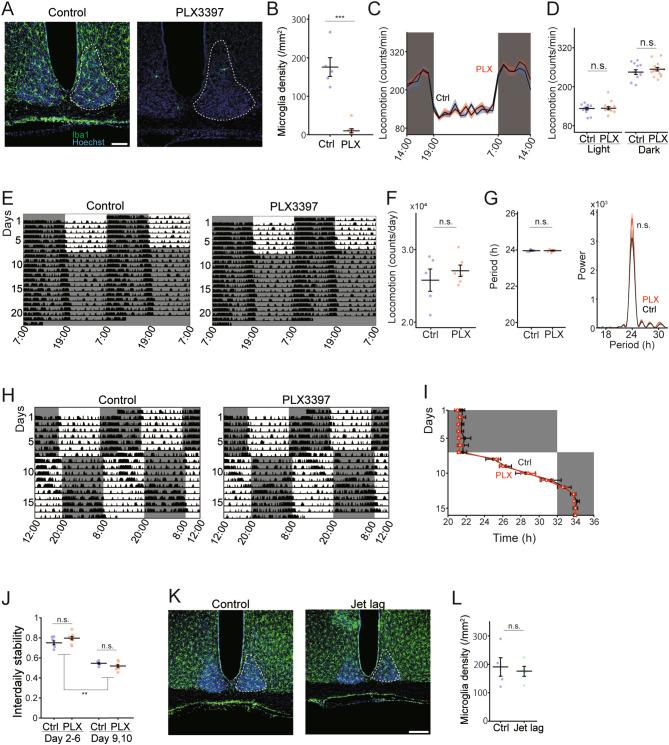
Microglia, as macrophages in the brain, are responsible for immune responses and synaptic remodeling. Although the function of microglia is regulated by circadian rhythms, it is still unclear whether microglia are involved in the generation and light entrainment of circadian rhythms of behavior. Here, we report that microglial depletion does not alter behavioral circadian rhythms. We depleted ~ 95% of microglia in the mouse brain by PLX3397, a CSF1R inhibitor, and analyzed the effect on the spontaneous behaviors of mice. We found that neither the free-running period under constant darkness nor light entrainment under jet-lag circumstances were influenced by the ablation of microglia. Our results demonstrate that the circadian rhythms of locomotor activity, an important output of the circadian clock in the brain, are likely a phenomenon not produced by microglia.
小胶质细胞作为大脑中的巨噬细胞,负责免疫反应和突触重塑。尽管小胶质细胞的功能受昼夜节律调节,但目前尚不清楚小胶质细胞是否参与行为昼夜节律的产生和光驯化。在这里,我们报告说,小胶质细胞耗竭不会改变行为昼夜节律。我们用 CSF1R 抑制剂 PLX3397 耗竭了约 95%的小鼠大脑中的小胶质细胞,并分析了其对小鼠自发行为的影响。我们发现,无论是在持续黑暗下的自由运行周期还是在时差情况下的光驯化,小胶质细胞的消融都没有影响。我们的结果表明,运动活动的昼夜节律(大脑生物钟的一个重要输出)可能不是由小胶质细胞产生的现象。
 Zotero 插件