
结直肠癌(CRC)筛查对降低全因死亡率和CRC特异性死亡率的有效性:一项系统评价和荟萃分析
Effectiveness of Colorectal Cancer (CRC) Screening on All-Cause and CRC-Specific Mortality Reduction: A Systematic Review and Meta-Analysis.
作者信息
Zheng Senshuang, Schrijvers Jelle J A, Greuter Marcel J W, Kats-Ugurlu Gürsah, Lu Wenli, de Bock Geertruida H
机构信息
Medical Center Groningen, Department of Epidemiology, University of Groningen, 9700 RB Groningen, The Netherlands.
Medical Center Groningen, Department of Radiology, University of Groningen, 9700 RB Groningen, The Netherlands.
出版信息
Cancers (Basel). 2023 Mar 24;15(7):1948. doi: 10.3390/cancers15071948.
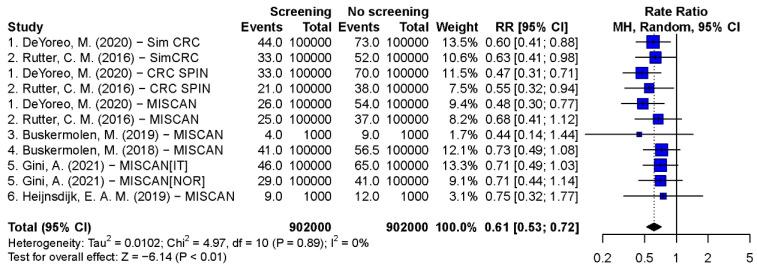
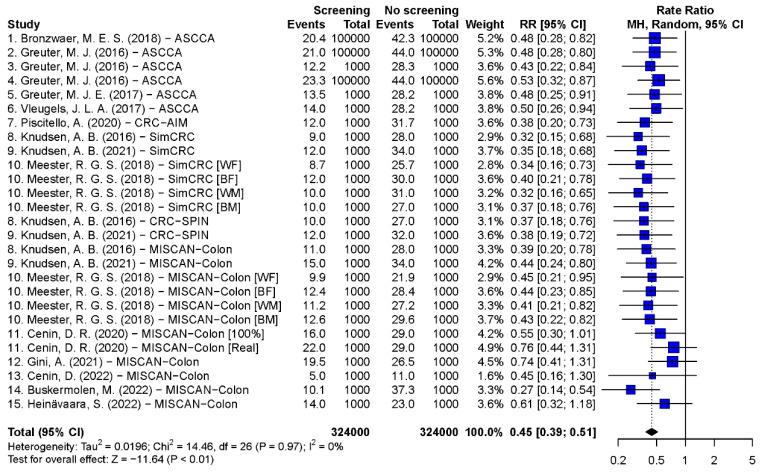
(1) Background: The aim of this study was to pool and compare all-cause and colorectal cancer (CRC) specific mortality reduction of CRC screening in randomized control trials (RCTs) and simulation models, and to determine factors that influence screening effectiveness. (2) Methods: PubMed, Embase, Web of Science and Cochrane library were searched for eligible studies. Multi-use simulation models or RCTs that compared the mortality of CRC screening with no screening in general population were included. CRC-specific and all-cause mortality rate ratios and 95% confidence intervals were calculated by a bivariate random model. (3) Results: 10 RCTs and 47 model studies were retrieved. The pooled CRC-specific mortality rate ratios in RCTs were 0.88 (0.80, 0.96) and 0.76 (0.68, 0.84) for guaiac-based fecal occult blood tests (gFOBT) and single flexible sigmoidoscopy (FS) screening, respectively. For the model studies, the rate ratios were 0.45 (0.39, 0.51) for biennial fecal immunochemical tests (FIT), 0.31 (0.28, 0.34) for biennial gFOBT, 0.61 (0.53, 0.72) for single FS, 0.27 (0.21, 0.35) for 10-yearly colonoscopy, and 0.35 (0.29, 0.42) for 5-yearly FS. The CRC-specific mortality reduction of gFOBT increased with higher adherence in both studies (RCT: 0.78 (0.68, 0.89) vs. 0.92 (0.87, 0.98), model: 0.30 (0.28, 0.33) vs. 0.92 (0.51, 1.63)). Model studies showed a 0.62-1.1% all-cause mortality reduction with single FS screening. (4) Conclusions: Based on RCTs and model studies, biennial FIT/gFOBT, single and 5-yearly FS, and 10-yearly colonoscopy screening significantly reduces CRC-specific mortality. The model estimates are much higher than in RCTs, because the simulated biennial gFOBT assumes higher adherence. The effectiveness of screening increases at younger screening initiation ages and higher adherences.
(1)背景:本研究的目的是汇总并比较随机对照试验(RCT)和模拟模型中结直肠癌(CRC)筛查的全因死亡率降低情况和CRC特异性死亡率降低情况,并确定影响筛查效果的因素。(2)方法:检索PubMed、Embase、Web of Science和Cochrane图书馆以查找符合条件的研究。纳入在一般人群中比较CRC筛查与未筛查死亡率的多用途模拟模型或RCT。通过双变量随机模型计算CRC特异性和全因死亡率比值及95%置信区间。(3)结果:检索到10项RCT和47项模型研究。基于愈创木脂的粪便潜血试验(gFOBT)和单次柔性乙状结肠镜检查(FS)筛查在RCT中的汇总CRC特异性死亡率比值分别为0.88(0.80,0.96)和0.76(0.68,0.84)。对于模型研究,两年一次的粪便免疫化学试验(FIT)的比值为0.45(0.39,0.51),两年一次的gFOBT为0.31(0.28,0.34),单次FS为0.61(0.53,0.72),十年一次的结肠镜检查为0.27(0.21,0.35),五年一次的FS为0.35(0.29,0.42)。在两项研究中,gFOBT的CRC特异性死亡率降低均随依从性提高而增加(RCT:0.78(0.68,0.89)对0.92(0.87,0.98),模型:0.30(0.28,0.33)对0.92(0.51,1.63))。模型研究显示单次FS筛查可使全因死亡率降低0.62 - 1.1%。(4)结论:基于RCT和模型研究,两年一次的FIT/gFOBT、单次和五年一次的FS以及十年一次的结肠镜检查筛查可显著降低CRC特异性死亡率。模型估计值远高于RCT中的值,因为模拟的两年一次gFOBT假定依从性更高。筛查效果在筛查起始年龄较小和依从性较高时会增加。


 Zotero 插件