
乙型和丙型肝炎病毒与肝细胞癌患者冠状动脉疾病和脑血管疾病风险的关联
Association of Hepatitis B and C Virus with the Risk of Coronary Artery Disease and Cerebrovascular Disease in Patients with Hepatocellular Carcinoma.
作者信息
Lu Meng-Chuan, Wu Ying-Hsuen, Chung Chi-Hsiang, Lin Hsuan-Hwai, Hsieh Tsai-Yuan, Chen Peng-Jen, Chien Wu-Chien, Chen Hsuan-Wei
机构信息
Division of Gastroenterology, Department of Internal Medicine, Tri-Service General Hospital, National Defense Medical Center, 325, Sec 2, Cheng-Kung Road, Taipei Neihu 114, Taiwan.
Department of Ophthalmology, China Medical University Hospital, School of Medicine, College of Medicine, China Medical University, Taichung City 404, Taiwan.
出版信息
J Clin Med. 2023 Mar 30;12(7):2602. doi: 10.3390/jcm12072602.
BACKGROUND
Hepatocellular carcinoma accounts for approximately 90% of primary liver cancers and hepatitis virus was believed to have the potential for altering the pathogenesis of arteriosclerosis. However, the influence of the hepatitis virus on coronary artery disease or cerebral vascular disease remains unclear. This study used the Taiwan National Health Insurance Research Database to clarify the virus-associated risk of coronary artery disease and cerebral vascular disease in patients with hepatocellular carcinoma (HCC).
METHODS
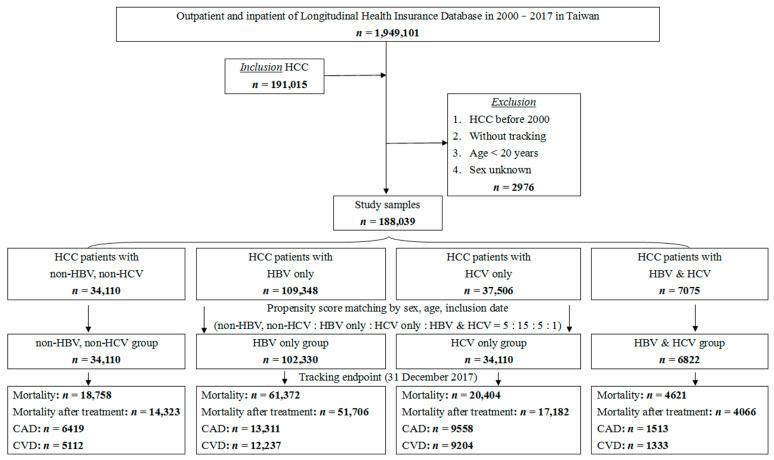
A total of 188,039 HCC individuals, age 20 years or older, were enrolled from the Longitudinal Health Insurance Database between 2000 and 2017 for cohort analysis. A total of 109,348 with hepatitis B virus (HBV) infection, 37,506 with hepatitis C virus (HCV) infection, 34,110 without HBV or HCV, and 7075 with both HBV and HCV were recorded. Statistically, propensity score matched by sex, age, and index year at a ratio of 15:5:5:1 and a sensitivity test using multivariable Cox regression were used.
RESULTS
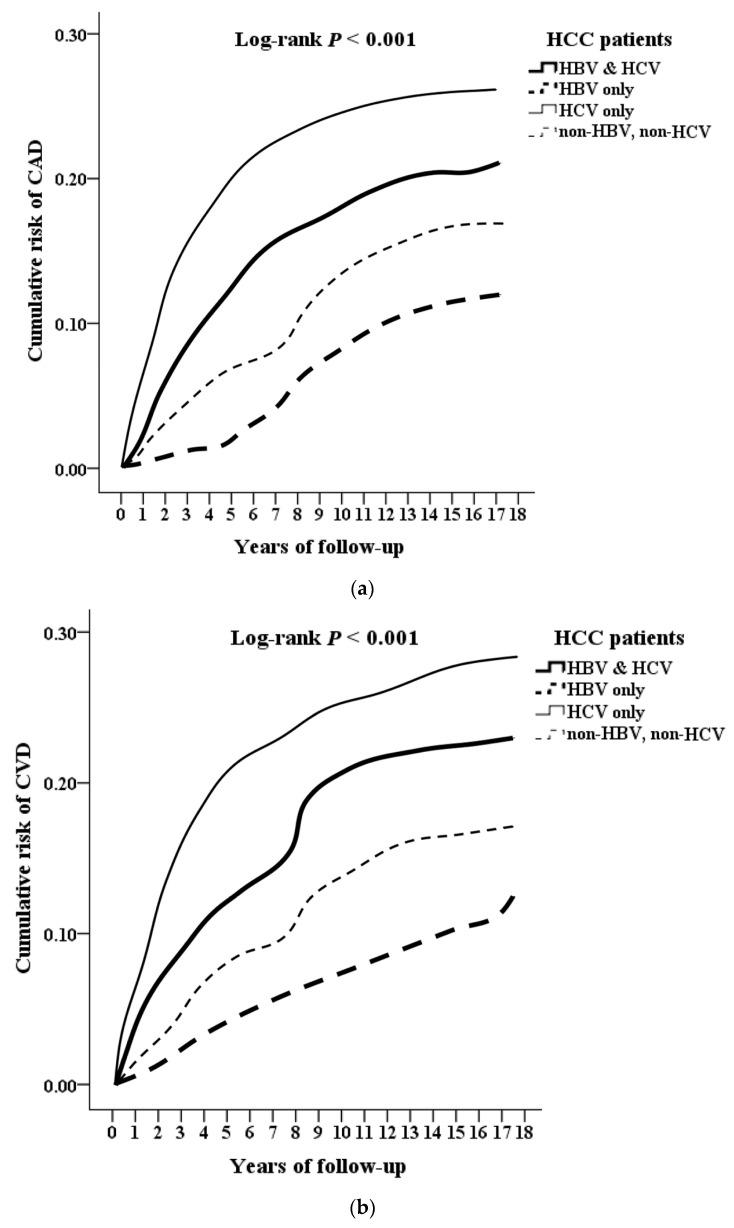
The risk of coronary artery disease in the HCV-related HCC group was 1.516-fold (95% CI: 1.328-2.034, < 0.001) higher than in the HBV-related HCC group, followed by the HBV/HCV-related HCC group and the non-B/C HCC group; the cerebral vascular disease risk in the HCV-related HCC group was 1.467-fold higher than in the HBV-related HCC group (95% CI: 1.335 to 1.786, < 0.001), followed by the HBV/HCV-related HCC group and the non-B/C HCC group.
CONCLUSION
Hepatitis C virus infection was found to have a higher risk of developing coronary artery disease or cerebral vascular disease in patients with hepatocellular carcinoma. For patients with hepatocellular carcinoma, our findings warrant the importance in preventing artherosclerotic disease in the setting of hepatitis C virus infection.
背景
肝细胞癌约占原发性肝癌的90%,并且人们认为肝炎病毒可能会改变动脉粥样硬化的发病机制。然而,肝炎病毒对冠状动脉疾病或脑血管疾病的影响仍不明确。本研究利用台湾国民健康保险研究数据库,以阐明肝细胞癌(HCC)患者中与病毒相关的冠状动脉疾病和脑血管疾病风险。
方法
2000年至2017年间,从纵向健康保险数据库中纳入了总共188,039名年龄在20岁及以上的HCC个体进行队列分析。记录了总共109,348名乙型肝炎病毒(HBV)感染者、37,506名丙型肝炎病毒(HCV)感染者、34,110名无HBV或HCV感染者以及7,075名同时感染HBV和HCV者。在统计学上,采用倾向评分按性别、年龄和索引年份以15:5:5:1的比例进行匹配,并使用多变量Cox回归进行敏感性测试。
结果
HCV相关HCC组的冠状动脉疾病风险比HBV相关HCC组高1.516倍(95%置信区间:1.328 - 2.034,P < 0.001),其次是HBV/HCV相关HCC组和非B/C HCC组;HCV相关HCC组的脑血管疾病风险比HBV相关HCC组高1.467倍(95%置信区间:1.335至1.786,P < 0.001),其次是HBV/HCV相关HCC组和非B/C HCC组。
结论
研究发现丙型肝炎病毒感染在肝细胞癌患者中发生冠状动脉疾病或脑血管疾病的风险更高。对于肝细胞癌患者,我们的研究结果证明了在丙型肝炎病毒感染情况下预防动脉粥样硬化疾病的重要性。
 Zotero 插件