
离子-电子耦合使离子热电材料具有新的运行模式和高能量密度。
Ion-Electron Coupling Enables Ionic Thermoelectric Material with New Operation Mode and High Energy Density.
作者信息
He Yongjie, Li Shaowei, Chen Rui, Liu Xu, Odunmbaku George Omololu, Fang Wei, Lin Xiaoxue, Ou Zeping, Gou Qianzhi, Wang Jiacheng, Ouedraogo Nabonswende Aida Nadege, Li Jing, Li Meng, Li Chen, Zheng Yujie, Chen Shanshan, Zhou Yongli, Sun Kuan
机构信息
MOE Key Laboratory of Low-grade Energy Utilization Technologies and Systems, CQU-NUS Renewable Energy Materials and Devices Joint Laboratory, School of Energy and Power Engineering, Chongqing University, Chongqing, 400044, People's Republic of China.
出版信息
Nanomicro Lett. 2023 Apr 13;15(1):101. doi: 10.1007/s40820-023-01077-7.
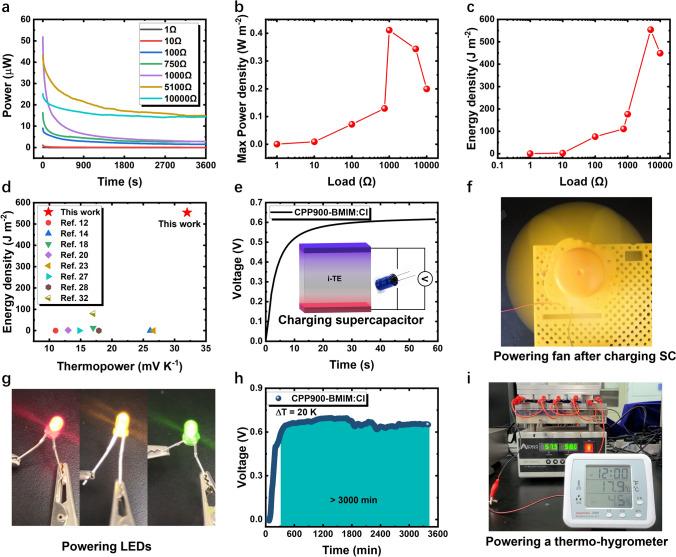
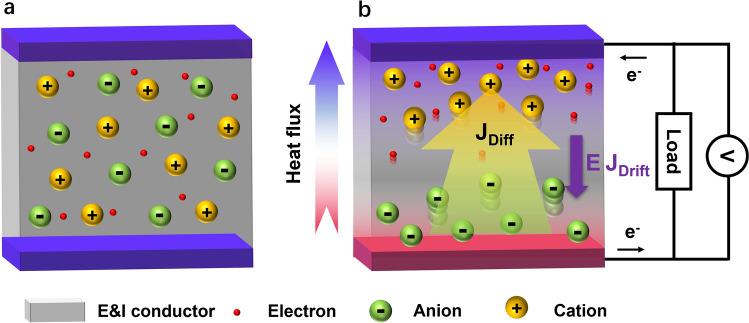
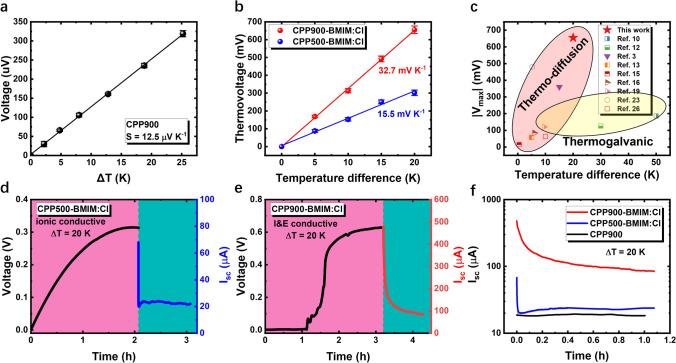
Ionic thermoelectrics (i-TE) possesses great potential in powering distributed electronics because it can generate thermopower up to tens of millivolts per Kelvin. However, as ions cannot enter external circuit, the utilization of i-TE is currently based on capacitive charge/discharge, which results in discontinuous working mode and low energy density. Here, we introduce an ion-electron thermoelectric synergistic (IETS) effect by utilizing an ion-electron conductor. Electrons/holes can drift under the electric field generated by thermodiffusion of ions, thus converting the ionic current into electrical current that can pass through the external circuit. Due to the IETS effect, i-TE is able to operate continuously for over 3000 min. Moreover, our i-TE exhibits a thermopower of 32.7 mV K and an energy density of 553.9 J m, which is more than 6.9 times of the highest reported value. Consequently, direct powering of electronics is achieved with i-TE. This work provides a novel strategy for the design of high-performance i-TE materials.
离子热电器件(i - TE)在为分布式电子设备供电方面具有巨大潜力,因为它每开尔文可产生高达数十毫伏的热电势。然而,由于离子无法进入外部电路,目前i - TE的应用基于电容式充放电,这导致其工作模式不连续且能量密度低。在此,我们通过利用离子 - 电子导体引入了一种离子 - 电子热电协同(IETS)效应。电子/空穴可在离子热扩散产生的电场作用下漂移,从而将离子电流转换为可通过外部电路的电流。由于IETS效应,i - TE能够连续运行超过3000分钟。此外,我们的i - TE展现出32.7 mV K的热电势和553.9 J m的能量密度,这是已报道最高值的6.9倍以上。因此,i - TE实现了对电子设备的直接供电。这项工作为高性能i - TE材料的设计提供了一种新策略。
 Zotero 插件