
老年人肌少症的运动疗法:系统评价和网络荟萃分析。
Exercise for sarcopenia in older people: A systematic review and network meta-analysis.
机构信息
Medical Device Regulatory Research and Evaluation Center, Chinese Evidence-Based Medicine Center, West China Hospital, Sichuan University, Chengdu, Sichuan, China.
The Center of Gerontology and Geriatrics/National Clinical Research Center of Geriatrics, West China Hospital, Sichuan University, Chengdu, Sichuan, China.
出版信息
J Cachexia Sarcopenia Muscle. 2023 Jun;14(3):1199-1211. doi: 10.1002/jcsm.13225. Epub 2023 Apr 14.
BACKGROUND
Sarcopenia is a serious public health concern among older adults worldwide. Exercise is the most common intervention for sarcopenia. This study aimed to compare the effectiveness of different exercise types for older adults with sarcopenia.
METHODS
Randomized controlled trials (RCTs) that examined the effectiveness of exercise interventions on patient-important outcomes for older adults with sarcopenia were eligible. We systematically searched MEDLINE, Embase and Cochrane Central Register of Controlled Trials via Ovid until 3 June 2022. We used frequentist random-effects network meta-analyses to summarize the evidence and applied the Grading of Recommendations, Assessment, Development, and Evaluations framework to rate the certainty of evidence.
RESULTS
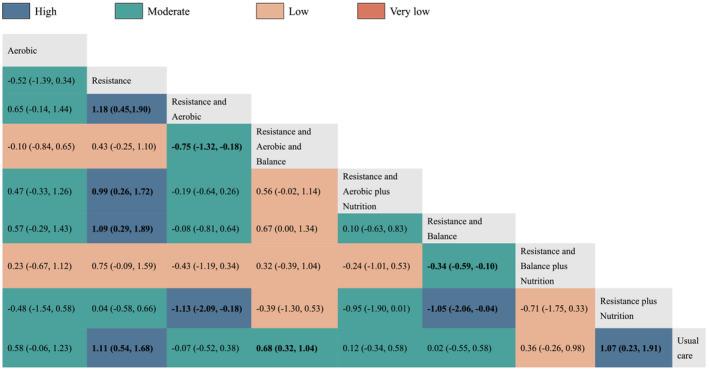
Our search identified 5988 citations, of which 42 RCTs proved eligible with 3728 participants with sarcopenia (median age: 72.9 years, female: 73.3%) with a median follow-up of 12 weeks. We are interested in patient-important outcomes that include mortality, quality of life, muscle strength and physical function measures. High or moderate certainty evidence suggested that resistance exercise with or without nutrition and the combination of resistance exercise with aerobic and balance training were the most effective interventions for improving quality of life compared to usual care (standardized mean difference from 0.68 to 1.11). Moderate certainty evidence showed that resistance and balance exercise plus nutrition (mean difference [MD]: 4.19 kg) was the most effective for improving handgrip strength (minimally important difference [MID]: 5 kg). Resistance and balance exercise with or without nutrition (MD: 0.16 m/s, moderate) were the most effective for improving physical function measured by usual gait speed (MID: 0.1 m/s). Moderate certainty evidence showed that resistance and balance exercise (MD: 1.85 s) was intermediately effective for improving physical function measured by timed up and go test (MID: 2.1 s). High certainty evidence showed that resistance and aerobic, or resistance and balance, or resistance and aerobic exercise plus nutrition (MD from 1.72 to 2.28 s) were intermediately effective for improving physical function measured by the five-repetition chair stand test (MID: 2.3 s).
CONCLUSIONS
In older adults with sarcopenia, high or moderate certainty evidence showed that resistance exercise with or without nutrition and the combination of resistance exercise with aerobic and balance training were the most effective interventions for improving quality of life. Adding nutritional interventions to exercise had a larger effect on handgrip strength than exercise alone while showing a similar effect on other physical function measures.
背景
肌肉减少症是全球老年人面临的严重公共卫生问题。运动是治疗肌肉减少症最常用的干预措施。本研究旨在比较不同类型的运动对肌肉减少症老年人的疗效。
方法
纳入比较运动干预对肌肉减少症老年人患者重要结局影响的随机对照试验(RCT)。我们系统地检索了 MEDLINE、Embase 和 Cochrane 中央对照试验注册库(通过 Ovid),检索截至 2022 年 6 月 3 日。我们使用频率论随机效应网络荟萃分析来总结证据,并应用推荐评估、制定与评价分级框架来评价证据的确定性。
结果
我们的检索共确定了 5988 条引文,其中 42 项 RCT 符合纳入标准,共纳入 3728 名肌肉减少症患者(中位年龄:72.9 岁,女性:73.3%),中位随访时间为 12 周。我们关注的是患者重要结局,包括死亡率、生活质量、肌肉力量和身体功能指标。高或中确定性证据表明,与常规护理相比,抗阻运动联合或不联合营养以及抗阻运动联合有氧运动和平衡训练是改善生活质量最有效的干预措施(标准化均数差为 0.68 至 1.11)。中确定性证据表明,抗阻和平衡运动加营养(平均差值 [MD]:4.19kg)是改善握力最有效的方法(最小临床重要差值 [MID]:5kg)。抗阻和平衡运动联合或不联合营养(MD:0.16m/s,中等)是改善常规步态速度测量的身体功能最有效的方法(MID:0.1m/s)。中确定性证据表明,抗阻和平衡运动(MD:1.85s)对改善计时起立行走测试测量的身体功能具有中等效果(MID:2.1s)。高确定性证据表明,抗阻和有氧运动、抗阻和平衡运动、抗阻和有氧运动加营养联合(MD 为 1.72 至 2.28s)对改善五次重复椅立测试测量的身体功能具有中等效果(MID:2.3s)。
结论
在患有肌肉减少症的老年人中,高或中确定性证据表明,抗阻运动联合或不联合营养以及抗阻运动联合有氧运动和平衡训练是改善生活质量最有效的干预措施。在运动的基础上添加营养干预比单纯运动对握力的影响更大,而对其他身体功能指标的影响相似。


 Zotero 插件