
产前暴露于颗粒物与足月低出生体重:系统评价和荟萃分析。
Prenatal exposure to particulate matter and term low birth weight: systematic review and meta-analysis.
机构信息
Department of Pediatrics, China-Japan Friendship Hospital, Beijing, China.
Graduate School of Peking Union Medical College, Chinese Academy of Medical Sciences, Beijing, China.
出版信息
Environ Sci Pollut Res Int. 2023 May;30(23):63335-63346. doi: 10.1007/s11356-023-26831-7. Epub 2023 Apr 14.
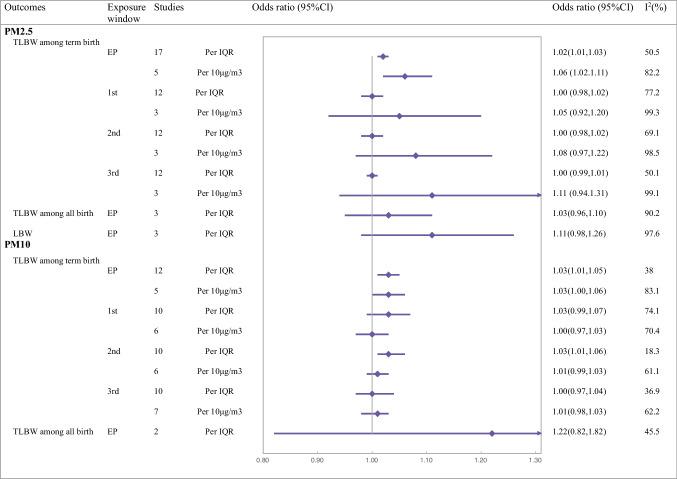
To evaluate the relationships between maternal particulate matter exposure and offspring birth weight. Studies were categorized into three subgroups: term low birth weight (TLBW) among full-term births and all births (regardless of gestational age) and low birth weight (LBW) among all births, based on the search results of MEDLINE and the Web of Science from the inception of the database to April 2022. Subgroup analyses were conducted based on the economic status, region, exposure assessment, risk of bias, and adjustment. Sixty-one studies involving 34,506,975 singleton live births in 15 countries were analyzed. Overall, the risk of bias for most studies (75%) was low. In 39 of 47 term birth studies, the pooled odds ratio of TLBW among term births for per interquartile range (IQR) increases throughout the entire pregnancy was 1.02 (1.01 to 1.03) for PM and 1.03 (1.01 to 1.05) for PM after adjustment for covariates. No significant relevance was detected across each trimester period for PM. A stronger effect was observed during the second trimester (1.03, 1.01 to 1.06) for PM. There was no increased risk of TLBW in all births associated with IQR increases in PM and PM. LBW was associated with PM exposure in 4 of 7 studies, but statistical heterogeneity was considerable. In the TLBW subgroup analysis, the effects of PM and PM were both greater in studies conducted in advanced countries, studies with low bias, and studies that adjusted for maternal age, infant sex, and parity. Stronger effects were present for PM exposure collected from monitoring stations and PM exposure interpolated from the inverse distance weighting model. TLBW may be associated with prenatal exposure to particulate matter, but no critical windows were identified. Stronger associations were observed in advanced countries. Future original study designs need to consider the impact of different exposure assessment modalities and all possible confounding factors.
评估母体颗粒物暴露与后代出生体重的关系。研究分为三组:足月低出生体重(TLBW)在足月分娩和所有分娩(无论胎龄)中,以及所有分娩中的低出生体重(LBW),基于 MEDLINE 和 Web of Science 从数据库建立到 2022 年 4 月的搜索结果。基于经济状况、地区、暴露评估、偏倚风险和调整进行亚组分析。分析了来自 15 个国家的 61 项涉及 34506975 例单胎活产的研究。总体而言,大多数研究(75%)的偏倚风险较低。在 47 项足月分娩研究中的 39 项中,整个孕期每增加一个四分位间距(IQR),PM 和 PM 暴露与足月分娩 TLBW 的比值比为 1.02(1.01 至 1.03),调整协变量后为 1.03(1.01 至 1.05)。PM 在每个三个月期间都没有显示出显著的相关性。在第二个三个月期间观察到更强的效应(1.03,1.01 至 1.06)。PM 和 PM 与 IQR 增加与所有出生 TLBW 无关。LBW 与 7 项研究中的 4 项 PM 暴露相关,但统计学异质性较大。在 TLBW 亚组分析中,在发达国家进行的研究、低偏倚研究和调整了母亲年龄、婴儿性别和产次的研究中,PM 和 PM 的影响更大。来自监测站收集的 PM 暴露和从倒数距离加权模型插值的 PM 暴露的影响更强。TLBW 可能与产前暴露于颗粒物有关,但未确定关键窗口期。在发达国家观察到更强的关联。未来的原始研究设计需要考虑不同暴露评估模式和所有可能的混杂因素的影响。

 Zotero 插件