
低母亲教育水平会增加 1 型糖尿病的风险,但不会增加其他自身免疫性疾病的风险:儿童 BMI 和经历严重生活事件在其中起中介作用。
Low maternal education increases the risk of Type 1 Diabetes, but not other autoimmune diseases: a mediating role of childhood BMI and exposure to serious life events.
机构信息
Department of Health, Medicine and Care, General Practice, Linköping University, Linköping, 581 83, Sweden.
Crown Princess Victoria Children's Hospital, Linköping University, Linköping, 581 85, Sweden.
出版信息
Sci Rep. 2023 Apr 15;13(1):6166. doi: 10.1038/s41598-023-32869-x.
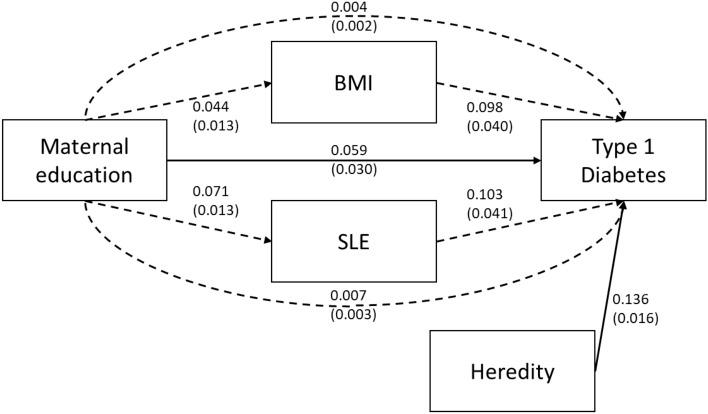
The objective of this paper was to investigate if socioeconomic status (SES), measured by maternal education and household income, influenced the risk of developing autoimmune disease (Type 1 Diabetes, Celiac disease, Juvenile Idiopathic Arthritis, Crohn's disease, Ulcerative colitis, and autoimmune thyroid disease), or age at diagnosis, and to analyse pathways between SES and autoimmune disease. We used data from the All Babies in Southeast Sweden (ABIS) study, a population-based prospective birth cohort, which included children born 1997-1999. Diagnoses of autoimmune disease was collected from the Swedish National Patient Register Dec 2020. In 16,365 individuals, low maternal education, but not household income, was associated with increased risk of Type 1 Diabetes; middle education RR 1.54, 95% CI 1.06, 2.23; P 0.02, low education RR 1.81, 95% CI 1.04, 3.18; P 0.04. Maternal education and household income was not associated with any other autoimmune disease and did not influence the age at diagnosis. Part of the increased risk of Type 1 Diabetes by lower maternal education was mediated by the indirect pathway of higher BMI and higher risk of Serious Life Events (SLE) at 5 years of age. The risk of developing Type 1 Diabetes associated to low maternal education might be reduced by decreasing BMI and SLE during childhood.
本文旨在探讨社会经济地位(SES),通过母亲的教育程度和家庭收入来衡量,是否会影响自身免疫性疾病(1 型糖尿病、乳糜泻、青少年特发性关节炎、克罗恩病、溃疡性结肠炎和自身免疫性甲状腺疾病)的发病风险或发病年龄,并分析 SES 与自身免疫性疾病之间的关联途径。我们使用了来自瑞典东南部所有婴儿(ABIS)研究的数据,这是一项基于人群的前瞻性出生队列研究,其中包括 1997 年至 1999 年出生的儿童。自身免疫性疾病的诊断是从 2020 年 12 月的瑞典国家患者登记处收集的。在 16365 名个体中,低母亲教育程度而非家庭收入与 1 型糖尿病的发病风险增加相关;中等教育程度 RR 为 1.54,95%CI 为 1.06-2.23;P 0.02,低教育程度 RR 为 1.81,95%CI 为 1.04-3.18;P 0.04。母亲教育程度和家庭收入与其他任何自身免疫性疾病均无关,也不影响诊断年龄。低母亲教育程度导致 1 型糖尿病风险增加的部分原因是通过间接途径,即 5 岁时 BMI 较高和严重生活事件(SLE)风险较高。通过降低儿童时期的 BMI 和 SLE,可能会降低与低母亲教育相关的 1 型糖尿病发病风险。
 Zotero 插件