
维生素D与慢性肾脏病:对肾小管间质纤维化中肾小管上皮细胞和巨噬细胞脂质代谢的见解
Vitamin D and chronic kidney disease: Insights on lipid metabolism of tubular epithelial cell and macrophages in tubulointerstitial fibrosis.
作者信息
Gonçalves Luís Eduardo D, Andrade-Silva Magaiver, Basso Paulo José, Câmara Niels O S
机构信息
Laboratory of Transplantation Immunobiology, Department of Immunology, Institute of Biomedical Sciences, University of São Paulo, São Paulo, Brazil.
Laboratory of Experimental e Clinical Immunology, Department of Clinical Medicine, Faculty of Medicine, Federal University of São Paulo, São Paulo, Brazil.
出版信息
Front Physiol. 2023 Mar 29;14:1145233. doi: 10.3389/fphys.2023.1145233. eCollection 2023.
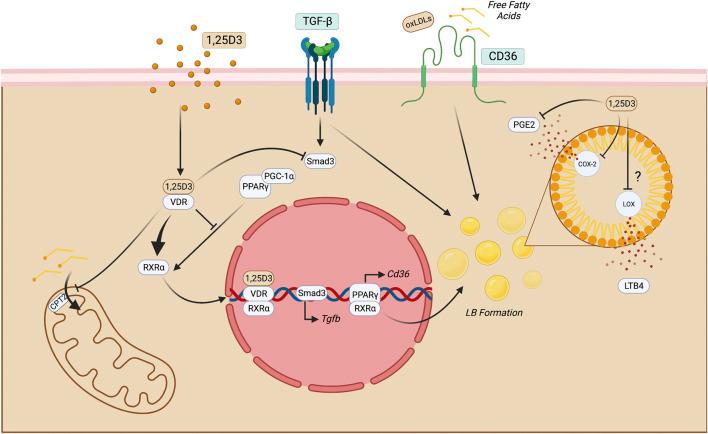
Chronic kidney disease (CKD) has been recognized as a significant global health problem due to being an important contributor to morbidity and mortality. Inflammation is the critical event that leads to CKD development orchestrated by a complex interaction between renal parenchyma and immune cells. Particularly, the crosstalk between tubular epithelial cells (TECs) and macrophages is an example of the critical cell communication in the kidney that drives kidney fibrosis, a pathological feature in CKD. Metabolism dysregulation of TECs and macrophages can be a bridge that connects inflammation and fibrogenesis. Currently, some evidence has reported how cellular lipid disturbances can affect kidney disease and cause tubulointerstitial fibrosis highlighting the importance of investigating potential molecules that can restore metabolic parameters. Vitamin D (VitD) is a hormone naturally produced by mammalian cells in a coordinated manner by the skin, liver, and kidneys. VitD deficiency or insufficiency is prevalent in patients with CKD, and serum levels of VitD are inversely correlated with the degree of kidney inflammation and renal function. Proximal TECs and macrophages produce the active form of VitD, and both express the VitD receptor (VDR) that evidence the importance of this nutrient in regulating their functions. However, whether VitD signaling drives physiological and metabolism improvement of TECs and macrophages during kidney injury is an open issue to be debated. In this review, we brought to light VitD as an important metabolic modulator of lipid metabolism in TECs and macrophages. New scientific approaches targeting VitD e VDR signaling at the cellular metabolic level can provide a better comprehension of its role in renal physiology and CKD progression.
慢性肾脏病(CKD)已被公认为一个重大的全球健康问题,因为它是发病和死亡的重要原因。炎症是导致CKD发展的关键事件,由肾实质和免疫细胞之间的复杂相互作用所调控。特别是,肾小管上皮细胞(TECs)与巨噬细胞之间的相互作用是肾脏中驱动肾纤维化(CKD的一种病理特征)的关键细胞通讯的一个例子。TECs和巨噬细胞的代谢失调可能是连接炎症和纤维化形成的桥梁。目前,一些证据报道了细胞脂质紊乱如何影响肾脏疾病并导致肾小管间质纤维化,这凸显了研究能够恢复代谢参数的潜在分子的重要性。维生素D(VitD)是哺乳动物细胞通过皮肤、肝脏和肾脏以协调方式自然产生的一种激素。CKD患者中维生素D缺乏或不足很普遍,血清维生素D水平与肾脏炎症程度和肾功能呈负相关。近端TECs和巨噬细胞产生活性形式的维生素D,并且两者都表达维生素D受体(VDR),这证明了这种营养素在调节它们功能方面的重要性。然而,维生素D信号在肾脏损伤期间是否驱动TECs和巨噬细胞的生理和代谢改善仍是一个有待辩论的开放性问题。在这篇综述中,我们揭示了维生素D作为TECs和巨噬细胞脂质代谢的重要代谢调节剂的作用。在细胞代谢水平上针对维生素D和VDR信号的新科学方法可以更好地理解其在肾脏生理学和CKD进展中的作用。


 Zotero 插件