
安步和非安步杜氏肌营养不良症患者 PUL 2.0 结构域的纵向分析:它们如何与功能能力相关变化?
Longitudinal Analysis of PUL 2.0 Domains in Ambulant and Non-Ambulant Duchenne Muscular Dystrophy Patients: How do they Change in Relation to Functional Ability?
机构信息
Pediatric Neurology, Università Cattolica delSacro Cuore, Rome, Italy.
Centro Clinico Nemo, Fondazione Policlinico Universitario Agostino Gemelli IRCCS, Rome, Italy.
出版信息
J Neuromuscul Dis. 2023;10(4):567-574. doi: 10.3233/JND-221556.
BACKGROUND
The performance of upper limb 2.0 (PUL) is widely used to assess upper limb function in DMD patients. The aim of the study was to assess 24 month PUL changes in a large cohort of DMD patients and to establish whether domains changes occur more frequently in specific functional subgroups.
METHODS
The PUL was performed in 311 patients who had at least one pair of assessments at 24 months, for a total of 808 paired assessments. Ambulant patients were subdivided according to the ability to walk: >350, 250-350, ≤250 meters. Non ambulant patients were subdivided according to the time since they lost ambulation: <1, 1-2, 2-5 or >5 years.
RESULTS
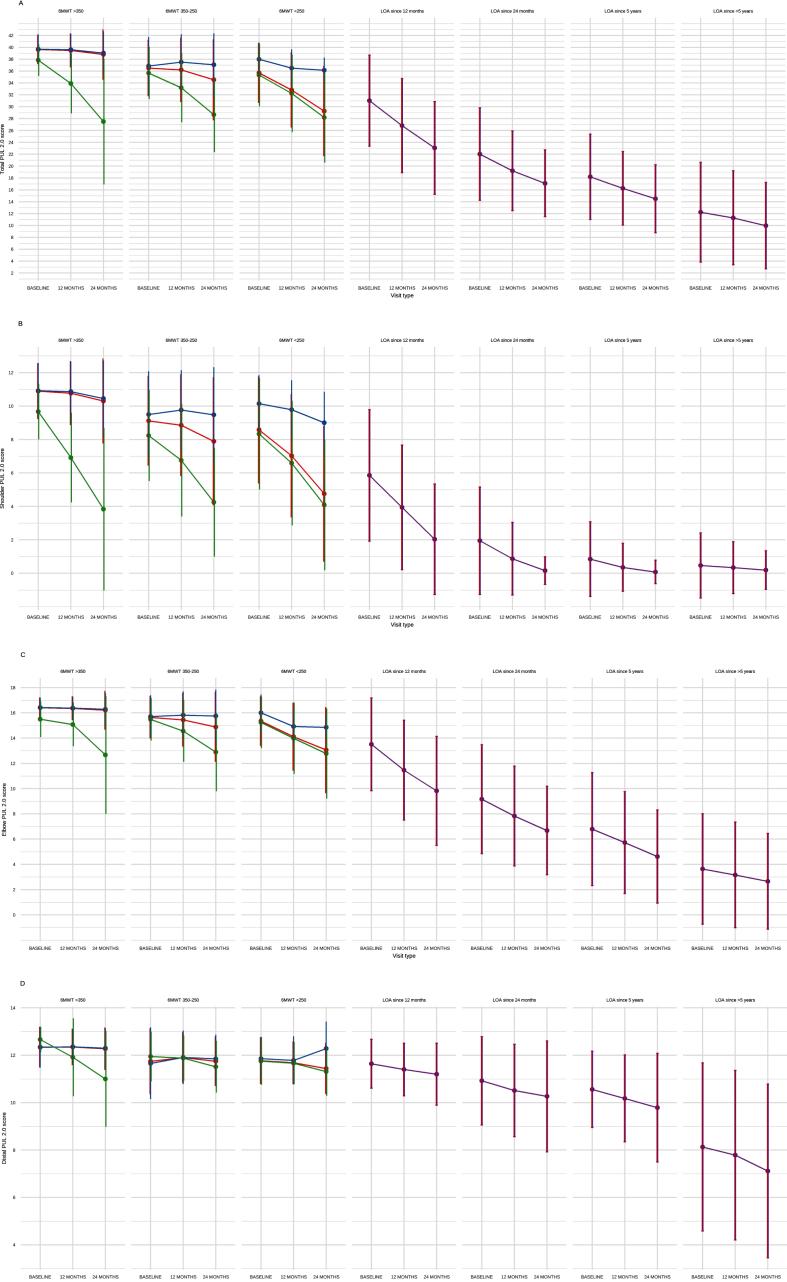
At 12 months, the mean PUL 2.0 change on all the paired assessments was -1.30 (-1.51--1.05) for the total score, -0.5 (-0.66--0.39) for the shoulder domain, -0.6 (-0.74--0.5) for the elbow domain and -0.1 (-0.20--0.06) for the distal domain.At 24 months, the mean PUL 2.0 change on all the paired assessments was -2.9 (-3.29--2.60) for the total score, -1.30 (-1.47--1.09) for the shoulder domain, -1.30 (-1.45--1.11) for the elbow domain and -0.4 (-1.48--1.29) for the distal domain.Changes at 12 and 24 months were statistically significant between subgroups with different functional abilities for the total score and each domain (p < 0.001).
CONCLUSION
There were different patterns of changes among the functional subgroups in the individual domains. The time of transition, including the year before and after loss of ambulation, show the peak of negative changes in PUL total scores that reflect not only loss of shoulder but also of elbow activities. These results suggest that patterns of changes should be considered at the time of designing clinical trials.
背景
上肢 2.0 表现(PUL)广泛用于评估 DMD 患者的上肢功能。本研究的目的是评估 24 个月大的 DMD 患者的 PUL 变化,并确定是否在特定的功能亚组中更频繁地发生领域变化。
方法
对至少有一对 24 个月评估的 311 名患者进行 PUL 检查,总共进行了 808 对评估。根据行走能力将可走动的患者细分:>350 米、250-350 米、≤250 米。根据丧失行走能力的时间将非走动患者细分:<1 年、1-2 年、2-5 年或>5 年。
结果
在 12 个月时,所有配对评估的 PUL 2.0 平均变化值为总评分-1.30(-1.51--1.05)、肩部域-0.5(-0.66--0.39)、肘部域-0.6(-0.74--0.5)和远端域-0.1(-0.20--0.06)。在 24 个月时,所有配对评估的 PUL 2.0 平均变化值为总评分-2.9(-3.29--2.60)、肩部域-1.30(-1.47--1.09)、肘部域-1.30(-1.45--1.11)和远端域-0.4(-1.48--1.29)。不同功能能力亚组之间的总分和每个域的变化在 12 个月和 24 个月时均具有统计学意义(p<0.001)。
结论
在各功能亚组中,各域之间存在不同的变化模式。过渡时间,包括丧失行走能力的前一年和后一年,显示 PUL 总分负向变化的峰值,这不仅反映了肩部的丧失,也反映了肘部活动的丧失。这些结果表明,在设计临床试验时应考虑变化模式。
 Zotero 插件