
5 岁以下儿童中中重度腹泻和发育迟缓:疫苗对非洲腹泻影响(VIDA)研究的结果。
Moderate-to-Severe Diarrhea and Stunting Among Children Younger Than 5 Years: Findings From the Vaccine Impact on Diarrhea in Africa (VIDA) Study.
机构信息
Department of Medicine, Center for Vaccine Development and Global Health, University of Maryland School of Medicine, Baltimore, Maryland, USA.
Department of Epidemiology and Public Health, University of Maryland School of Medicine, Baltimore, Maryland, USA.
出版信息
Clin Infect Dis. 2023 Apr 19;76(76 Suppl1):S41-S48. doi: 10.1093/cid/ciac945.
BACKGROUND
Stunting affects >20% of children <5 years old worldwide and disproportionately impacts underserved communities. The Vaccine Impact on Diarrhea in Africa (VIDA) Study examined the association between an episode of moderate-to-severe diarrhea (MSD) and the risk of subsequent stunting in children <5 years living in 3 sub-Saharan African countries.
METHODS
In this prospective, matched, case-control study among children <5 years, data were collected over 36 months from 2 groups. "Children with MSD" visited a health center within 7 days of illness onset experiencing ≥3 loose stools/day plus sunken eyes, poor skin turgor, dysentery, intravenous rehydration, or hospitalization. "Children without MSD" were enrolled from the community within 14 days of the index MSD child; they were diarrhea-free during the previous 7 days and were matched to the index case by age, sex, and residence. Using generalized linear mixed-effects models, we estimated the effect of an MSD episode on odds of being stunted, defined as height-for-age z-scores <-2, at a follow-up visit 2-3 months post-enrollment.
RESULTS
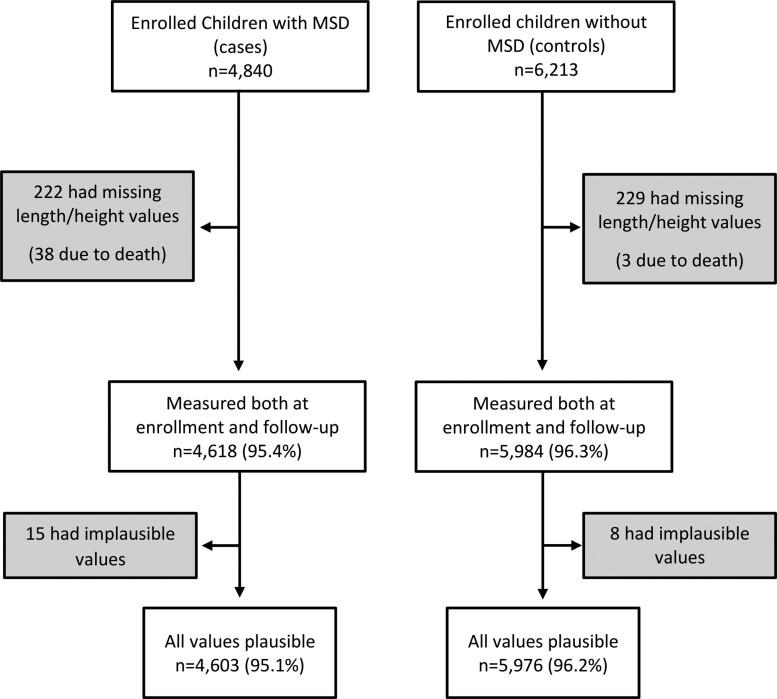
The proportion of stunting at enrollment was similar when 4603 children with MSD and 5976 children without MSD were compared (21.8% vs 21.3%; P = .504). Among children not stunted at enrollment, those with MSD had 30% higher odds of being stunted at follow-up than children without MSD after controlling for age, sex, study site, and socioeconomic status (adjusted OR: 1.30; 95% CI: 1.05-1.62: P = .018).
CONCLUSIONS
Children <5 years in sub-Saharan Africa without stunting experienced an increased likelihood of stunting during 2-3 months following an episode of MSD. Strategies for control of early childhood diarrhea should be integrated into programs intended to reduce childhood stunting.
背景
全球有超过 20%的 5 岁以下儿童发育迟缓,且这一问题不成比例地影响到服务不足的社区。在非洲,疫苗对腹泻的影响(VIDA)研究考察了中度至重度腹泻(MSD)发作与生活在撒哈拉以南 3 个非洲国家的 5 岁以下儿童随后发生发育迟缓的风险之间的关联。
方法
在这项针对 5 岁以下儿童的前瞻性、匹配病例对照研究中,数据在 36 个月内从两组中收集。“患有 MSD 的儿童”在发病后 7 天内到卫生中心就诊,每天腹泻次数≥3 次,伴有眼球凹陷、皮肤弹性差、痢疾、静脉补液或住院。“没有 MSD 的儿童”在指数 MSD 儿童发病后 14 天内从社区招募;他们在之前的 7 天内没有腹泻,并且按年龄、性别和居住地与指数病例相匹配。使用广义线性混合效应模型,我们估计 MSD 发作对身高年龄 z 分数<-2 的发育迟缓(定义为 2-3 个月随访时)的比值比的影响。
结果
当比较 4603 名患有 MSD 的儿童和 5976 名没有 MSD 的儿童时,入学时的发育迟缓比例相似(21.8% vs 21.3%;P =.504)。在入学时没有发育迟缓的儿童中,在校正年龄、性别、研究地点和社会经济地位后,患有 MSD 的儿童在随访时发育迟缓的可能性比没有 MSD 的儿童高 30%(调整后的 OR:1.30;95%CI:1.05-1.62:P =.018)。
结论
撒哈拉以南非洲没有发育迟缓的 5 岁以下儿童在 MSD 发作后 2-3 个月内发生发育迟缓的可能性增加。控制儿童早期腹泻的策略应纳入旨在减少儿童发育迟缓的计划中。
 Zotero 插件