
印度马哈拉施特拉邦西部地区农村人群中 SARS-CoV-2 特异性免疫球蛋白 G 抗体的血清流行率。
Seroprevalence of SARS-CoV-2 specific Immunoglobin G antibodies in rural population of Western Maharashtra, India.
机构信息
Vadu Rural Health Program, KEM Hospital Research Centre, Pune, India.
Centre for Global Health, Usher Institute, Edinburgh Medical School, University of Edinburgh, Edinburgh, Scotland, UK.
出版信息
J Glob Health. 2023 Apr 21;13:06011. doi: 10.7189/jogh.13.06011.
BACKGROUND
Severe acute respiratory syndrome coronavirus 2 (SARS-CoV-2) infection, responsible for the coronavirus disease 2019 (COVID-19) pandemic, has been a major public health concern requiring continuous efforts for understanding its epidemiology. Patients infected with SARS-CoV-2 have a wide range of clinical features ranging from asymptomatic infection to mild or severe illness with fatal outcomes or recovery. Population-based seroepidemiological studies are an effective method for measuring the rapid spread of SARS-CoV-2 and monitoring the pandemic's progress.
METHODS
We conducted repeated cross-sectional community-based sentinel surveillance between January and June 2021 in the rural parts of the Pune district of Maharashtra, India to assess the seroprevalence against SARS-CoV-2 in three age categories. We selected 30 clusters for each round using a proportional population sampling method and 30 individuals in each of the three age groups (1-17 years, 18-49 years, and ≥50 years). We took blood samples from consenting study participants to check for the presence of Immunoglobulin G (IgG) antibodies against SARS-CoV-2 in all five rounds.
RESULTS
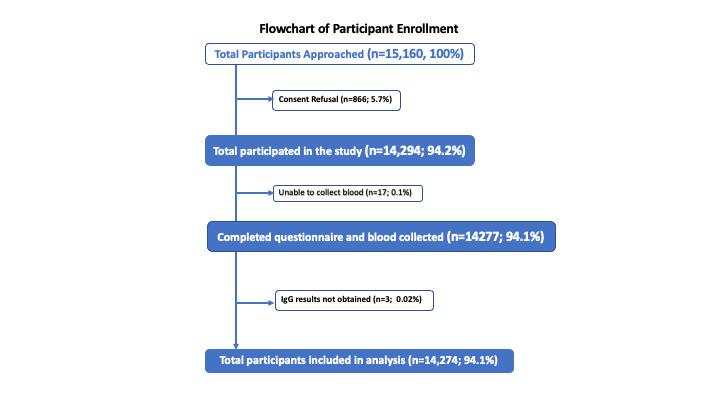
We included 14 274 individuals across five rounds; 29% were from the 1-17, 39% from the 18-49, and 32% from the ≥50-year-old group. Overall seroprevalence combining all rounds was 45%. There was an increase in seropositivity in rounds four (51.15%) and five (58.32%) contributed mostly by adults. We found that about 72% of elderly individuals ≥50 years in round five were seropositive. The factors strongly associated with the seropositivity were being in contact with suspected or confirmed cases of COVID-19 (odds ratio (OR) = 7.15; 95% confidence interval (CI) = 4.2-12.14), receiving at least one dose of COVID-19 vaccine (OR = 3.13 (95% CI = 0.70-14.07), being aged ≥50 years (OR = 1.97; 95% CI = 1.81-2.15), and being in an occupation belonging to a high-risk category (OR = 1.92; 95% CI = 1.65-2.26). Among 135 hospitalizations reported due to COVID-19-like illness, 91 (67%) were in the elderly age group of ≥50 and 33 (24%) were in the 18-49-year-old age group.
CONCLUSIONS
Seroprevalence of SARS-CoV-2 was high in the last two rounds (April to June 2021) which coincide with the second wave of the pandemic (Delta variant B.1.617.2) in India. Overall, one in three children and one in two adults had antibodies for SARS-CoV-2. The suspected or confirmed case of COVID-19 emerged as the significant factor strongly associated with the seropositivity followed by COVID-19 vaccination.
背景
严重急性呼吸系统综合征冠状病毒 2(SARS-CoV-2)感染引发了 2019 年冠状病毒病(COVID-19)大流行,这是一个重大的公共卫生问题,需要不断努力了解其流行病学。感染 SARS-CoV-2 的患者临床表现广泛,从无症状感染到轻度或重度疾病,甚至有致命结局或康复。基于人群的血清流行病学研究是衡量 SARS-CoV-2 快速传播和监测大流行进展的有效方法。
方法
我们在印度马哈拉施特拉邦浦那县的农村地区于 2021 年 1 月至 6 月间进行了重复的横断面社区监测,以评估三个年龄段的 SARS-CoV-2 血清流行率。我们使用比例人口抽样法为每轮选择 30 个集群,每个年龄组(1-17 岁、18-49 岁和≥50 岁)各有 30 人。我们从同意的研究参与者中抽取血液样本,以检查所有五轮中 SARS-CoV-2 的免疫球蛋白 G(IgG)抗体是否存在。
结果
我们在五轮研究中纳入了 14274 人;29%来自 1-17 岁年龄组,39%来自 18-49 岁年龄组,32%来自≥50 岁年龄组。结合所有五轮的总体血清阳性率为 45%。第四轮(51.15%)和第五轮(58.32%)的血清阳性率均有所增加,主要由成年人构成。我们发现,在第五轮中,约 72%的≥50 岁老年人血清呈阳性。与血清阳性率密切相关的因素是接触疑似或确诊的 COVID-19 病例(比值比(OR)=7.15;95%置信区间(CI)=4.2-12.14)、至少接种一剂 COVID-19 疫苗(OR=3.13(95%CI=0.70-14.07))、年龄≥50 岁(OR=1.97;95%CI=1.81-2.15)和从事高风险类别的职业(OR=1.92;95%CI=1.65-2.26)。在报告的 135 例因 COVID-19 样疾病住院的病例中,91 例(67%)为≥50 岁的老年人,33 例(24%)为 18-49 岁的成年人。
结论
在印度 COVID-19 第二波(Delta 变体 B.1.617.2)期间,即 2021 年 4 月至 6 月的最后两轮,SARS-CoV-2 的血清流行率很高。总体而言,三分之一的儿童和二分之一的成年人有针对 SARS-CoV-2 的抗体。疑似或确诊的 COVID-19 病例是与血清阳性率密切相关的重要因素,其次是 COVID-19 疫苗接种。

 Zotero 插件